

Prizes, as every parent knows, are meant to encourage positive behavior and strengthen the motivation to repeat the behavior that earned the reward. Cultural prizes, for example, help define literary, cinematic, and other canons, as well as the kinds of works considered worthy of recognition. Bonuses for outstanding employees reward workers who show high productivity or initiative.Scientific prizes, in turn, define what counts as scientific quality and highlight the principles and values the scientific community seeks to promote and reinforce.
What are those values and principles? First and foremost, we would probably want to reward scientific excellence, creativity, precision, and rigor, alongside transparency, reliability, equality, and collaboration — all values essential to scientific work.
Gallery
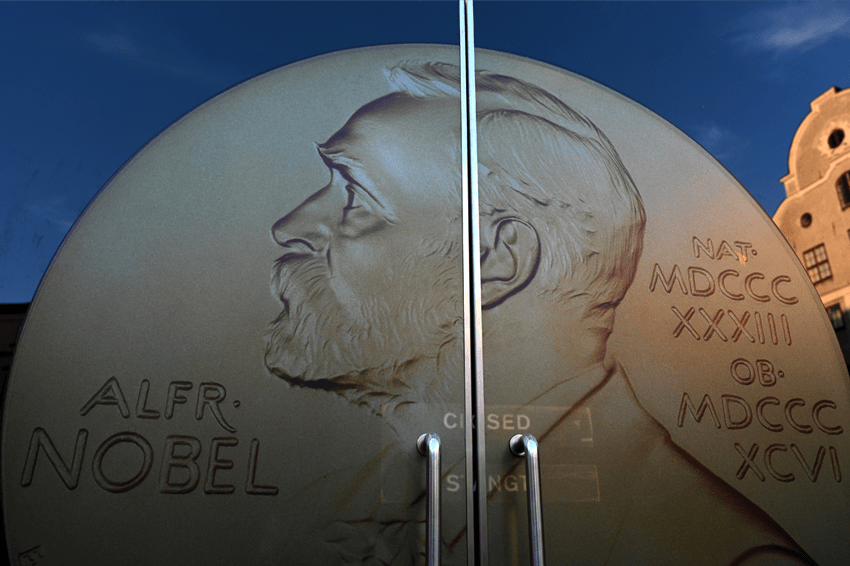
Prize-awarding bodies must ensure that their criteria are transparent, that they reflect the values of high-quality science, and that they do not preserve historical biases. An illustration of a Nobel Prize medal at the entrance to the Nobel Museum
(Photo: Shutterstock, Bumble Dee)
The prizes, and the publicity that accompanies them, play valuable roles for scientists, for science, and for society as a whole. They provide important financial support to winners, raise awareness of the importance of science, and give significant discoveries a public platform. Above all, they convey a message from scientists to the general public: this is the kind of excellence we value.
That message places a heavy responsibility on those who award prizes. Prize-awarding bodies must ensure that their criteria are transparent, that they reflect the values of high-quality science, and that they do not perpetuate historical biases. Without a clear commitment to those values, prizes are little more than money and publicity. With that commitment, they can become engines of deep cultural change.
Prizes, prizes everywhere
There are many scientific prizes, awarded by different organizations and created for different purposes. Some are awarded by countries to their own scientists — for example, the Israel Prize in the sciences. Others are awarded by international bodies such as UNESCO. Some recognize scientific excellence in general, while others are limited to a specific field. There are prizes awarded by professional associations in particular scientific disciplines, prizes for researchers, prizes for papers, prizes for outstanding students, prizes for scientific discoveries and technological developments — and many more.
The best-known scientific prize is, of course, the Nobel Prize. It is awarded each year to researchers in chemistry, physics, and physiology or medicine: the Royal Swedish Academy of Sciences awards the prizes in physics and chemistry, while the Nobel Assembly at Karolinska Institutet awards the prize in physiology or medicine. The prize is intended to recognize exceptional research, pioneering inventions or technologies, and extraordinary contributions to society. Alfred Nobel, who established the prize, stipulated in his will that it should go to researchers whose discovery or published work in the preceding year had contributed the greatest benefit to humankind. He also stipulated that only one winner should be named in each field. In practice, the prize-awarding institutions chose to disregard the first rule and depart from the second. Their members understood that major scientific achievements cannot be evaluated over such a short period, and they also decided that, when necessary, the prize could be shared by up to three winners rather than awarded to just one.
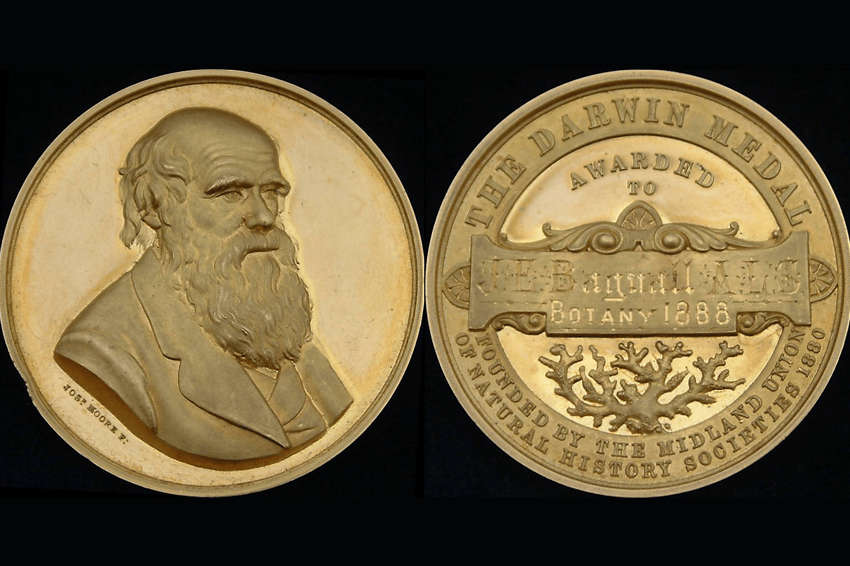
A less familiar example is the Darwin Medal, awarded for work of distinction in evolution, biological diversity, and developmental, population, and organismal biology
(Photo: Wikimedia, Katherine Clifford)
For mathematicians, the Fields Medal is often regarded as the closest equivalent to the Nobel Prize in prestige. It is awarded once every four years to researchers under the age of forty for exceptional achievements. Recipients are selected by an international committee of leading experts, and the criteria emphasize groundbreaking discoveries. The low age threshold and the focus on early achievement promote a particular model of the ideal mathematical scientific career — one that does not necessarily reflect the full range of paths a mathematician’s career can take. To date, only two women have won the Fields Medal, compared with dozens of men. One apparent reason for this enormous gap is that the period in life when mathematicians are expected to reach their peak overlaps with women’s main reproductive years.
An example of a less familiar prize is the Darwin Medal, which is awarded for work of distinction in evolution, biological diversity, and developmental, population, and organismal biology. Recipients are selected by the members of a standing committee, according to uniform but confidential criteria. The nomination guidelines state that nominations of women, people from ethnic minority groups, and people with disabilities are welcome; in practice, however, since 1890 only two women have received the medal. The Darwin Medal should not be confused with the Darwin Awards, a humorous honor given to people who, in the words of the Darwin Awards, “improve our gene pool by removing themselves from it in a spectacularly stupid manner.”
Who oversees the prizes?
Do the prizes awarded by the scientific community truly reflect the principles and values that community seeks to promote? To investigate possible flaws in how such prizes are awarded worldwide, a 2024 study examined 222 prizes given to scientists for outstanding papers in specific fields. The international research team looked at the criteria used to award each prize and asked whether those criteria reflected sound principles of high-quality science.
The study’s most striking finding was a consistent lack of transparency in the public descriptions of the prizes. In most cases, the criteria used to evaluate candidates were vague, hidden behind fine-sounding but highly general language about the abstract idea of “excellence.” By contrast, these descriptions made almost no reference to core scientific values such as comprehensive reporting, rigor, and reliability.
If the language used in these public prize descriptions reflects how winners are actually selected, it may suggest that the evaluation process overlooks essential requirements of scientific practice. The researchers also expressed concern about what they described as a growing tendency to use sensational language in prize descriptions, at the expense of clear and transparent criteria.
In many cases, the organizations behind the prizes rely on simple, measurable criteria, such as paper impact metrics, including citation and download counts. Such metrics give the criteria an appearance of objectivity and make the evaluation process simpler. But they also preserve built-in biases, rewarding visibility and striking findings at the expense of careful, well-grounded, and comprehensive work.
The problem with impact metrics is that they do not necessarily reflect scientific excellence. Senior researchers and well-funded institutions tend to publish more papers, and those papers often receive more citations than papers by early-career researchers at less prominent universities, regardless of the quality of the research itself. Studies on popular topics — such as artificial intelligence or climate change today — are also likely to receive more attention than equally important studies in fields considered less glamorous. This creates a feedback loop: well-known researchers publish more, their work receives more attention, and their chances of winning prizes increase. The prizes, in turn, further strengthen their status. None of this necessarily reflects excellence, precision, or quality.

Public descriptions of scientific prizes often show a broad lack of transparency
(Photo: Patrick Tomasso, Unsplash)
Conservatism at the service of innovation
Although scientific prizes are meant to promote innovative science, their criteria often overlook newer scientific practices that encourage sharing and critique, foremost among them open science. According to the researchers, the bodies that administer these prizes seem to place little value on practices such as the early publication of research drafts in preprint repositories, where studies can be reviewed and improved, or the public sharing of data and code. These practices encourage transparent and reliable research, and ignoring them may introduce bias into the way scientific work is rewarded.
Another source of bias is familiar from many other areas of human culture: the world of scientific prizes is still dominated overwhelmingly by men and white researchers. This imbalance is visible not only among the winners, but even in the names of the prizes themselves. One study found that fewer than ten percent of scientific prizes worldwide are named after women, and most of those were established only in recent years — meaning that until quite recently, the gap was even wider.
The proportion of women winning prizes named after women is higher than for other scientific prizes, perhaps because the organizations that award them, and the judges on their selection committees, are more aware of discrimination against women. The gender and ethnic imbalance appears to be sustained by several feedback loops. It begins with those who recommend candidates for prizes, who may tend to stick with the names and fields they already know. Second, women have fewer role models than men: fewer women have won scientific prizes, and the prizes themselves are often named after men. In another study, which examined the proportion of women among winners of scientific prizes, researchers suggested that the more prizes are named after women, the more equitable the distribution of prizes may become.
The same study also argued that prizes are meant, among other things, to motivate exceptional research and strengthen scientists’ sense of belonging to the scientific community. A prize sends a powerful message: “I am seen. My work matters.” That recognition can increase a scientist’s motivation to excel and deepen their connection to the field. But when people see others around them — not necessarily more deserving than they are — receiving recognition and respect, the opposite can happen: resentment, alienation, and a loss of motivation. After all, “no one notices what I do anyway.” As a group, women are more likely to experience this because they receive fewer prizes.
Prizes, especially major ones such as the Nobel Prize, also have broader systemic effects. They shine a spotlight on the field for which the prize was awarded and encourage new researchers to take an interest in it. This rise in attention can reach as much as forty percent and may also influence how research funding is allocated. The aura surrounding Nobel laureates can increase public interest in science and help their institutions raise funds for further research.
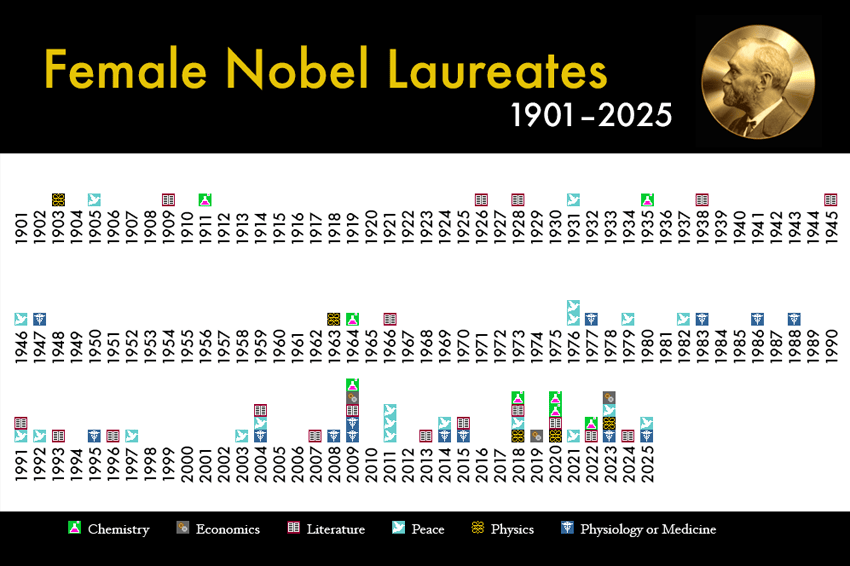
As in many other areas of human culture, the world of scientific prizes is still dominated largely by male researchers and white academics. An image showing the number of women who won the Nobel Prize from 1901 to 2025; in many years, there was not a single female laureate
(Photo: Wikimedia, Girona7)
Lone genius or winning team?
Many scientific prizes, especially the Nobel Prize, reinforce the myth of the lone genius: the romantic image of a single scientist who, through intellect and determination, unlocks the secrets of the universe. Such figures may exist, but in most fields, contemporary science is typically carried out by large, interdisciplinary, and international teams. Yet scientific prizes often fail to reflect this reality. By limiting recognition to one person, or to a small number of scientists, they create a simple, compelling story that is easy to market, but one that fails to reflect how scientific knowledge actually develops: collectively, incrementally, and through collaboration.
As a result, the choice of winners does not truly represent the processes of scientific discovery and technological development. It leaves out overlooked scientists who also contributed to important discoveries but did not receive the recognition they deserved. For example, in 2017 the Nobel Prize in Physics was awarded to three leading researchers in the LIGO and Virgo collaborations — Rainer Weiss, Barry Barish, and Kip Thorne — for their contribution to the discovery of gravitational waves. However, that discovery was the product of a broad team effort involving hundreds of scientists and engineers, and more than a thousand researchers were listed as authors on the scientific paper.
What can be done?
A study that examined scientific prizes in psychology proposed a new approach to awarding them: a “two-stage” evaluation process. The goal is to make prizes reflect not only innovation, but also the quality, rigor, reliability, stability, and transparency of the nominated research.
In the first stage, they propose examining a series of indicators designed to ensure that the research rests on solid ground. For example: Was the study published as a preprint? Are the data and code available to anyone interested, in an accessible and comprehensive form? Can the study be replicated? Do the theoretical formulations conform to the principles of formal logic? Only in the second stage do they move on to the content and substantive merits of the research, using more subjective criteria such as ambition, relevance, innovation, and creativity.
Scientific prizes do have real value. They raise the public profile of science, bring important discoveries into the spotlight, promote scientific excellence, and reward researchers whose work has made a meaningful contribution to humanity. And yet, those who award prizes do not always seem faithful to the principles they claim to represent. For prizes to fulfill their purpose, they too must meet standards of transparency, reliability, and excellence. The committees that select winners must acknowledge biases against women and minorities and work to reduce them, without abandoning the demand for scientific excellence. And perhaps — perhaps the time has come to move beyond the myth of the lone genius and open the Nobel Prize and other major awards to research and development teams as well, finally acknowledging that high-quality science today is almost always born of collaboration among scientists, shared effort, and mutual inspiration.