


On the morning of October 7, shut inside her young adults’ apartment in Nir Oz, Dekel Goren was corresponding with her parents on WhatsApp. Her father, Avner, told her that terrorists had entered the family home and left, and that he had struggled to hold the handle of the safe-room door. Her mother, Maya, was hiding behind a pile of mattresses in the kindergarten where she worked. A few hours later, both stopped responding, and Dekel remained hidden in the apartment until the afternoon. Every few minutes, she checked whether her brother, who was in a nearby apartment, was still alive.
Her father was murdered and his body was found in the fields. Her mother was abducted to Gaza and murdered. Three years later, at age 21, she serves as a commander of an IDF medic course.
Gallery
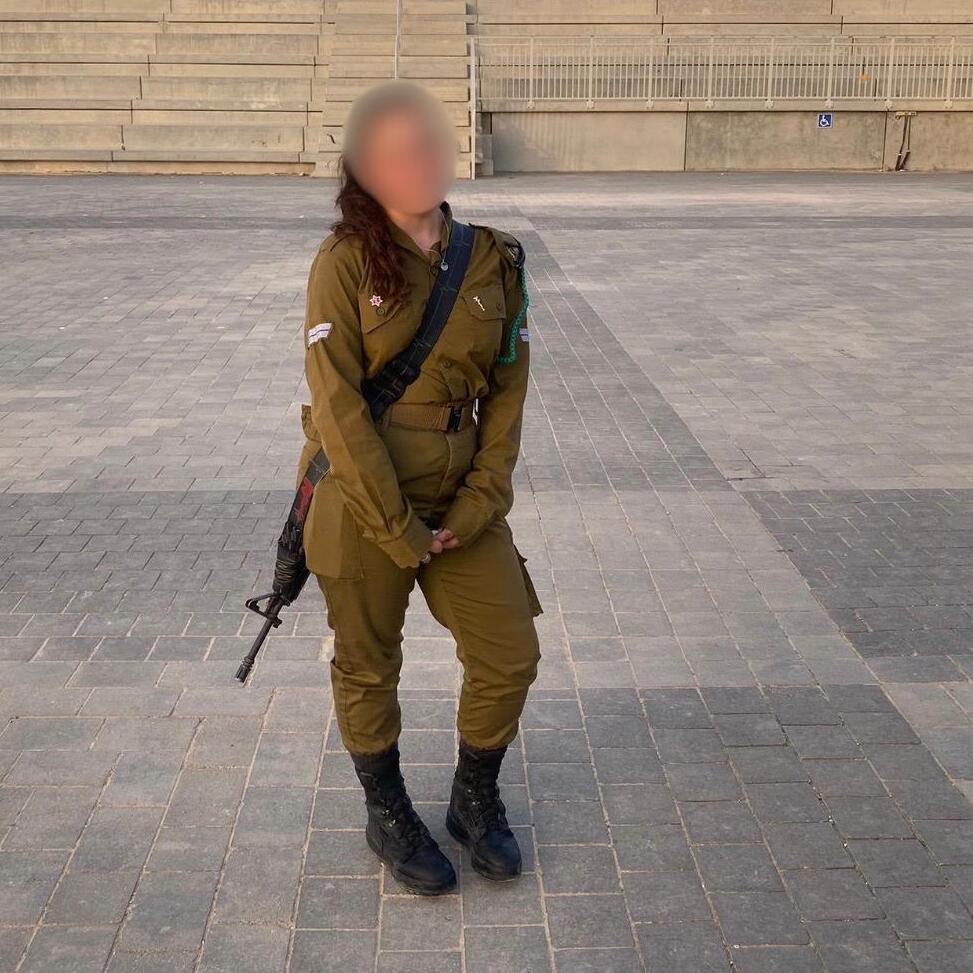
Dekel Goren currently serves as a commander of an IDF medic course
(Photo: IDF Spokesperson's Unit)
“It has enormous meaning,” she said.
One family, four locations in the kibbutz
The Goren family was scattered across several locations that morning. Dekel was in the young adults’ apartment with her then-boyfriend, one of her three brothers was in a nearby apartment in the kibbutz and her other two brothers were outside Nir Oz. Her father remained in the family home, while her mother was at the kindergarten.
“On Friday night, we had Friday dinner at my parents’ house, as usual,” Goren recalled in an interview with ynet and Yedioth Ahronoth. “At 18, I already had a young adults’ apartment in the kibbutz, so I spent the night there with my ex-boyfriend. In the morning, I didn’t even hear the sirens. My father called me and told us to close the door and the window, and then a long sequence of Red Alert sirens began.”
It quickly became clear that this was not just another rocket barrage.
“About half an hour after it started, someone wrote in the community group that there were two terrorists dressed like soldiers in one area of the kibbutz.”
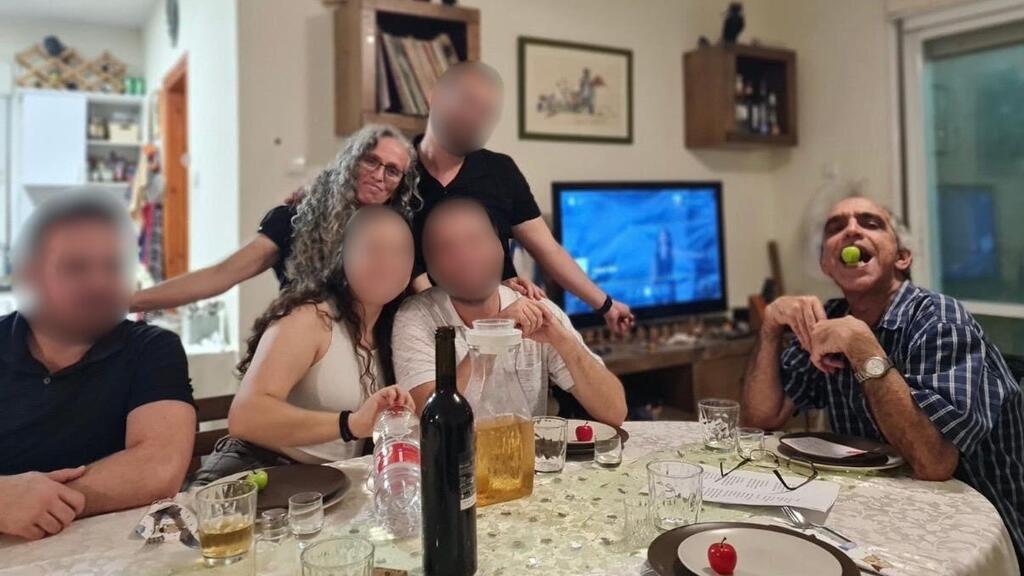
Avner and Maya Goren with their four children at home in Kibbutz Nir Oz on Rosh Hashana 2023
(Photo: Courtesy of the family)
At that stage, the family was still able to stay in contact. “I spoke with my mother and father on the phone and on WhatsApp, but mainly I texted with my father. I was sure they were together at home. Only afterward did I discover they weren’t even in the same place,” Dekel said.
“My mother was addicted to her work,” she adds. “She loved what she did very much. She worked in education, and she would always arrive early and stay late, and that is exactly what she did that Saturday too.”
She did not tell Dekel she was at the kindergarten.
“I assume she preferred not to tell me so I wouldn’t worry more. Once it was already clear there were terrorists, my brother wrote to her and asked whether there was a door she could lock and whether her phone was on silent. She hid behind a pile of mattresses. She also managed to speak with my cousin, who was in Sderot, and she was worried about him. No matter how deeply she herself was caught up in the situation, she was constantly worrying about other people, and especially about my father.”
On that horrific morning, Dekel corresponded with her father. “I spoke with him a little more. He told me he had heard the terrorists entering and leaving the house, that it sounded like they were destroying it and stealing things, and that several times he fought to hold the safe-room door handle. At some point, he also stopped responding. His last message was at 10:23 a.m. Only months later did we learn from intelligence information that he had been wounded in the house and taken from there alive.”
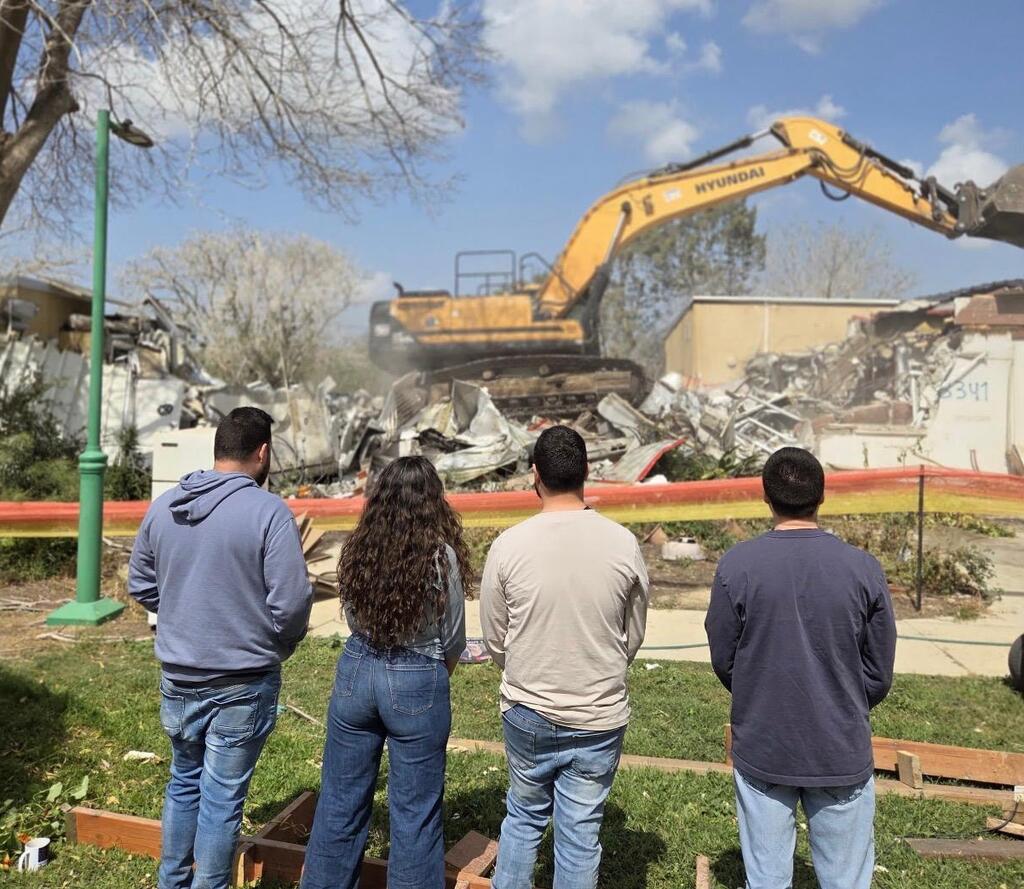
The four Goren children at the demolition of the familoy home on Kibbutz Nir Oz
(Photo: Courtesy of the family)
Meanwhile, Dekel and her boyfriend remained locked inside the apartment.
“At some point, my parents stopped responding to us, each at a different time. We tried to tell ourselves maybe it was reception problems, because we also didn’t always have reception, and we hoped. I stayed in contact with my brother, who was a few meters away from me. Every few minutes, we checked who was still alive. My other brothers tried to call anyone they could, phoned hospitals, tried to understand what was happening. That was how we spent about 11 hours, until we were rescued at around 5:30 in the afternoon.”
The terrorists didn’t reach you?
“No. In Nir Oz, there were six homes they didn’t enter, and my apartment was one of them. I was in a row of four young adults’ apartments. I was at one end, another friend was at the other end, and the two middle apartments were empty. Those two apartments were completely burned and entirely black, and they didn’t enter ours.
“Maybe they assumed our apartment would burn too, or maybe there was simply no sign anyone was inside. The shutters were closed. With my brother too, it is not entirely clear what happened. When they came to rescue him, the door was open even though it had been locked that morning, so terrorists probably went in and out. He just didn’t encounter them.
“The whole time, we heard gunfire, shouting in Arabic and banging on gas cylinders, and there were power outages. There were also moments of silence, and maybe those were even more frightening. They were very long hours of trying to summon help without understanding where the army was or when anyone would come. In hindsight, we know there was almost no fighting in Nir Oz, other than by the local security squad. The army arrived after the terrorists had already left the kibbutz.”
From the locked apartment into uncertainty
After the rescue, she was first taken to a nearby apartment, where she met her brother, and from there to the kibbutz command center.
“That’s where I saw everyone. People covered in soot, in pajamas, wounded, and so many people missing. Everything had started at 6:30 a.m., and by then almost an entire day had passed. We still hadn’t seen my parents’ neighbors, so we hoped maybe their area had not yet been searched, maybe no one had reached them yet,” she said.
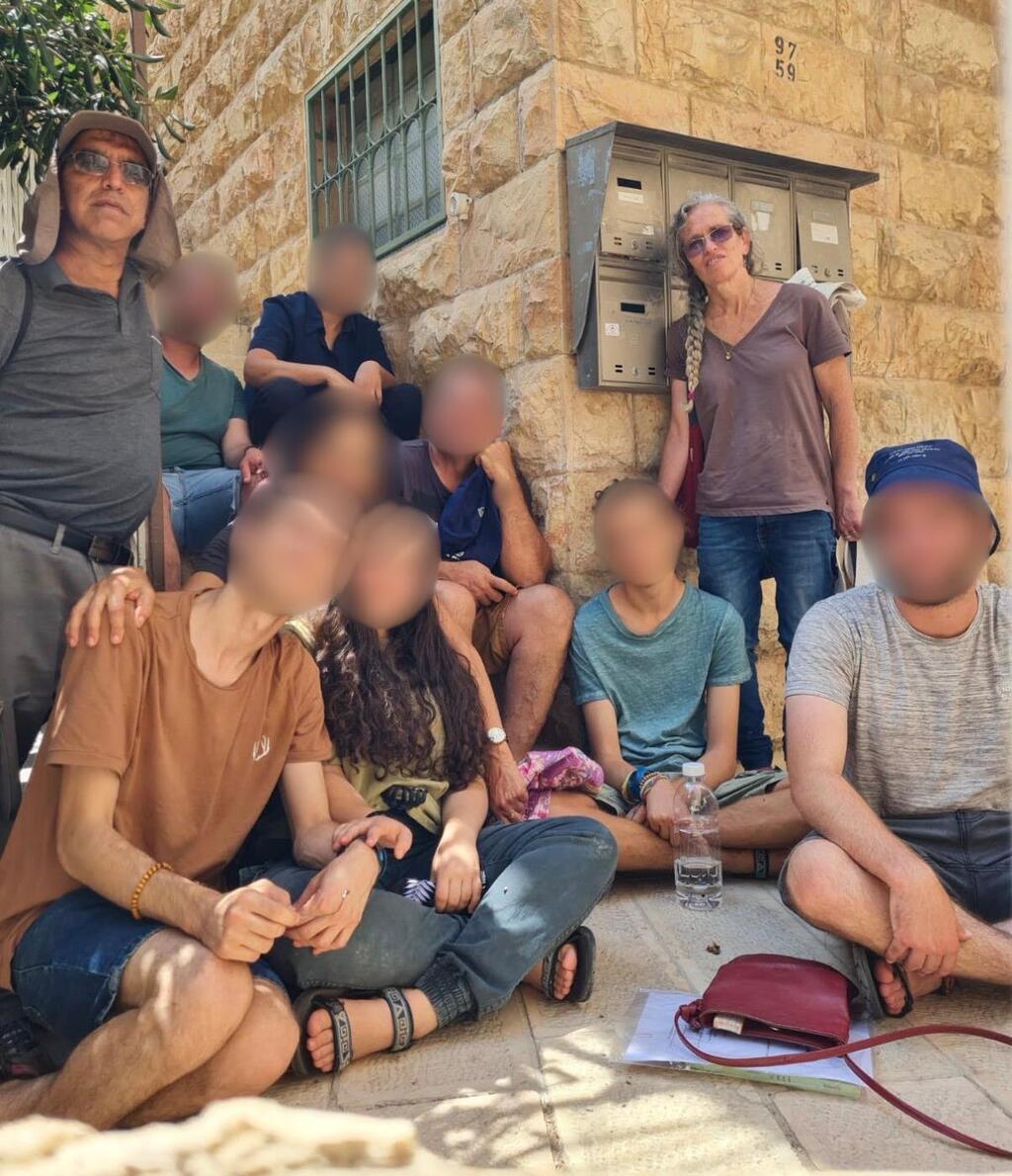
The Goren family with their cousins on a family trip
(Photo: Courtesy of the family)
Later, residents were taken to sleep in a kindergarten in the kibbutz, where they also met her parents’ neighbors. “We asked them what they knew, and they said they had asked the soldiers and that at the house they had only seen our dog. That is how we spent the night, in uncertainty. We didn’t know where my parents were or what had happened to them. We knew nothing.”
The following morning brought few answers.
“We made a list of things we needed to take: wallets, passports, important things. We went first to the apartments and then to my parents’ house with a soldier.”
Outside, it was already difficult to recognize the kibbutz she knew. “There was smoke in the air, the smell of burning, the smell of burned paint because the Nirlat factory had been hit. We entered the house and started looking for the things we had written down, but almost nothing was left. The house was completely destroyed. It didn’t burn, thank God, but you could barely see the floor because of the mess. A lot had been stolen.
“The soldier who searched the house told us our dog had died on the bed. It was in my room, because I was still in the process of moving out. We said goodbye to him, and in the end we left with almost nothing from the list.”
On the afternoon of October 8, residents boarded buses to Eilat. “We said goodbye to the kibbutz without knowing when I would see home again,” Dekel recounts.
At that stage, did you already understand what had happened to your parents?
“Nothing. In Nir Oz, one out of every four people was abducted or murdered, and everyone was in the same situation of uncertainty. In the community group, throughout the day people wrote about terrorists here and terrorists there, that someone had been abducted, someone had been murdered, homes had burned. Some things had started becoming clearer, but most of what happened was still shrouded in fog," according to Dekel.
“You simply didn’t know where your people were or what had happened to them. Everything was so surreal. As far as we were concerned, my parents were simply defined as missing. I didn’t want to define them any other way," she said.
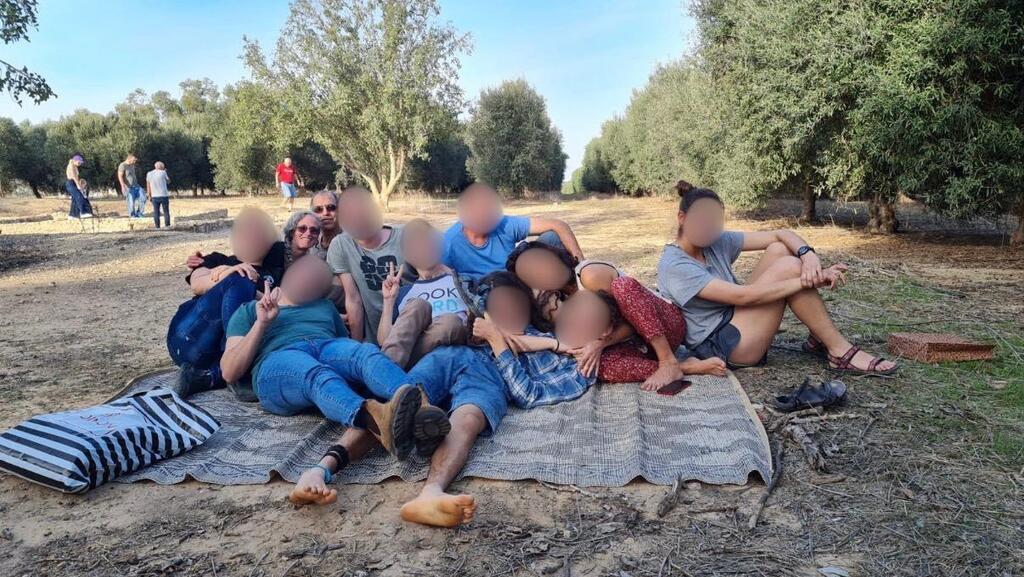
The Goren familoy joined by other relatives on a family trip
(Photo: Courtesy of the family)
“About 10 days later, we were told they had been classified as hostages based on the location of their phones in Gaza. Even that did not give us certainty, because I knew people whose phones were in Gaza while they themselves were actually in Israel. And just a few days after that, they told us they had found my father’s body in the fields between the kibbutz and the border.”
How did you react?
“I broke. I just fell apart. I didn’t really understand what was happening here, what world I was in, and I just cried a lot. I was in Eilat at the time, and they told us about my father separately because each of us was in a different place. Afterward we came together there, and a few days later there was the funeral.
“We held the ceremony at a kibbutz in the Arava, and the burial itself was in Nir Oz, with a very limited number of people. The whole thing was terribly surreal, and in the middle of all that we still didn’t know what had happened to my mother.”
In the case of her mother, Maya, the uncertainty lasted much longer. Her last message was sent shortly before 10 a.m., and from that moment the family had no idea what had happened to her.
Only in November did an almost accidental clue emerge: someone remembered that security cameras had been installed at the kindergarten where she had been. “We saw that she had been abducted from there. We knew she was wounded and needed treatment, but we didn’t know what happened afterward, whether anyone treated her, whether she survived. We knew nothing.”
Those were the days of the first hostage deal, and every new list brought another cycle of hope and fear.
“Every day you waited to see whether your person was on the list, and then another day passed and she wasn’t there, and another day she wasn’t there, and then they told us my mother had been murdered and that her body was being held by Hamas.”
Once again, the family had no possibility of saying goodbye in the usual way. “We sat shiva without a body, without a burial. It was at the end of November, beginning of December. Everything was simply impossible to grasp.”
'The most practical thing there is'
After all that, somehow, life still had to be rebuilt.
Just weeks before October 7, Goren had been in a completely different place in life. She had only just begun a year of national service before the army and was settling into a new routine. In the months that followed, she slowly and cautiously tried to find her way back to what she had begun.
“I would come every so often to see friends from the commune, sometimes for a day, sometimes for a few days, even before I knew what had happened to my mother. Eventually, in January, I returned to the activity and to guiding, and it was the best thing I could have done for myself,” she said.
“My students were everything to me. They gave enormous meaning to what I was doing. I told them about everything that happened, and slowly I began to understand that there was also value in what I had to tell, in what I could pass on.”
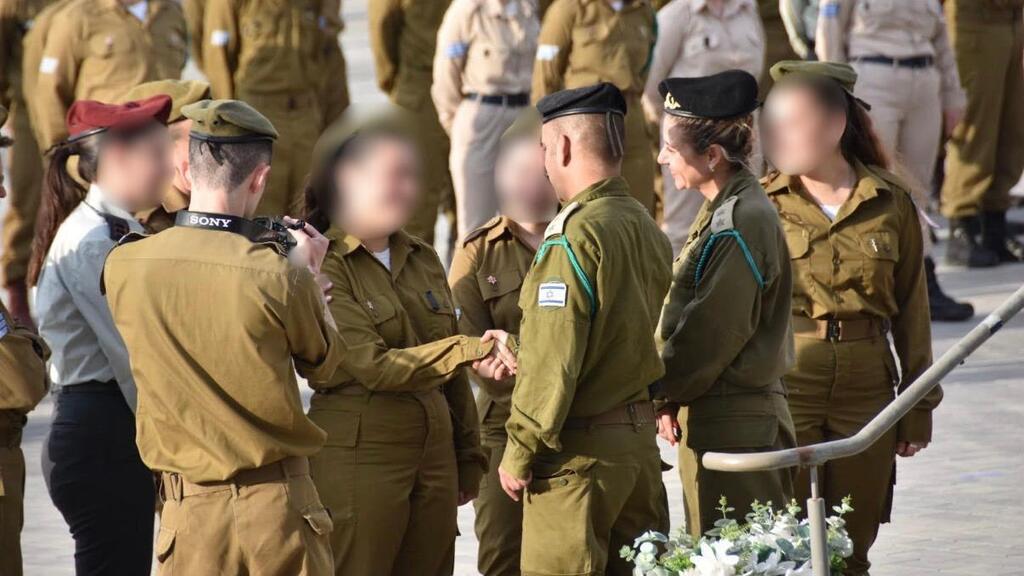
Awarding of a paramedic pin to Dekel Goren by the IDF commander at the graduation ceremony of the paramedic course
(Photo: IDF Spokesperson's Unit)
In November 2024, the time came for her to enlist in the IDF, and Goren hesitated. Even before October 7, she had been slated for a paramedic track, which she had aimed for from the outset. But after everything she had been through, that plan was no longer self-evident. She now had to ask herself not only what she wanted to do in the army, but what she was even capable of doing.
“I really had to listen to myself and understand what I could and could not do at that time. I gave up on paramedics and signed up for a Nahal track with my friends from my service year. At that stage, I simply needed stable ground, and they were my home and my family. But as enlistment approached, I understood that I wanted to return to what had interested me in the first place,” she explained.
Today, she is a commander at the IDF School of Military Medicine, Bahad 10, where she trains medics.
“I’m glad I ended up doing this, because as far as I’m concerned there aren’t many things more important than teaching people how to save lives. This role combines two things I love very much: instruction and command, and the ability to give people tools that one day can truly make a difference.”
Gradually, her personal story also became part of her instruction.
“At first, it was important to me to tell it so people would remember my parents, but the more I told it, the more I understood that people also take things from it for their own lives. In my medic course, I told my friends the story and took them on a tour of Nir Oz, and the reactions I received made me realize I have something else to give beyond the professional training,” she said.
“I’m not coming to teach people how to cope. I simply share what I went through, what helped me choose to keep going, to live, to do things that are good for me and for others, and at the same time I teach them the most practical thing there is: how to save a person. Especially in the reality we live in today, I feel that has enormous meaning.”
The sky, the air and the sunset
Goren was born and raised in Nir Oz, and for 18 years the word “home” required no special thought. Today she lives elsewhere, and from time to time returns to the place where she spent her entire childhood and adolescence.
Despite everything that happened there that morning, on one point she has no doubt: Nir Oz is still home. One day, however terrible, is not enough to erase an entire life.
“I’m still evacuated in Kiryat Gat,” she said. “People have started returning to the kibbutz, and there is the pioneer neighborhood, where quite a few people are already living, but the kibbutz is still not fully populated. It is still in stages of demolition and rebuilding.
“The first time I returned was only the day before my mother’s funeral, a few months after October 7. Since then, I have gone back to pack up my apartment and my parents’ house, and every so often just to visit. Not long ago, we had Friday dinner there.”
How does it feel?
“I love going there. With everything that place went through, it all happened in one day, but I also had 18 years there beforehand. It even makes me happy to arrive.”
Perhaps it can be called a hesitant return to routine, though today’s routine is very far from what it once was. For many Israelis who did not experience October 7 unfolding before their eyes, the date returns once a year with concentrated intensity, through ceremonies, reports and memories. For Goren, it does not really need to return. For her, the loss is there on the other 364 days as well.
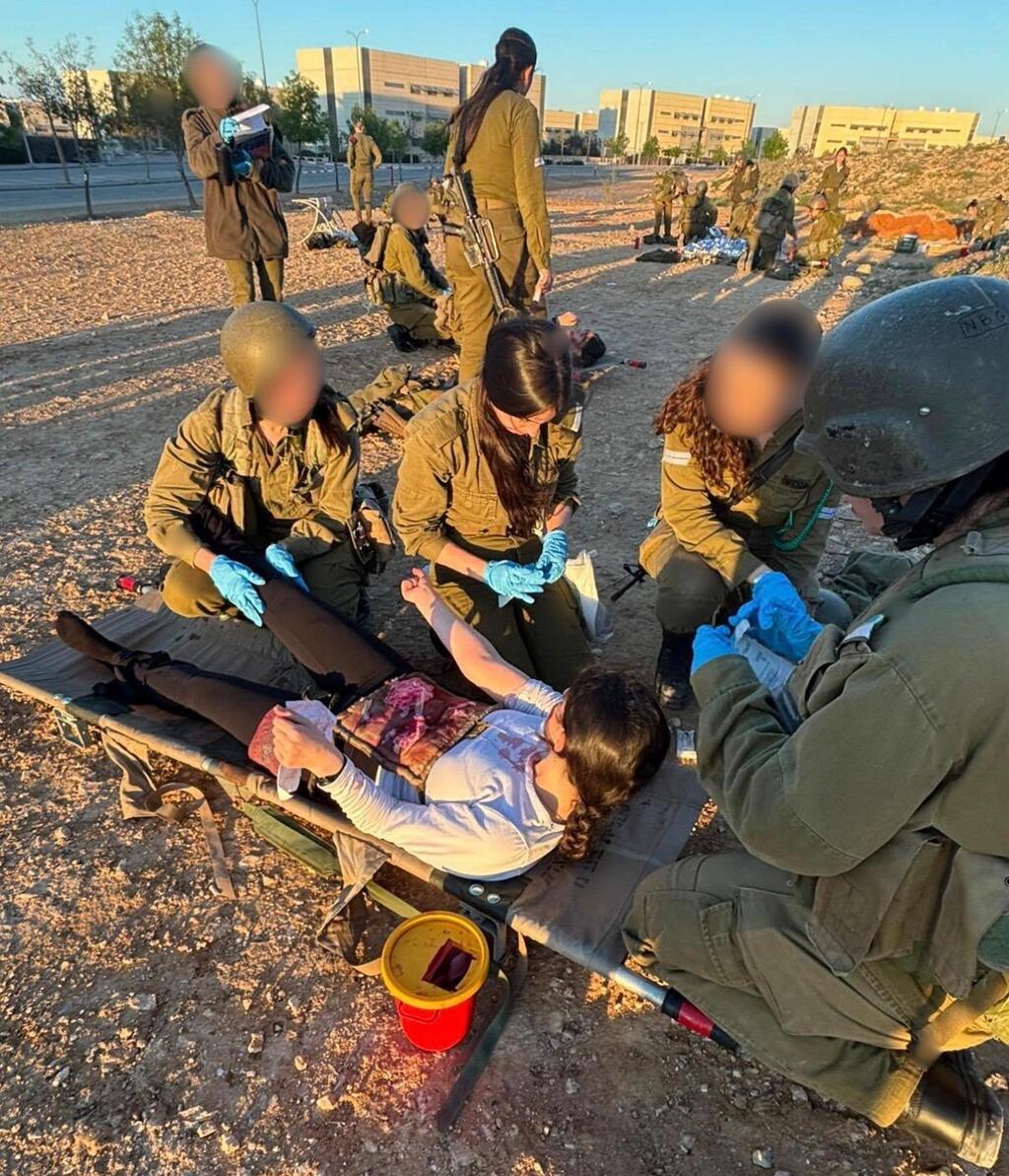
Dekel Goren teaches trainees in the general paramedic course during a casualty care exercise
(Photo: IDF Spokesperson's Unit)
“There is meaning to that date, but it is more for people who do not live this all the time,” she said. “I live my loss every day. There are days when it is more present and days when it is calmer, but it is always there, together with everything that comes with it.
“Obviously, on October 7 it comes up more, there are ceremonies and suddenly people talk about these things much more, but for me there is not really a difference between that day and another day. Even now, while I’m talking to you, I am still inside the same situation. The difference is mainly in what I choose to do with it.”
She tells her story on many occasions. “People are still interested, they listen and they want to know as much as possible,” she said. “Within the community too, it is there all the time. There are all kinds of projects and initiatives commemorating the people we lost, and you feel it in a kind of comforting way.”
In the meantime, she is preparing for the next chapters of her life. Will she return to live in Nir Oz? She herself does not yet know and, in any case, this is an age marked by a great deal of uncertainty.
“We are still in the war, and I myself don’t know what is going to happen or how it is going to end, both physically and in terms of my personal security. I’m also at a stage in life where everything is still open: I’m in the army, I’ll probably travel at some point, there will be studies," she said.
“Emotionally, at least, I want to explore it, to see how I feel there,” she said. “So many things happened there, but when I enter and see the sky, smell the air and see the sunset, it still feels like my home. I haven’t felt that feeling anywhere else.”