


In Nir Oz, most of the burned and destroyed homes have already been cleared away and reconstruction is well underway. But several damaged houses are still standing, including the home of the Bibas family, from which Shiri Bibas and her young sons, Ariel and Kfir, were abducted, and the home of the Kedem Siman Tov family, where Johnny and Tamar Kedem Siman Tov and their children were murdered.
A painful debate now surrounds those homes: Should the buildings remain as physical testimony to the Oct. 7 massacre and serve as memorial sites, or should the ruins be removed so residents returning to the community do not have to live with constant reminders of their grief? Other kibbutzim in the communities near the Gaza border have faced the same question in the aftermath of the Hamas attack and the devastation it left behind.
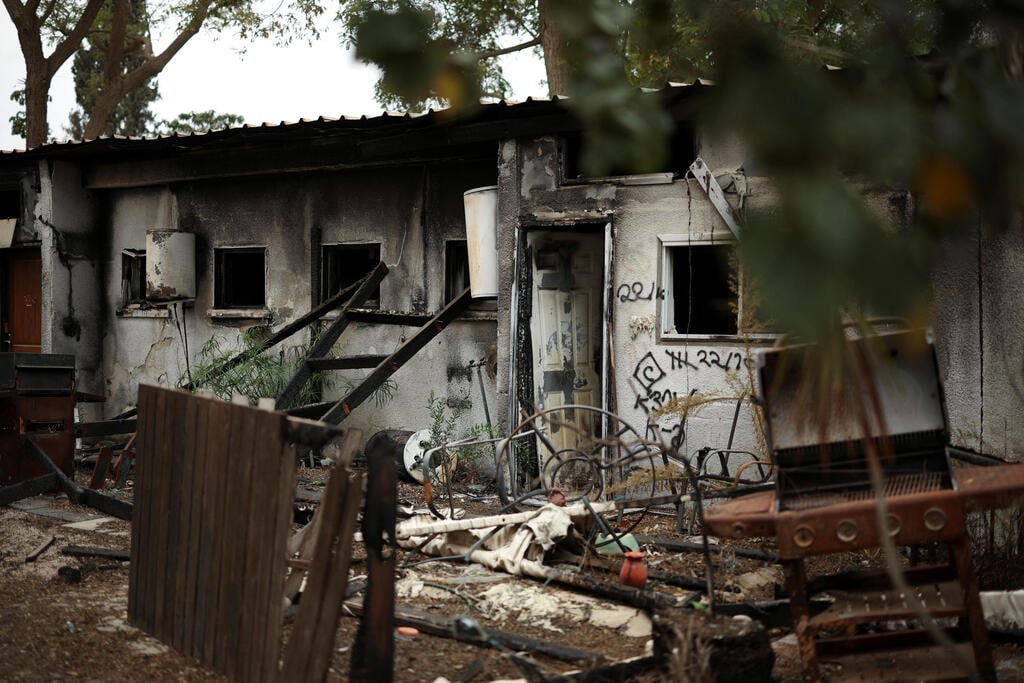
In Nir Oz, the debate is particularly acute. One in four members of the kibbutz was killed or abducted in the Hamas-led Oct. 7, 2023, attack. Terrorists moved from house to house, and more than 90 homes were eventually designated for demolition.
Unlike at Kfar Aza, for example, where the dispute over preservation has focused largely on the community’s “young generation” neighborhood, almost every part of Nir Oz was touched by the attack. The question of what to do with the homes is therefore about far more than reconstruction. For some residents, they are the places where loved ones were killed. For others, they are places alongside which they are being asked to rebuild their lives.
Almost surrealistically, the argument has become familiar in kibbutzim devastated on Oct. 7. On one side are residents who put their position starkly: “We don’t want to live in Auschwitz.” On the other are bereaved families and other residents who struggle with the idea that the homes where their loved ones were murdered could simply disappear.
Nir Oz established a temporary preservation zone where burned homes were initially to be left untouched. With the consent of some families, however, several structures in the area have already been demolished.
The kibbutz is now trying to find a balance. A dedicated professional team is overseeing the process and presenting the community with various alternatives. No vote has yet been held and the final decision will rest with kibbutz members.
The team overseeing the process has also sought the views of residents, bereaved families and the wider community, distributing a “heritage questionnaire” asking them to indicate their preferences on commemoration. In the case of the Bibas home, for example, most respondents favored either preserving it or putting its demolition on hold for now. The ultimate decision, however, will be made by members of the kibbutz.
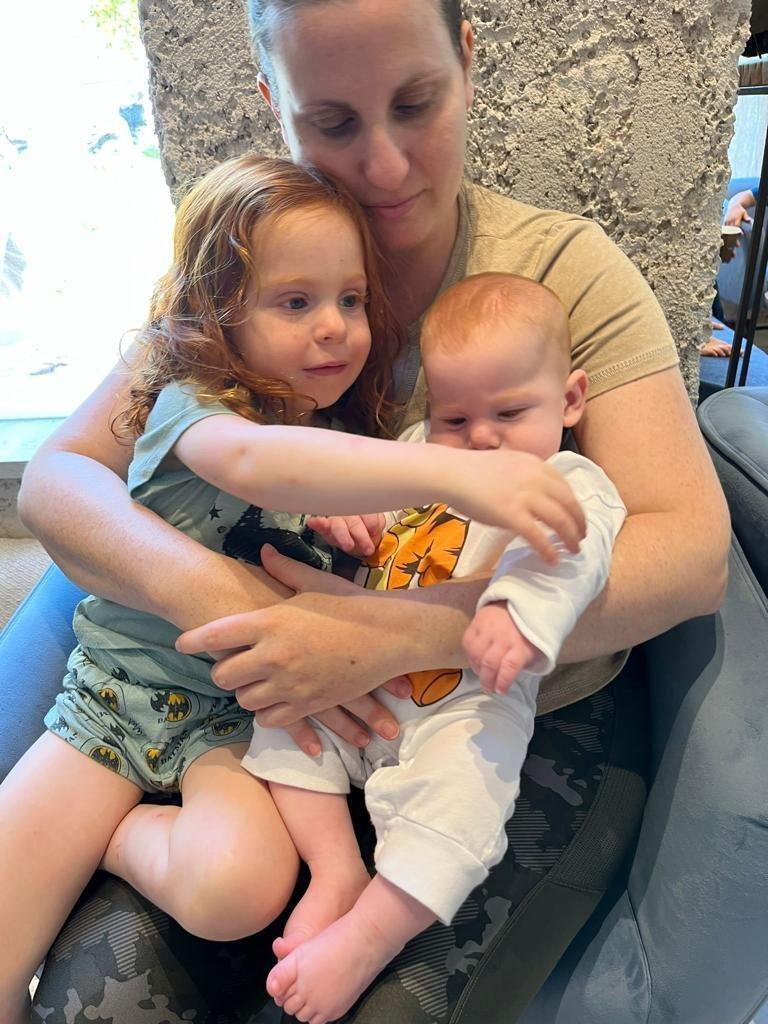
Shiri Bibas with her sons, Ariel and Kfir
(Photo: Courtesy of the family)
“Those who don’t live here, or don’t want to return to the kibbutz, want to leave the destroyed houses standing,” said Ran Pauker, the kibbutz’s longtime gardener.
Pauker strongly supports clearing the ruined homes.
“In Judaism, you don’t create a cemetery inside the kibbutz,” he said.
Pauker, who is approaching 90, lost his brother Gideon in the massacre and recently returned to live in the kibbutz with his wife.
“Those who are coming back to live in Nir Oz don’t want to leave destroyed houses standing,” he said. “They want to commemorate and preserve the memory in other ways, including creating a memorial site outside the kibbutz, moving one or two houses there and transferring the safe rooms there.”
“It’s not a simple discussion,” he added.
Many others share Pauker’s support for clearing the ruins, and kibbutz members say that is probably the majority view. But others are determined to preserve at least some of the homes.
Ofri Bibas, the sister of Yarden Bibas, who survived Hamas captivity in Gaza, opposes demolishing the Bibas family home. She understands the desire to rebuild and move forward but believes that can be done without erasing the physical evidence of what happened.
‘I call it Oct. 7’
Adina Moshe, whose husband, Sa’id, was murdered on Oct. 7, also wants some of the structures preserved. Her former home has already been demolished and she wants to return to Nir Oz, but she has set clear conditions: Her new house must be built on the same site as her old one, and she wants a row of four destroyed homes opposite it to remain.
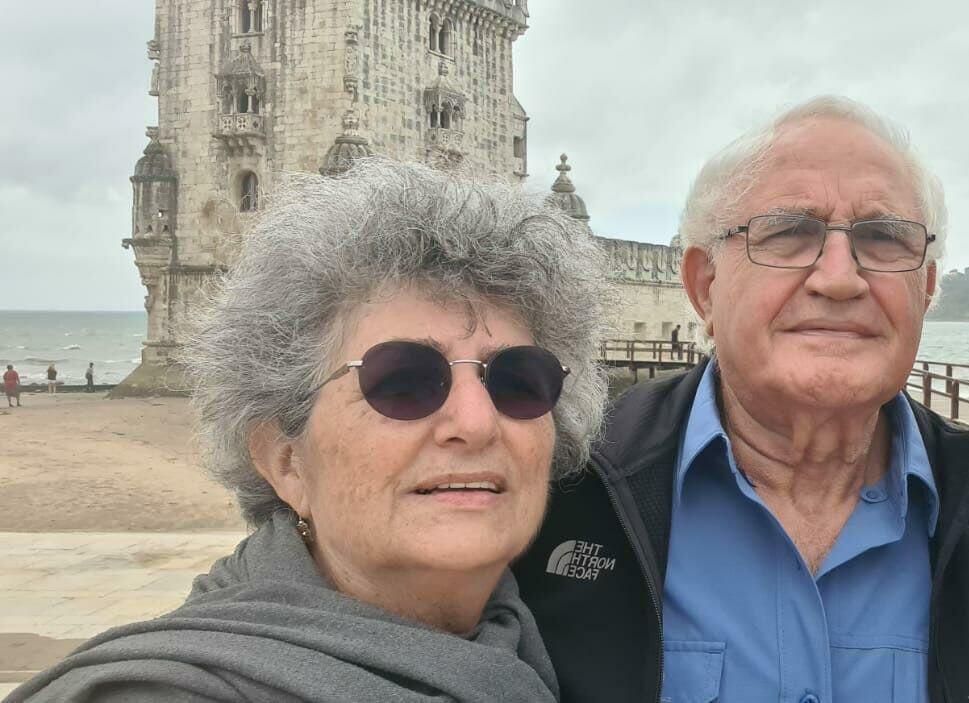
Adina Moshe and her husband, Sa’id
(Photo: Courtesy of the family)
“I agreed on the condition that opposite my house there would be the four houses where Carmela Dan and her granddaughter Noya, Bracha Levinson and Katzir were murdered,” Moshe said.
“And yes, I’m willing to live opposite this Auschwitz, as they call it. I call it Oct. 7,” she said. “I gave my consent on the condition that the new house be built on the foundations of the destroyed house. I want to return at least to that little patch of lawn, to the garden and to the memory. I feel like I can’t leave Sa’id there.”
For Moshe, preserving the ruins does not conflict with the desire to resume living. On the contrary.
“There is tremendous difficulty and sadness,” she said. “I am in favor of leaving this structure so we remember, and of course the house of Johnny and Tamar and the children who were murdered there should remain, as should the house of Shiri Bibas and the children.”
She rejects the argument that people cannot rebuild their lives alongside burned-out homes.
“What does one have to do with the other? Why wouldn’t I want to go on living? Life will continue,” Moshe said. “These will be lives. The issue of preservation has nothing to do with the fundamental question of the kibbutz.”
She said the preserved structures could be screened from everyday view for residents who do not want to see them.
“You can conceal them so they aren’t visible. Whoever doesn’t want to see them won’t have to unless they go inside,” she said. “You can plant bushes, frame them. It can be done. I’ve already looked into it.”
Moshe said the dispute within Nir Oz has become deeply contentious.
“I feel like I’m part of a small minority in the kibbutz, but there is broad opposition and it reaches the point of battles,” she said. “Especially among the younger people and those who don’t want to return.”
Families have also been presented with the possibility of moving some of the structures to a site outside the kibbutz. Moshe is not convinced that is practical.
“It can’t really be done,” she said. “These are rows of houses, and moving them could cause them to collapse.”
Renana Gome Yaakov, whose sons Or and Yagil were abducted to Gaza and later released while their father, Yair Yaakov, was killed, also believes Nir Oz must find a way to preserve physical evidence of the massacre.
“I think everyone understands the importance of memory and preservation,” she said. “There are simply people who want to live there and find it difficult to live and imagine a community where burned houses remain as testimonial homes.”
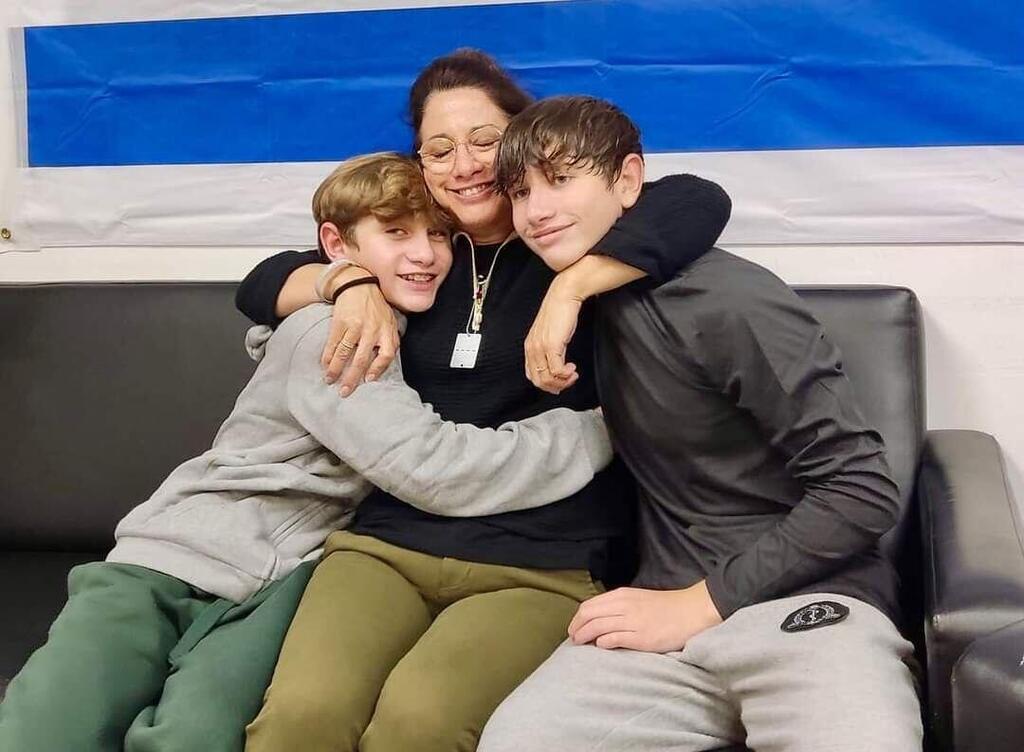
Renana Gome Yaakov and her sons Yagil and Or
“Some people think one way and some think another,” she added. “This is not an individual person’s struggle. The importance of this discussion is national. It is not something specific to one particular family.”
Gome Yaakov said she fears future generations could be left without anything tangible to convey what happened in the kibbutz.
“I just think that 20 years from now, we’ll look our children and grandchildren in the eye and ask what we left behind to illustrate the horror of that day,” she said. “Even a year from now — what did we leave behind?”
“Nothing compares with seeing it with your own eyes,” she said. “No digitization, no memorial center — which should also be established — and no project of that kind can replace preserving the memory.”
Her proposed solution is to preserve some of the houses while covering or restoring their exteriors so residents are not confronted daily by the destruction.
“I thought it would be right to actually reconstruct the houses on the outside, down to the bicycles and mobility scooter, while leaving the interiors as they were after the massacre,” she said. “To emphasize the gap between normal life outside and the horrors that took place inside. That would also allow people to live alongside it without constantly being triggered.”
For Gome Yaakov, rebuilding must not become erasure.
“Amid the momentum of reconstruction, we must not join what I see as the government’s narrative of forgetting,” she said. “I very much hope one of the options will be to leave several houses in their original locations and create some kind of covering, so people aren’t forced to look directly into the horror.”
She said she believes most residents will ultimately choose a compromise.
“At this stage, there is still no decision,” she said. “We have so many other things we are dealing with. It will make things easier for all of us when this is behind us. Of course, I hope we find a solution that is relatively acceptable to everyone.”
The professional team overseeing the process is trying to do precisely that: find a middle ground between the two positions.
The proposals presented to the community include preserving the testimonial homes at their original sites, partial preservation, clearing the ruins or relocating structures. If homes are preserved, various forms of screening and design are also being considered to reduce the daily visual presence of the destruction.
But the houses are not the only reminders raising questions over what should remain and what should be removed.
Walking through Nir Oz, reinforced safe rooms can still be seen standing alone after the houses around them were torn away. No final decision has been made about those structures either. One option under consideration is to move them to a centralized memorial site west of the kibbutz cemetery, where they would become part of the story presented to future visitors.
The kibbutz refers to the proposal as an “external memorial and testimony complex.”
A similar decision must be made about an area around a junction inside the kibbutz, known as the “Junction of Heroism,” where members of Nir Oz’s local emergency response team — Aviv Atzili, Tamir Adar and Dolev Yehoud — were killed fighting the attackers.
For Nir Oz, the decisions will determine not only how the kibbutz looks as residents return and homes rise again, but also how one of the communities hardest hit on Oct. 7 chooses to preserve the physical evidence of what happened there.