

Nearly a month after an Iranian missile slammed into Soroka Medical Center in Be’er Sheva, the full scope of the damage is coming into view. With operating rooms destroyed and upper floors reduced to rubble, the hospital has been forced to treat dozens of patients in makeshift underground wards as it braces for what could be a yearlong recovery.
Destruction at Soroka
(Video: Oren Rice)


“The physical conditions are horrific—what you’d call ‘hell’s basement’—but the staff is doing everything they can,” said Limor, whose 80-year-old father, Haim, has been hospitalized for a week. He is one of 52 patients now being cared for in converted family dining areas and training rooms two levels below ground.
Beds are separated by thin curtains, with less than three feet between them. Showers are nonexistent, and bathrooms are scarce. “You wouldn’t want to leave anyone here, but we have no other space,” said Dr. Tzachi Slutsky, Soroka’s deputy director. “In the end, an 80-year-old man with a urinary tract infection still needs to be admitted—and he deserves dignity. This is not that. I wouldn't hospitalize my mother here today in this situation." And the bad news, he says, is that this situation won't change in the six months to year.
The hospital’s northern surgical tower took a direct hit in the April strike. Eight of 19 operating rooms were destroyed, along with vital surgical equipment, medications, and ventilators—damage totaling tens of millions of dollars. “ENT, ophthalmology, urology, pediatric surgery—all wiped out in one blow,” Slutsky said.
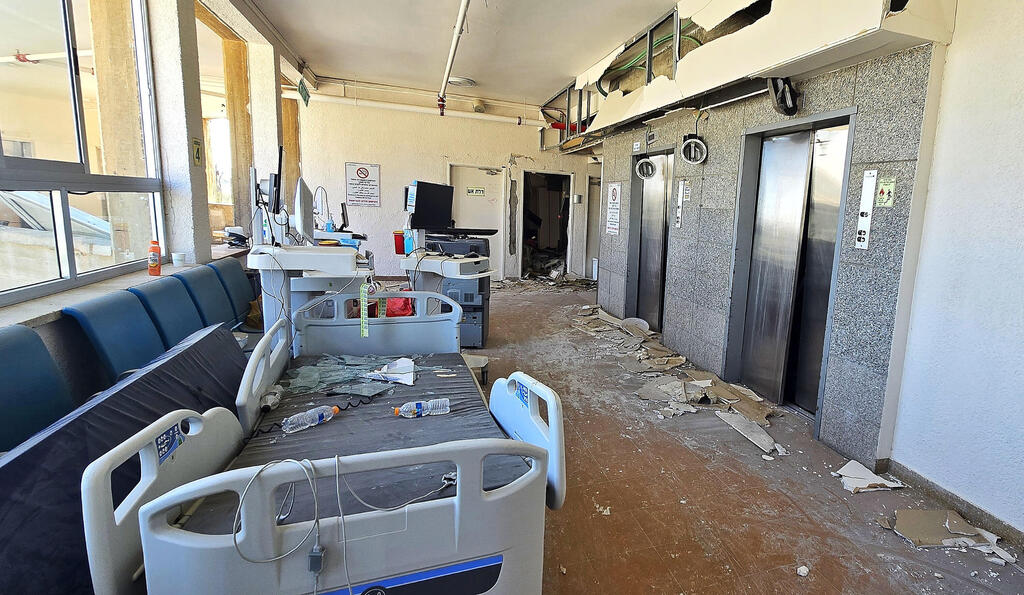
In response, Soroka has shifted all surgical activity to its southern tower, operating around the clock. Four gynecology ORs have been converted to accommodate general surgeries, and the hospital is negotiating to use operating rooms at nearby facilities in Be’er Sheva.
Despite the upheaval, urgent procedures are still being performed. “We canceled only non-essential surgeries that don’t endanger the patient or seriously affect their quality of life,” said Slutsky. “Oncology, trauma, and time-sensitive cases are all being treated immediately.”
The worst destruction occurred on floors five and six—the missile’s impact site. The urology ward had been evacuated just a day earlier, likely saving lives. Two doctors on site reached a secure area in time and escaped unharmed.
The hospital’s 6th floor, which housed key research labs, was reduced to ashes. “A lot of groundbreaking studies vanished in a single day,” Slutsky said. The smell of smoke still lingers in the corridors.
Israel’s Tax Authority estimates reconstruction costs between $54 million and $82 million. But hospital officials say that only covers structural rebuilding—adding two more floors to the southern tower—not full replacement of equipment and infrastructure. “That’s just a preliminary estimate,” Slutsky noted. “We haven’t even assessed all the damaged medical devices yet.”
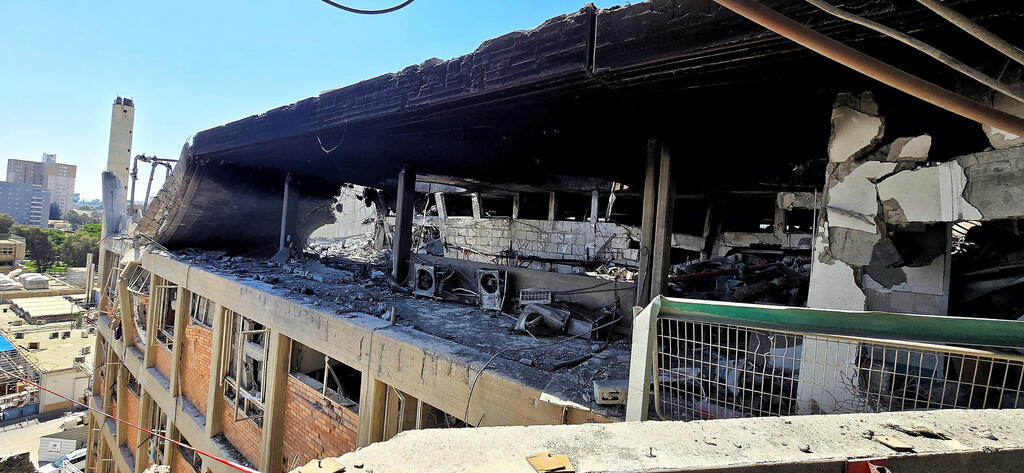
Research lab wiped out
(Photo: Meir Even-Haim)
Although some charitable groups have stepped in, there’s concern the government may rely too heavily on private donations to fund the recovery. “This is far bigger than Soroka or Clalit,” Slutsky said. “It requires direct government investment—no question.”
Long term, Soroka is pushing for a fully protected medical facility known as the Tkuma Tower, which would include inpatient wards, operating rooms, imaging labs, a cardiology unit, and an underground emergency hospital. Estimated cost: $260 million.
The hospital’s rehabilitation department—critical in treating hundreds of wounded soldiers since October 7—is also out of commission. “The damage wasn’t just structural,” Slutsky said. “We lost extremely specialized and expensive equipment.” A once-bustling therapy room, where patients learned to walk again, now lies in ruins. “Alma Avraham—who returned after 51 days in Hamas captivity—danced here with her physical therapist,” he recalled. “Now that space is gone.”
To address the urgent gap, Soroka is working to lease a nearby space and resume rehabilitation services in the coming days.
In Europe, they would have shut down for six months
About two and a half weeks ago, as the ceasefire took hold and hospitals across Israel began transitioning from bomb shelters back to standard operations, Soroka Medical Center in Be'er Sheva was already planning where to set up new wards to replace those destroyed by missile strikes.
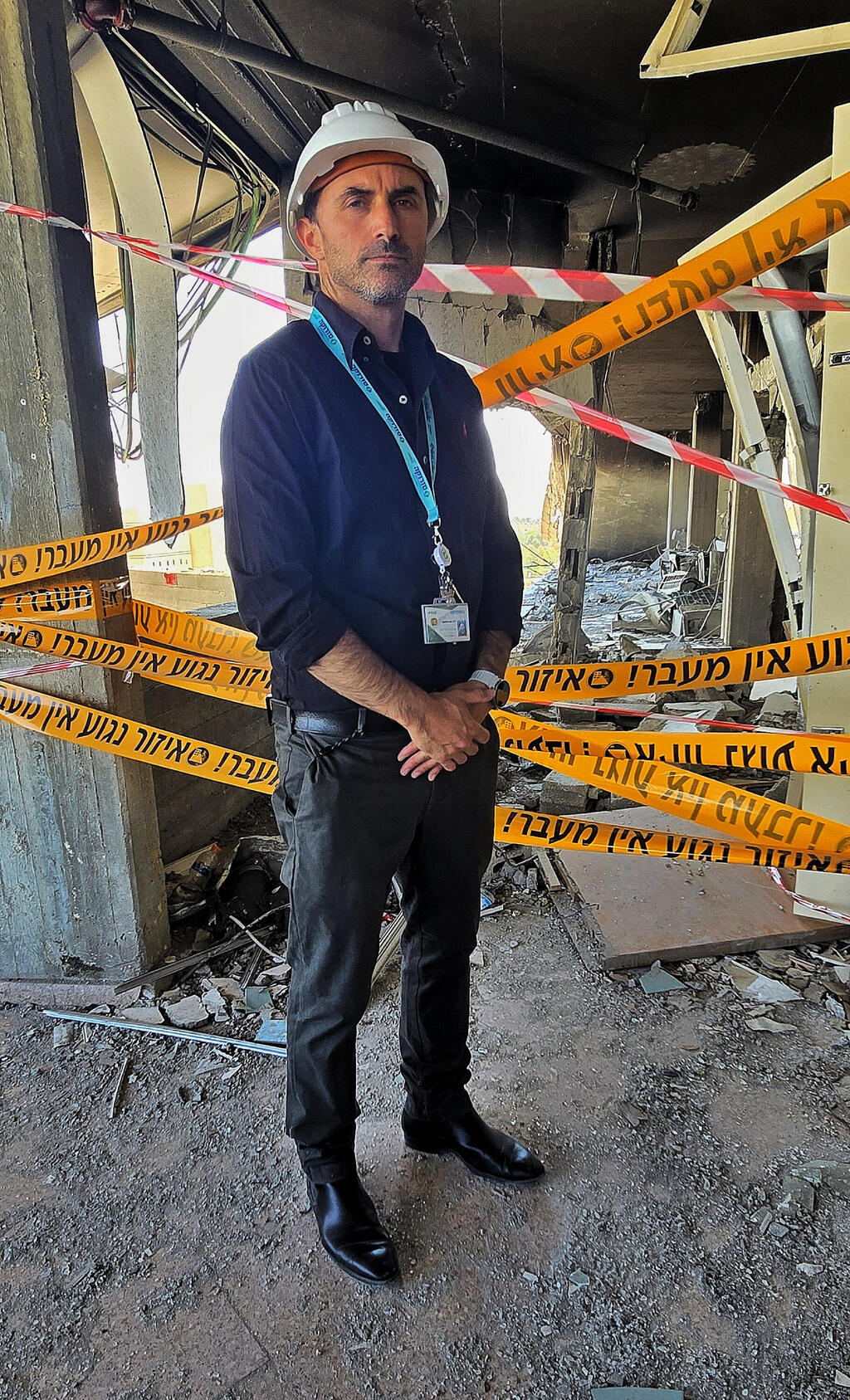
Dr. Tzachi Slutsky
(Photo: Meir Even-Haim)
The hospital's rehabilitation department sustained massive damage. The area that had been treating dozens of wounded soldiers and civilians since the start of the war was completely demolished. Today, roughly 900 of Soroka’s original 1,200 beds are in use. Most departments are functioning, though not at full capacity—and many are not in their original locations. Urology and ophthalmology have been moved to the women's building, ENT is now housed in orthopedics, and six internal medicine departments are spread across the hospital.
“Colleagues in Europe tell me, ‘Anywhere else would have shut down the hospital for six months, rebuilt it, and only then resumed operations.’ But that’s not an option here—it just doesn’t exist,” said Slutsky. “And it’s not in our DNA. Soroka is the only hospital in the Negev. It serves over a million people.”
“Three hours after the missile strike on that Thursday, the ER was already open. We were performing heart and brain catheterizations. The trauma unit and southern operating rooms were functioning. The staff here knows they’re the only lifeline for the region—so they keep going,” he added.
In the internal medicine building, blast pressure shattered windows. Only one elevator is functioning. Drywall panels now cover broken windows. Elevators across the affected buildings were destroyed. So far, one has been restored in the surgical wing and three in the internal medicine complex. “You can’t run a hospital without elevators,” Slutsky emphasized. “It severely limits us—especially in emergencies like fires when rapid evacuation is essential.”
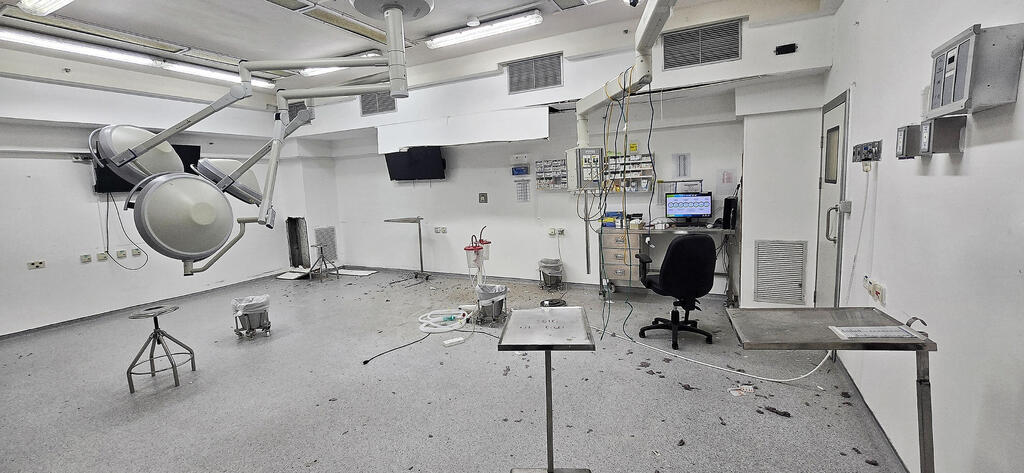
Damage in surgical suites
(Photo: Meir Even-Haim)
Before the missile strike, the internal medicine departments had 280 patients. Now, that number is down to about 190, with 52 of them located in a sublevel two, underground. Soroka, known for its infection prevention excellence in recent years, is now struggling to maintain those standards due to crowding and poor ventilation.
“We’re doing the best we can, but it’s hard when you don’t even have basic conditions,” said Professor Leonid Barsky, head of internal medicine. “Nobody expected us to absorb so many patients. This doesn’t meet modern global standards—not in 2025.”
“When the missile hit, we didn’t stop providing care. We just kept going,” Barsky added. “Even students and interns—training wasn’t suspended.”
In the damaged internal medicine wing, only one floor has reopened. Windows remain sealed with drywall. “It’s not easy,” said Aliza Mordechai, head nurse of Internal Medicine A. “We’re dealing with pressure ulcers, gangrene, terrible smells—and the ventilation is sealed. Still, we try to make it feel as comfortable as possible for the patients.”
Looking ahead to winter, when occupancy typically exceeds 100% and patients line the hallways, the situation looks bleak. “If we don’t fully restore this building before flu season hits, we’re in real trouble,” Slutsky warned. “You can’t face viral outbreaks with drywall-covered windows.”
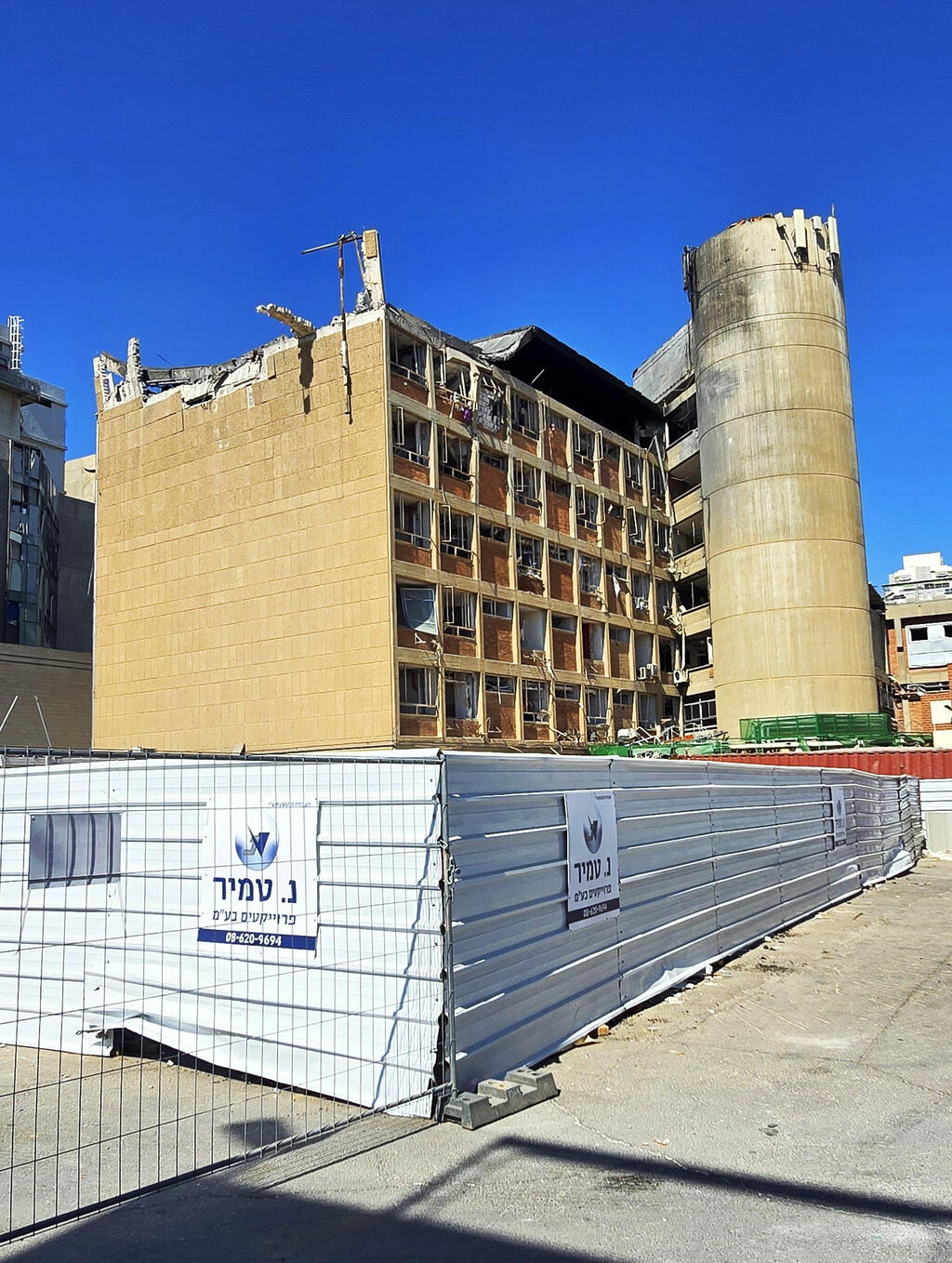
Enormous damage
(Photo: Meir Even-Haim)
Patient frustration is mounting. “At first, everyone understood and cooperated. But after a while, families want their loved ones to be treated in proper conditions. Complaints are coming in—and rightly so. This can’t continue indefinitely.”
Get the Ynetnews app on your smartphone: Google Play: https://bit.ly/4eJ37pE | Apple App Store: https://bit.ly/3ZL7iNv
There’s also concern that doctors might begin leaving due to deteriorating conditions. “It’s hard to imagine any medical team in Israel going through this much and still showing up daily to work under such impossible constraints,” Slutsky said. “Senior doctors don’t even have offices. Interns don’t have a place to put their bags. We can’t expect this to go on forever. Soroka must remain a national anchor. And that means attracting and retaining talent. If there’s no future here, people will think twice about specializing—or staying.”
Racing Against Time
The immediate solution, Slutsky explained, is to build two new upper floors on the southern surgical building. The estimated cost is $54 million and would add four inpatient departments. “Plans are ready. If we get the green light, we can start building tomorrow.”
Looking further ahead, Soroka hopes to construct a 10-story fortified inpatient tower, the “Revival Building,” at an estimated cost of $270 million. It would include four underground levels to withstand future attacks. The goal is for the new tower to eventually replace the damaged northern surgical building. “Our preference is to demolish that building entirely,” Slutsky said. “That’s under review with the Health Ministry’s structural engineers.”
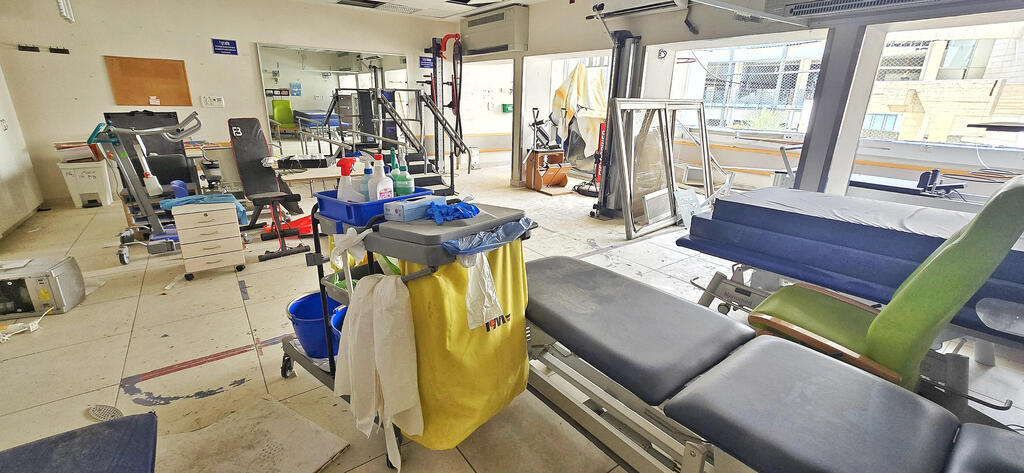
Physical rehabilitation space
(Photo: Meir Even-Haim)
Although the Health Ministry frequently highlights the Revival Building in public statements, it remains in early planning stages—and based on experience, it could take years to complete.
“You might hear Soroka is back to 80% capacity and coping on its own—but that’s not accurate,” Slutsky emphasized. “We’re doing everything we can to serve the Negev, but this situation can’t fade into the background. Soroka cannot be left to fend for itself. This is the moment for the state to step in—not just to restore what we lost, but to rebuild stronger.”