

Dr. Dan Rorman never set out to create a family dynasty in medicine. Yet nearly three decades after opening a small community clinic in the Jerusalem-area town of Tzur Hadassah, he now sees all three of his daughters following him into the profession.
Rorman, 66, says he never encouraged his daughters — Hadass, Ella and Dafna — to become doctors. Still, all three chose medicine, something he attributes to what they absorbed at home. “I was honestly surprised,” he said. “I never pushed them. But they probably saw me coming home fulfilled. Somehow, that sank in.”
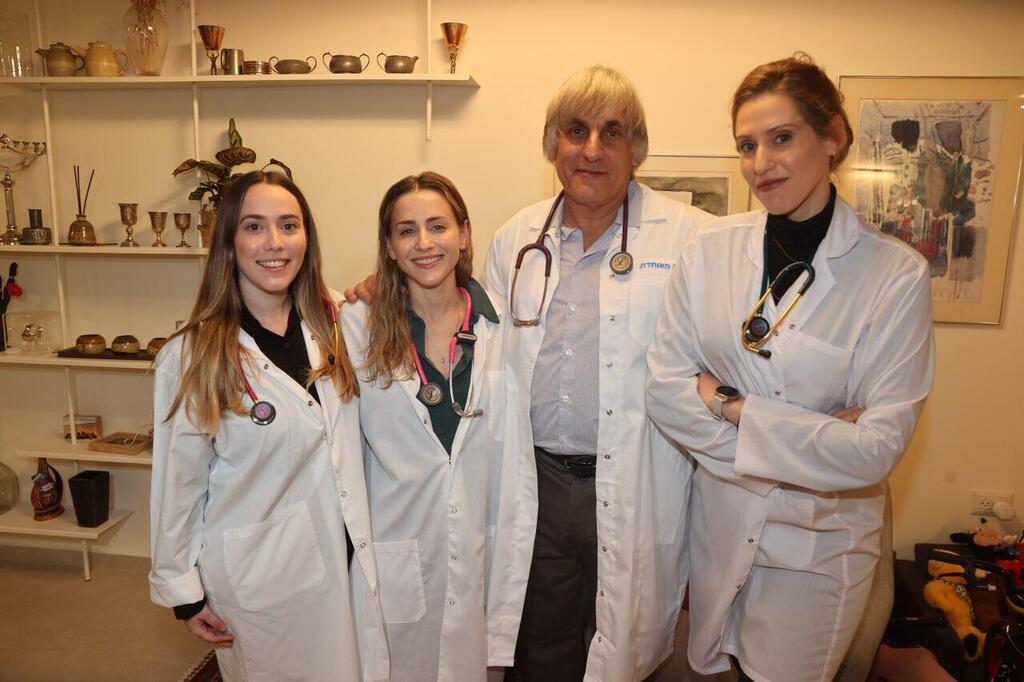
(Photo: Yariv Katz)
When Rorman opened his clinic in 1997, Tzur Hadassah was a small community of about 1,000 residents. His was the only clinic in the area, modest in size and scope. Nearly 30 years later, the town has grown to around 13,000 people, and the clinic has expanded with it, caring for multiple generations of families.
Rorman was born in Los Angeles and raised in the United States. He studied chemistry and mathematics at UCLA, where a visiting Israeli professor encouraged him to continue his studies in Israel. During that time, Rorman fell in love with the country — and with his future wife, Efrat.
After completing his undergraduate degree, he returned to New York, studied medicine and specialized in internal medicine. In 1993, he immigrated to Israel with his family and began an additional specialization in surgery at Hadassah Ein Kerem Hospital in Jerusalem.
The workload was intense. Rorman recalls months in cardiothoracic surgery when only two residents staffed the department, working shifts every other day with full workdays in between. “I was driving home exhausted, sometimes falling asleep at the wheel,” he said. “When I was awake at home, I felt like a guest in my own house, with daughters I barely knew.”
That period prompted a turning point. Rorman stepped away from hospital surgery and shifted to community medicine, a move he says allowed him to slow down and focus on both family and patients. “Like a singer finding their voice, a doctor finds their style over time,” he said. “When you find it, it doesn’t feel like work anymore.”
Community medicine also changed his daily life. Rorman took up long-distance trail running around Tzur Hadassah, sometimes pushing his daughters in a jogging stroller when they were young. Still, he says the sense of responsibility never fades. “You always feel you could have done more — professionally, and at home. This profession demands sacrifice.”
The rewards, he says, come quietly over time. “There’s nothing greater than helping someone in distress,” Rorman said. “Today, people still come in and tell me about something I did for them 20 years ago. I’m always surprised. Seeing a scared child leave the clinic smiling — that’s huge.”
Rorman and his wife raised their daughters in Tzur Hadassah. Hadass, 35, is a urology resident at Beilinson Hospital. Ella, 33, is specializing in pediatrics at Schneider Children’s Medical Center. Dafna, 31, is a sixth-year medical student at Tel Aviv University and holds a degree in psychobiology from the Hebrew University.
Each says their father’s work shaped their outlook. Ella said watching him practice medicine in a small community showed her “the power of simple human connection.” Dafna said she grew up in a home where medicine meant humility, home visits to the elderly and care for soldiers and people with special needs. “Medicine wasn’t just a job,” she said. “It was a way of life.”
Asked what advice he gives his daughters, Rorman does not hesitate. “The day you come home and think you were a great doctor — that’s the day you should quit,” he said. “You have to stay uncomfortable, feeling you could have done more.”
Despite the sacrifices, he has no regrets. “Even if I had $100 million in the bank,” Rorman said, “I would do exactly what I’m doing now. I wouldn’t change a thing.”