


Dmitry Nuyanzin, a 30-year-old fitness coach and social media influencer from Orenburg, Russia, died in his sleep from cardiac arrest after spending several weeks consuming around 10,000 calories a day as part of an extreme challenge to rapidly gain weight. His goal was to gain at least 25 kilograms (about 55 pounds) and then lose it quickly to demonstrate the effectiveness of his weight loss program to his followers—but he never made it to the second stage.
The dangerous challenge was part of what Nuyanzin dubbed a "marathon" on social media, during which he promised to pay 10,000 rubles (about $110) to anyone weighing over 100 kg who lost 10% of their body weight by New Year's. Over the course of several weeks, he shared his intentional weight gain journey with thousands of followers, detailing meals like “a plate of pastries and half a cake for breakfast, 800 grams of dumplings with mayonnaise for lunch, snacks like chips throughout the day, and a burger with two small pizzas for dinner.”

The effects of the extreme eating quickly showed on his body. On November 18, Nuyanzin announced on Instagram that he had reached 105 kilograms—an increase of over 13 kilograms in just one month. In a video, he appeared tired while casually snacking and admitted feeling unwell, though no one expected a serious health risk. The day before his death, he canceled his fitness training and told friends he wasn’t feeling well and planned to see a doctor. He died in his sleep shortly afterward. Friends said his heart "simply stopped," and local media reported heart failure as the cause.
Medical dangers of extreme challenges
The British Heart Foundation warns that excess weight can have dangerous consequences for the heart, including clogged arteries, high blood pressure, high cholesterol and type 2 diabetes—all risk factors for heart disease. “If the arteries supplying blood to the heart become damaged or blocked, it can lead to a heart attack,” the organization notes. “If this happens in arteries supplying the brain, it can cause a stroke or vascular dementia.”
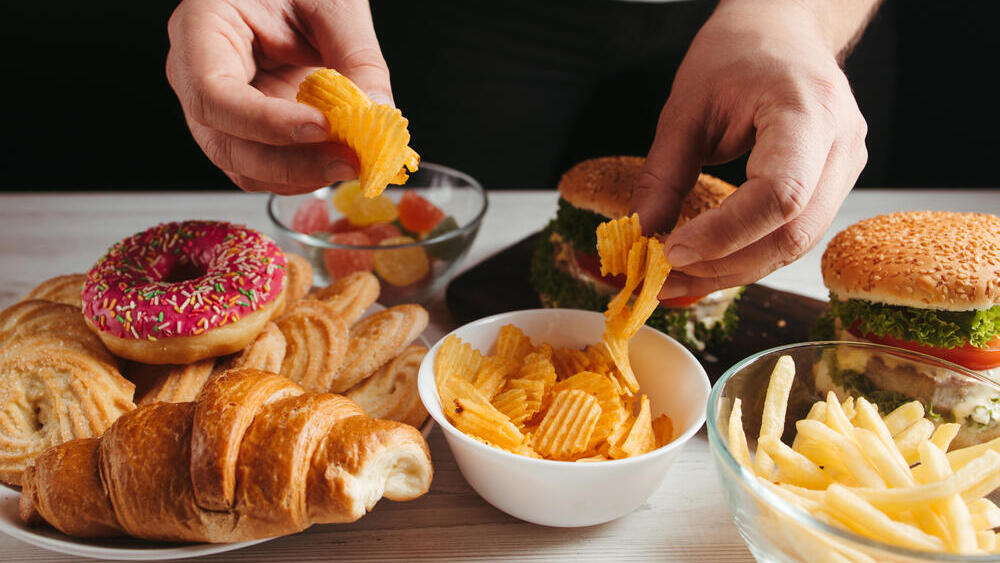
An overload of processed foods
(Photo: Shutterstock)
Brown University also explains that excess body weight increases strain on the heart: “The larger the body, the harder the heart has to work to pump blood. Extra weight adds volume, increasing resistance that the heart must overcome with each beat.”
Social media followers reacted with a mix of sorrow and warning. “Better not to test theories like this in real life. Rest in peace,” one user wrote. Another added: “It’s true—if you’re not used to junk food and fast food, it can really make you sick.” A third commented: “If ever there was a warning sign, this story is it.”

He gained 13 kg in one month
(Photo: Instagram )
Nuyanzin’s case isn’t an isolated one. In September, 36-year-old Belarusian bodybuilder Ilya Yefimchuk, known as “Golem,” also died of cardiac arrest. He reportedly consumed 16,500 calories daily to maintain his 158-kilogram physique. These cases reflect a broader problem in social media’s “transformation culture,” which often glorifies dramatic before-and-after results over safe, sustainable methods.
Health experts emphasize that any diet or fitness plan requiring extreme, rapid changes should be viewed with skepticism. They warn against challenges disguised as fitness experiments, especially those involving massive junk food consumption or sharp calorie spikes. Social media “transformations” may look dramatic, but often don’t reveal the full health toll.

A hamburger and two pizzas for dinner, a plate of pastries for breakfast
(Photo: Instagram)
Nuyanzin, a graduate of the Olympic Fitness School in Orenburg and the National Fitness University in St. Petersburg, worked as a personal trainer for a decade. Friends described him as “a bright soul,” “positive,” and “amazing,” with tributes flooding Russian social media. He had served eight months in prison for drug possession in 2022 before returning to his fitness career.
The message left by this tragedy is clear: the body does not easily forgive extreme eating or dieting. Nuyanzin hoped to prove that “anyone can lose weight, no matter their starting point,” but experts hope the real takeaway is different—slow, gradual change is safer, healthier and more lasting.