

A spectacular sight unfolded in the skies Sunday night, visible to billions across Asia, Europe, Africa and Australia: a total lunar eclipse, when the Earth blocks sunlight from reaching the moon. The event is often called a “blood moon” or “red moon.”
The name refers to the moon during the total eclipse phase, when some of the sun’s rays — those in the red wavelengths — pass through Earth’s atmosphere and bend into the umbra, the cone of total shadow. The result is a reddish glow, similar to the colors seen at sunrise or sunset.
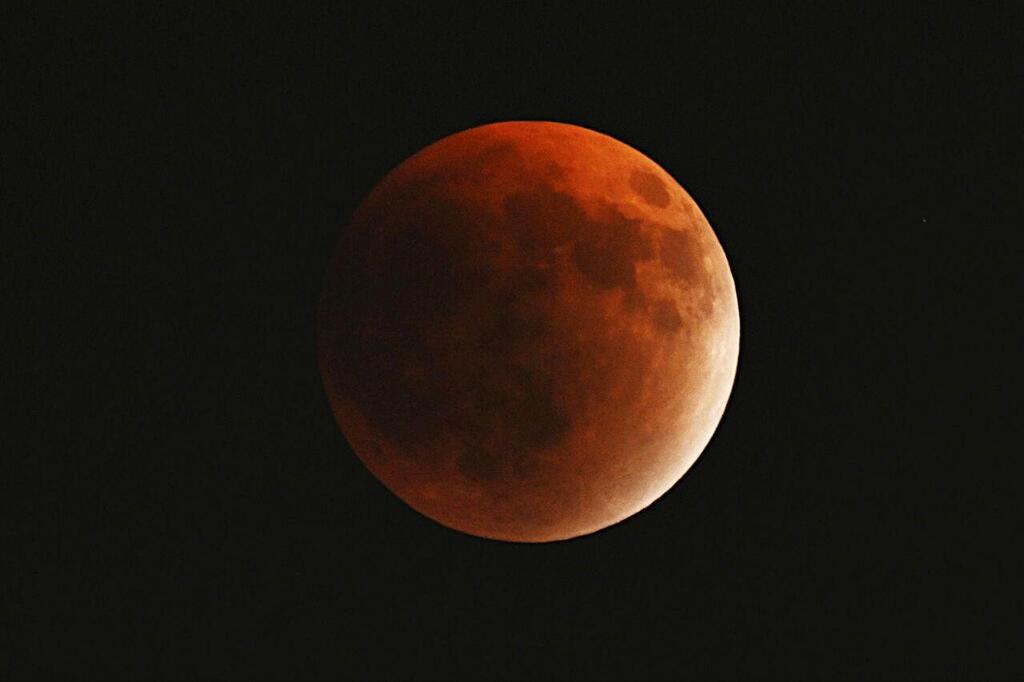
Lunar eclipse
(Photo: David Ben Or)
Why does a lunar eclipse occur?
A lunar eclipse happens when Earth passes directly between the sun and the moon. Since the moon reflects sunlight, it darkens when Earth blocks that light. This alignment can only occur during a full moon, in the middle of the Hebrew month.
Timeline of the eclipse (Israel time)
6:28 p.m. – The moon entered Earth’s partial shadow, though still below the horizon in Israel.
6:51 p.m. – The moon rose over Israel already partly in shadow.
7:27 p.m. – The moon moved into Earth’s full shadow, and a darkening became visible on its eastern edge.
8:30 p.m. – Total eclipse began.
9:12 p.m. – Peak of the eclipse.
9:52 p.m. – The moon began leaving the full shadow, with sunlight gradually returning to its western side.
10:56 p.m. – The moon exited the full shadow completely, remaining slightly dimmed.
11:55 p.m. – The eclipse ended as the moon left the partial shadow entirely.
What exactly is a ‘blood moon’?
During totality, Earth’s atmosphere filters out most colors of sunlight except red. These red rays bend around the planet and reach the moon, giving it a coppery hue. At the deepest point of the eclipse, fewer rays reach the surface, and the moon may appear extremely dim or nearly vanish from sight.
How to watch
The eclipse is visible anywhere on Earth where the moon is above the horizon, meaning more than half the globe can see it. In Israel, the eclipse is visible throughout all phases. No telescope or binoculars are needed, though using one can enhance the experience.
First published: 16:22, 09.07.25