

Another summer, another trend prompting large numbers of teenagers and young adults to put their health at risk without fully understanding the consequences.
This time, the trend is Contour Tanning, also known as Sunscreen Contouring — an attempt to turn the sun into a makeup tool. Instead of using bronzer or traditional contour makeup to define facial features, users apply sunscreen only to certain areas, such as the bridge of the nose, cheekbones, forehead or chin, while leaving other areas exposed. The goal is for the unprotected areas to tan more deeply, creating the appearance of natural shading and definition.
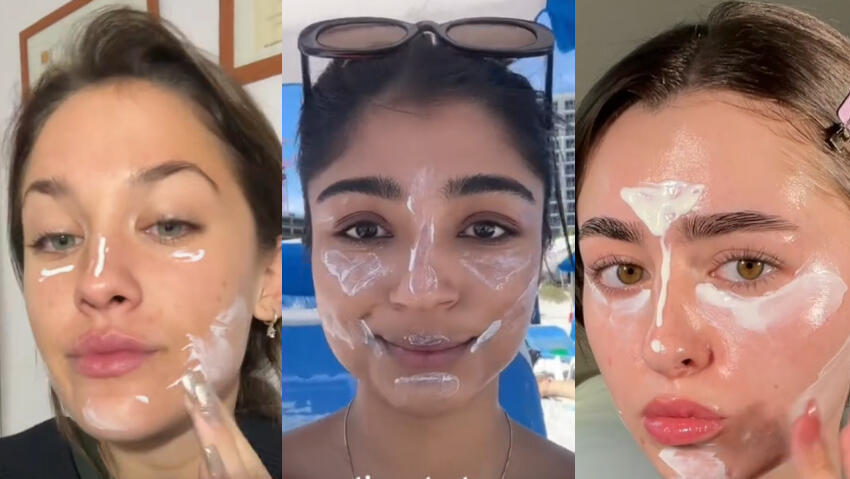
The Contour Tanning trend
(Photo: TikTok)
Some variations of the trend involve using different SPF levels on different parts of the face, while more extreme versions leave portions of the skin completely unprotected. Unlike conventional tanning, which is also dangerous when exposure is uncontrolled, this trend deliberately attempts to “sculpt” the face using ultraviolet radiation: one area is more protected, another is less protected or not protected at all. That is precisely what concerns dermatologists, who warn that the trend not only normalizes sun exposure but also makes avoiding sunscreen part of the method itself.
The trend did not emerge in a vacuum. It comes amid growing use of the UV Index by teenagers to time their tanning sessions. A measure originally designed to warn people about dangerous levels of sun exposure has, for some young people, become a tool for identifying when it is most “efficient” to go outdoors, to the beach or to the pool in hopes of achieving a faster, more noticeable tan.
The result is a troubling reversal: What is meant to serve as a warning about intense UV radiation is being reframed on social media as an opportunity to tan more quickly.
What has made the trend particularly viral is the gap between the immediate result and the actual damage. In a short TikTok video, viewers see a more tanned face, defined contour lines or what appears to be an innocent beauty hack. What they do not see is the cumulative damage: radiation penetrating the skin, cellular injury, sunspots and wrinkles that may not appear until years later.
For teenagers, who already live in a culture of instant results and constant self-documentation, the appeal is obvious. The cost, however, could be far greater than the temporary cosmetic effect.
The problem is that the “tan” at the center of the trend is not a neutral cosmetic process but rather the skin’s protective response to damage caused by UV radiation. According to the Centers for Disease Control and Prevention, most skin cancers are caused by excessive exposure to ultraviolet radiation from the sun, tanning beds and sun lamps, which can damage skin cells.
“It’s terrible and very alarming,” Dr. Ella Egozi, a dermatologist and medical director at Maccabi Aesthetics, told Ynet. “The UV Index is meant to encourage caution, to tell people when UV radiation is more dangerous and when they should avoid going out in the sun. Instead, those are exactly the times they want to tan.
“This is not some cute or harmless tan. The skin remembers those hours of radiation exposure and sunburns, and they can come back years later in the form of skin cancers, both melanoma and nonmelanoma skin cancers, whose incidence is increasing, as well as skin aging.”
 Dr. Ella Egozi Photo: Adi Orni
The primary danger of contour tanning, experts say, is that it is marketed as a lighthearted aesthetic solution while encouraging deliberate and uneven exposure of facial skin to UV radiation.
The face is one of the body’s most exposed areas, and participants in the trend are effectively identifying areas where they are willing to accept sun damage in exchange for a temporary contouring effect. Unlike makeup, which can be applied, blended and removed, sunlight is not precise. UV radiation reflects off surfaces such as sand, water and concrete, varies according to time of day, cloud cover, angle of exposure and UV levels, and can damage the skin even when people do not feel themselves burning.
As a result, someone who believes they are leaving only a small area exposed for a “nice tan” may actually receive broader and more unpredictable exposure than intended.
The CDC emphasizes that UV protection is important year-round, not just during the summer, and that UV radiation can reach the skin even on cloudy or cool days. In other words, although the trend is presented as a precise and controlled process, it involves exposure to radiation that cannot truly be controlled the way a cosmetic product can.
Dr. Alex Eltes, a dermatologist and sexual health physician, echoed those concerns.
“The tan you see is not a sign of healthy skin; it is a sign of skin damage,” he said. “A tan is a pathological finding. It indicates that cells have been damaged. In addition, 80% to 90% of the rate of skin aging is linked to what we call photoaging — aging that results from sun exposure.”
 Dr. Alex Eltes
According to Dr. Eltes, the cumulative damage is often visible to the naked eye. “For anyone over 30, it is very easy to see on the forearms,” he said. “Look at the inside of the forearm and then at the outside, and it becomes obvious how much damage the sun has caused.
“As someone who works in dermatology every day, I see many people who say, ‘If only I had known, I would have taken precautions.’ Years ago, awareness was not as widespread. In Israel, there was even a trend of deliberately ‘baking’ in the sun. Today, the awareness exists and the tools to prevent this damage are available.
“Sun exposure accumulates. The damage is cumulative. If skin could talk, it would not say ‘thank you’ — it would say ‘enough.’”
“The attitude of ‘we’ll deal with it when it happens’ is misguided,” Dr. Egozi added. “It stems from a lack of understanding of how the skin works. The skin remembers everything. Over time, it develops those diseases and tumors because radiation damage accumulates over many years.
“What they are doing now will affect them in the future. These are irreversible injuries. You cannot simply fix them later.” According to Dr. Egozi, the consequences extend beyond the risk of skin disease and are also reflected in the skin’s appearance.
“Today we are seeing more pronounced wrinkles, more facial pigmentation and signs of aging at much younger ages because of this obsession with sun exposure,” she said. “It is important to remember that there are safer ways to enhance appearance. For example, a tanned look can be achieved with makeup.”