

There are questions no manager likes to hear. What happens if the company’s largest client leaves? Can the organization continue functioning without the person at its center? And what remains of the business model if the product driving growth loses its relevance?
Organizations invest considerable effort in keeping such questions out of the boardroom. They present growth forecasts, emphasize success and build presentations designed to project certainty. There is a need for that: leadership cannot operate in a state of constant anxiety. But sometimes optimism stops being a source of momentum and becomes a screen that conceals risk, until reality asks the question for us.
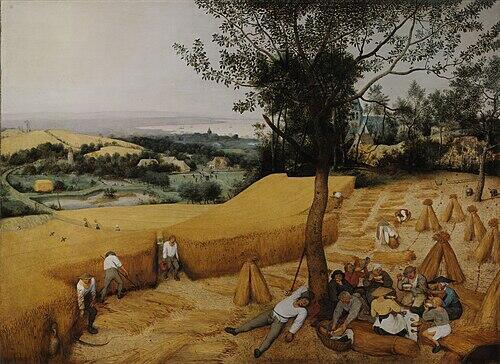
Pieter Bruegel the Elder - The Harvesters
The commandment of shmita, the sabbatical year, takes the opposite approach. Once every seven years, the farmer is required to stop cultivating the land. In an agricultural society, this is not merely a break from work. The land is the source of food, income and security. The Torah instructs a person to stop the very mechanism on which life depends, and then gives voice to the obvious question: “What will we eat in the seventh year, since we will not sow or gather our produce?”
The Torah does not rebuke the person who asks. It does not declare that concern itself reflects a failure of faith. It acknowledges the fear, gives it space and only then responds: “I will command My blessing for you.”
Rabbi Isaac Arama, author of Akeidat Yitzhak, sees shmita as an idea far broader than an agricultural promise. Continuous work and economic routine can create an illusion of complete control. A person sows, waters and harvests, and gradually begins to believe not only that these actions matter, but that they alone guarantee the future.
Shmita deliberately breaks that continuity. It reminds us that work is an essential means, but it is not the source of life itself. This is not a call for passivity or an abandonment of responsibility. On the contrary, it is an invitation to distinguish between responsibility and control, and between necessary effort and the illusion that every variable can be predicted and managed.
From this emerges a more mature understanding of security. Security is not a state in which there are no questions, anxiety or risk, nor is it a promise that everything will unfold according to plan. It is built when a person can confront the possibility of shortage, admit that not everything is under control and still preserve judgment, faith and the ability to act.
Weak leadership tries to silence the question, “What will we eat?” It fears that raising risks will damage morale or undermine employees’ confidence. Strong leadership invites the question into the room, not to create panic, but to replace false certainty with genuine resilience.
A healthy organization occasionally needs a shmita of its own: a deliberate pause in which it stops running on habit and examines what it truly rests on. What happens if its main source of revenue is damaged? Is critical knowledge concentrated in one person? Can the company operate without the founder’s daily involvement? And does a project that continues to grow still serve the purpose for which it was created?
The pause need not be dramatic. It can take the form of a management day devoted to underlying assumptions rather than next quarter’s results; a structured “what if” exercise; a process for transferring knowledge away from key individuals; or a temporary halt to a successful activity to test whether its present success is concealing future risk.
Armies conduct such exercises even when the system is strong. They do not wait for war to discover which scenario was never tested or what would happen if the chain of command were disrupted. Organizations tend to do so only after a crisis has already been imposed on them. By then, the room for choice has narrowed, pressure has increased and the cost of every mistake is higher.
Optimism cannot be sold without a plan. Saying that everything will be fine may offer temporary reassurance, but it is no substitute for cash flow, scenarios, alternatives and priorities. Resilience is not the refusal to imagine a difficult outcome; it is the ability to examine it without losing faith that it can be confronted.
Israel’s electricity market also illustrates this tension. Creating large market players may enable investment in costly infrastructure, but it can also raise concerns about concentration and market power. There is no single slogan that resolves the dilemma. Leadership and regulation must hold two valid questions at the same time, even when they pull in opposite directions.
There is also a warning here for managers: faith, vision and talk of resilience must not be used to ignore employees’ fears. The Torah does not leap directly from the commandment to the blessing; between them, it allows the human question to be heard. A manager asking people to change direction or endure a period of cutbacks must listen to their version of “What will we eat?” The manager must provide information, explain the plan and honestly define the risk. Trust is not built by demanding, “Believe in me,” but by being willing to discuss what may go wrong.
The innovation in Rabbi Arama’s interpretation lies not only in his understanding of shmita, but in the model of leadership that emerges from it. A leader is measured not only by the ability to preserve continuity, but also by the ability to interrupt it at the right time; not only by the ability to provide answers, but by the courage to allow the right question to be asked; and not only by the power to project confidence, but by the capacity to turn fear into diagnosis, diagnosis into a plan and a plan into action.
Before the next management meeting, choose one area that appears especially stable and ask: What underlying assumption does it depend on? What happens if that assumption proves false? Who can continue leading if the key person becomes unavailable? And what can be done now, from a position of strength rather than panic, to reduce that dependency?
Not every pause is weakness. Sometimes it is the only way to distinguish between movement and progress.
“What will we eat in the seventh year?” is not a failure of faith. It is the beginning of a more mature faith, one that neither denies risk nor becomes enslaved by it. The same is true in an organization: the question that briefly unsettles its sense of security may be precisely the question that prevents it from moving confidently in the wrong direction.