


How did Jewish children learn to write Hebrew 1,000 years ago? Manuscripts preserved in the Cairo Genizah offer a surprisingly familiar answer: They started with the alphabet, copied letters again and again and, whenever possible, found ways to make the repetition a little less tedious.
Researchers studying the Genizah have uncovered numerous examples of children’s writing exercises. Some contain the Hebrew alphabet written out in sequence, occasionally accompanied by childlike drawings. Other pages show individual letters practiced in different forms or with vowel markings.
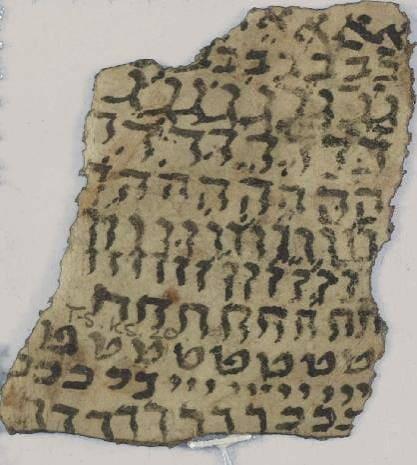
In some cases, the letters were enlarged, enclosed in decorative frames or written in different colors, evidence that teachers a millennium ago already understood that a little creativity could make learning more appealing.
But teachers and pupils in the Middle Ages also developed a considerably more sophisticated way to practice the alphabet.
Instead of repeatedly writing the letters "aleph", "bet", "gimel" and the letters that followed, students copied rhythmic phrases constructed to contain all 22 Hebrew letters, together with the five final letter forms known collectively as "mantzepach". Each character appeared only once.
One surviving example reads: "Hakets atsel dayakh minum, garesh kazav pen tosef khet" (Wake up, lazy one; enough sleep. Drive away falsehood, lest you add sin).
Another says: "Atah gochi tzur mibeten kol zo'em saf kodshecha napetz" (You brought me forth from the womb, Rock; shatter every raging one at the threshold of Your sanctuary).
Children copied such lines repeatedly, effectively practicing every letter in the Hebrew alphabet without simply reproducing a list. The verses were discovered decades ago and appear in dozens of Genizah fragments.
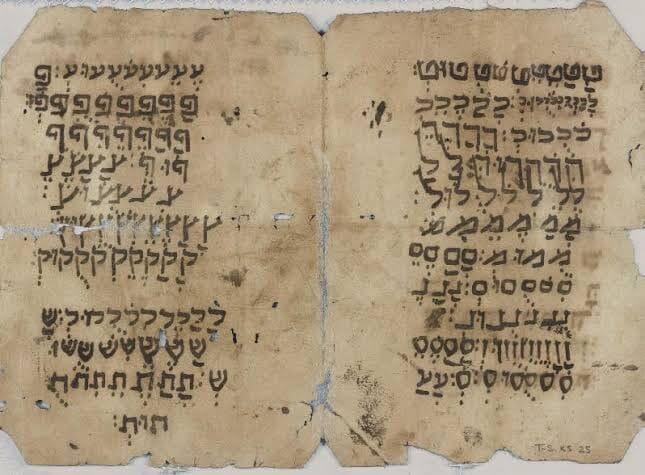
Hebrew letters as they were written about 1,000 years ago
(Photo: Cambridge University)
The exercises also carried a broader educational message. The opening "Hakets atsel" (Wake up, lazy one) urges the pupil to get out of bed and warns against laziness and sleeping late.
Another sentence preserved in the Genizah declares: "Etzlach chefetz gazar hashem, tov mikesef kinyan da'at" (God has decreed a desire for you; acquiring knowledge is better than silver), an almost ideal message for the start of the school year: knowledge matters more than possessions.
That final phrase was identified by Prof. Shulamit Elizur, a scholar of Hebrew liturgical poetry at the Hebrew University of Jerusalem and a member of the Academy of the Hebrew Language, in a Genizah fragment held at Cambridge.
“What is surprising is that these sentences were not merely technical exercises,” Prof. Elizur said. “They were intended to practice writing all the letters of the alphabet, but at the same time they conveyed an educational message to children: Get up, don't be lazy, persevere in your studies and value the acquisition of knowledge over material possessions.”
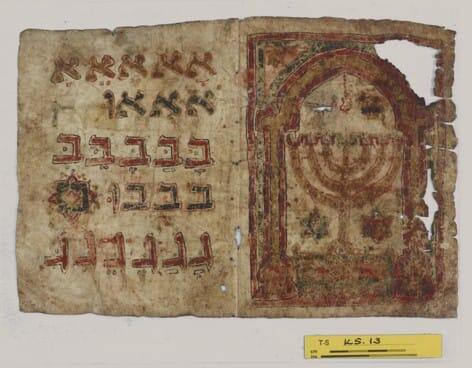
Students sometimes added drawings alongside the letters
(Photo: Cambridge University)
Between the ink stains, colorful letters and peculiar-looking verses, the Cairo Genizah provides a rare glimpse of the study desk of Jewish children living roughly a millennium ago.
Jewish communities in the medieval Islamic world may not have had branded notebooks, pencils or tablets, but they had teachers, pupils, exercises and word games. And they appear to have understood the message that learning can be enjoyable.