


Joseph ben Matityahu, better known as Josephus Flavius—the Roman name Titus Flavius Josephus given to him after his surrender—is a deeply controversial historical figure. The man who left his fellow Jews and joined the Romans ultimately became the principal chronicler of Jerusalem at the time of its destruction. Today, his writings remain the most important source on the fall of the Second Temple.
Born into a priestly family in Jerusalem, Josephus commanded Jewish forces in the Galilee during the Great Revolt against Roman rule. After his forces were defeated, he hid in a cave with a group of commanders. The others chose to kill themselves rather than surrender, but Josephus, the final survivor, emerged and gave himself up.
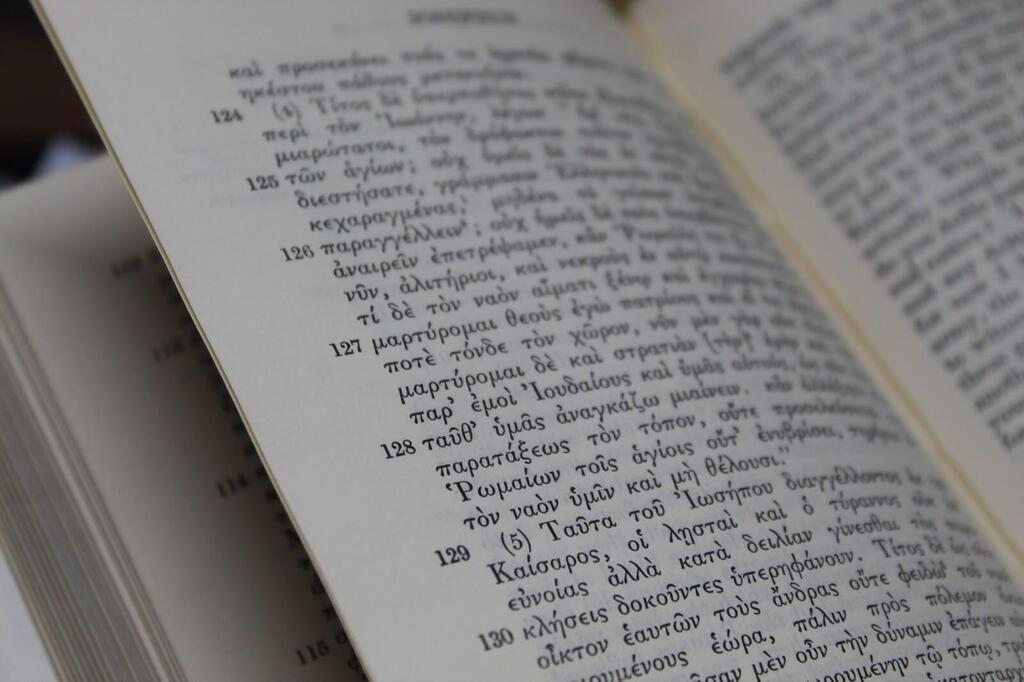
He was brought before the Roman emperor as a prisoner, but later developed close ties with the imperial authorities and became associated with Titus. Under Roman patronage, he documented the war for Jerusalem. His writings, particularly The Jewish War, are regarded as indispensable historical sources. Even critics who condemn his decision to abandon his people for their enemies rely on his accounts when studying the destruction.
Now, using advanced artificial intelligence tools and stylistic analysis of ancient Greek, researchers have achieved what was once considered nearly impossible: identifying where Josephus quoted known sources, where he drew on the writings of Nicolaus of Damascus, Herod’s court historian, and where he relied on other works that have been entirely lost.
The central finding could reshape the prevailing view of Josephus’ reliability. The project is a collaboration between the Holon Institute of Technology and Bar-Ilan University.
“When we read a person’s text, we examine their terminology and style, and that allows us to determine how much they are writing in their own voice and how much they are representing another source,” said Prof. Jonathan Schler of the School of Computer Science at the Holon Institute of Technology.
“We apply the same method to historical texts—not to learn what was written, but to learn who wrote it. In Josephus’ case, it is clear that he is the author, but the question was where he was truly writing independently and where he was relying on others. We did all of this through analysis of ancient Greek.”
Dr. Stéphanie E. Binder of Bar-Ilan University’s Department of Classical Studies said the project brought together historians and computer scientists.
“Josephus was an eyewitness to the destruction of the Second Temple, but he also wrote about much earlier periods,” she said. “He sought to prove that the Jews had always been a wise and respected people and to refute Greek claims against them. To do that, he collected many sources.”
The researchers focused on Nicolaus of Damascus, Herod’s personal secretary and court historian, who was the principal source for the Hasmonean period and the House of Herod.
“We asked whether Josephus copied him word for word, altered what he wrote or attributed to him things he never wrote,” Binder said.
She noted that The Jewish War was composed under the patronage of the Flavian dynasty, making it difficult to know how much freedom Josephus had. Jewish Antiquities, by contrast, was written years later, when he enjoyed greater independence.
“We compared the versions and examined where he was closer to Nicolaus,” Binder said. “The story remains the same, but the wording changes. Beyond that, we found signs that Josephus also used additional sources that he does not identify by name. The next challenge is to determine what those sources were.”
Schler said the ability to demonstrate stylistic changes computationally was itself a significant achievement.
“Until now, this was largely a hypothesis discussed by scholars,” he said. “Now it can be demonstrated in measurable terms.”
One example appears in Josephus’ account of Herod’s expansion of the Temple. In The Jewish War, Josephus writes that Herod told the people he wished to rebuild the Temple and that it would be the greatest of all his achievements.
In Jewish Antiquities, a parallel account says Herod announced that he intended to rebuild the Temple and that it would be the most magnificent undertaking of his reign.
A similar pattern appears in the account of the execution of Mariamne the Hasmonean, Herod’s wife. In The Jewish War, Josephus writes that after Mariamne was executed, Herod’s grief intensified and he mourned her as though nothing in life could console him.
In Jewish Antiquities, the account says that after Mariamne’s death, Herod was overcome by grief and could not forget the woman he had lost or the disaster that had befallen him.
Researchers also found parallels in the accounts of Herod’s death. The Jewish War says Herod ordered Antipater’s execution and died five days later. Jewish Antiquities gives essentially the same sequence: Herod commanded that Antipater be put to death, and five days afterward, his own life ended.
According to the researchers, the fact that these stories appear in both works with the same structure, similar details and closely related phrasing makes it possible to identify the sources Josephus used and distinguish between direct quotation and adaptation.
‘There was good reason to question his motives’
Noam Bar David, a doctoral candidate in Bar-Ilan University’s Department of Land of Israel Studies and Archaeology, said historians had long treated Josephus with suspicion.
“He wrote under the patronage of the Roman emperors, was adopted by them and received their name and financial support,” Bar David said. “There was therefore good reason to question his motives. He was also preserved primarily through Christian tradition rather than Jewish tradition. Some viewed him as a traitor and propagandist more than a historian.”
That is what made the findings so surprising.
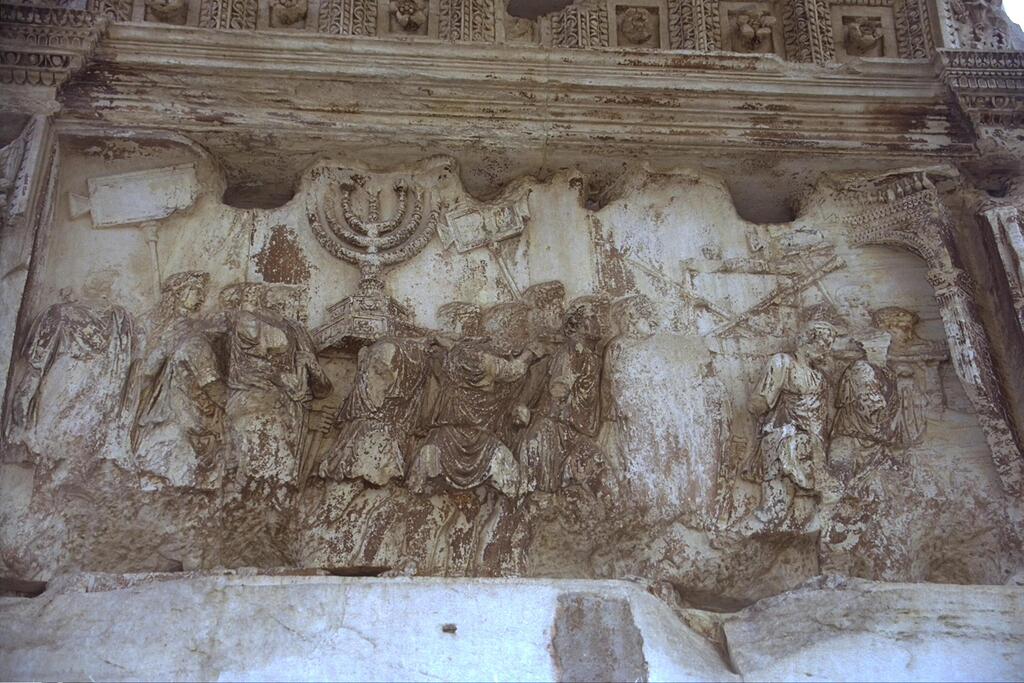
Relief of the Temple menorah on the Arch of Titus in Rome
(Photo: GPO)
“When we applied a new test to his texts, we found that when Josephus says he is quoting a source, he really is quoting it,” Bar David said. “The language of Nicolaus of Damascus is preserved consistently throughout the quotations, so Josephus’ attributions are reliable.”
Bar David stressed, however, that Josephus’ interpretation should still be treated critically.
“He portrays the Jews as people swept along by extremist groups and argues that, without those groups, harmony with the Romans would have been possible,” he said. “Here, we have reason to suspect that he was serving a political interest. We can trust the technical details he provides while questioning the way he describes the atmosphere and the motivations.”
The broader historical context is also important, he said.
“The Great Revolt took place during a crisis across the Roman Empire,” Bar David explained. “Nero persecuted Christians, devalued the currency and contributed to an economic crisis. The Flavian dynasty later came to power and stabilized the empire.”
Vespasian suppressed the revolt in Judea, and wealth seized during the campaign was used to build some of Rome’s most prominent imperial monuments, including the Colosseum. A rediscovered inscription indicates that the structure was financed with war spoils—in effect, with wealth taken during the suppression of the Jewish revolt.
“Josephus clearly had extraordinary talent,” Bar David said. “He began as commander of the revolt in the Galilee, met the most senior Roman commander and, instead of being killed, became a protégé of the emperors. That suggests rare rhetorical ability.”
Although questions about his credibility followed him throughout his life, the new study found that when he explicitly names a source, he represents it faithfully.
Binder also sees ideological continuity between Josephus’ worldview and later rabbinic tradition.
“There are no military heroes in the Talmud either,” she said. “Those who attempted to fight the Romans ended badly. The approach that prevailed was that of Rabbi Yohanan ben Zakkai: the Torah and the people must be preserved, and through that preservation, the divine plan will be fulfilled.”
Bar David said Josephus likewise regarded events as part of a divine plan, which became part of his justification for surrendering.
“When he gives himself up, he argues that his death would have benefited no one,” Binder said. “But as a historian, he could preserve the memory of Judaism and find a place for it in the civilized world. From his perspective, joining the Romans was not an act of betrayal, but another way of acting on behalf of the Jewish people.”