

Are the best people in your organization also your greatest risk?
There are moments in an organization when you look at a brilliant employee — proactive, sharp, highly motivated — and ask yourself how it was specifically he who caused the greatest damage.
Not out of negligence or laziness, but on the contrary: from an excess desire to contribute.
This phenomenon is far more common than it seems. A team that bypasses procedures “to move faster.” A manager who makes decisions alone because “there’s no time to wait.” A creative initiative born of passion that ends up breaking the system from within.
Gallery

Sometimes the most motivated and capable employee causes the greatest damage to a business from an excess desire to contribute
(Illustration: ChatGPT)
It is precisely here that the sharp insight of Rabbi Isaac Arama, in his interpretation of the death of Aaron’s sons, becomes relevant. On the surface, these were the holiest individuals - acting from an excess desire to contribute — with immense enthusiasm in their service of God. And yet, they are punished severely. This was a peak moment: the Tabernacle had just been completed after six months of preparation involving the entire people, from Bezalel to the last participant. These two exalted figures sought to honor the moment with a ritual of incense offering — yet they were struck down on the spot.
The author of Akedat Yitzhak offers a counterintuitive reading: the problem was not only in the act, but in the approach. They entered a space where they were required to step back. They acted from holiness, but not from obedience and from desire, but without boundaries.
This is a sharp managerial insight: you can fail precisely because you are too good, too proactive, too eager.
The lesson is especially relevant to management. A healthy organization relies not only on talent, but on structure — hierarchy, process and discipline. Not because creativity should be stifled, but because there are contexts in which unrestrained creativity becomes a risk.
There are situations where the most dangerous employee is not the one who does nothing, but the one who does too much — without a framework.
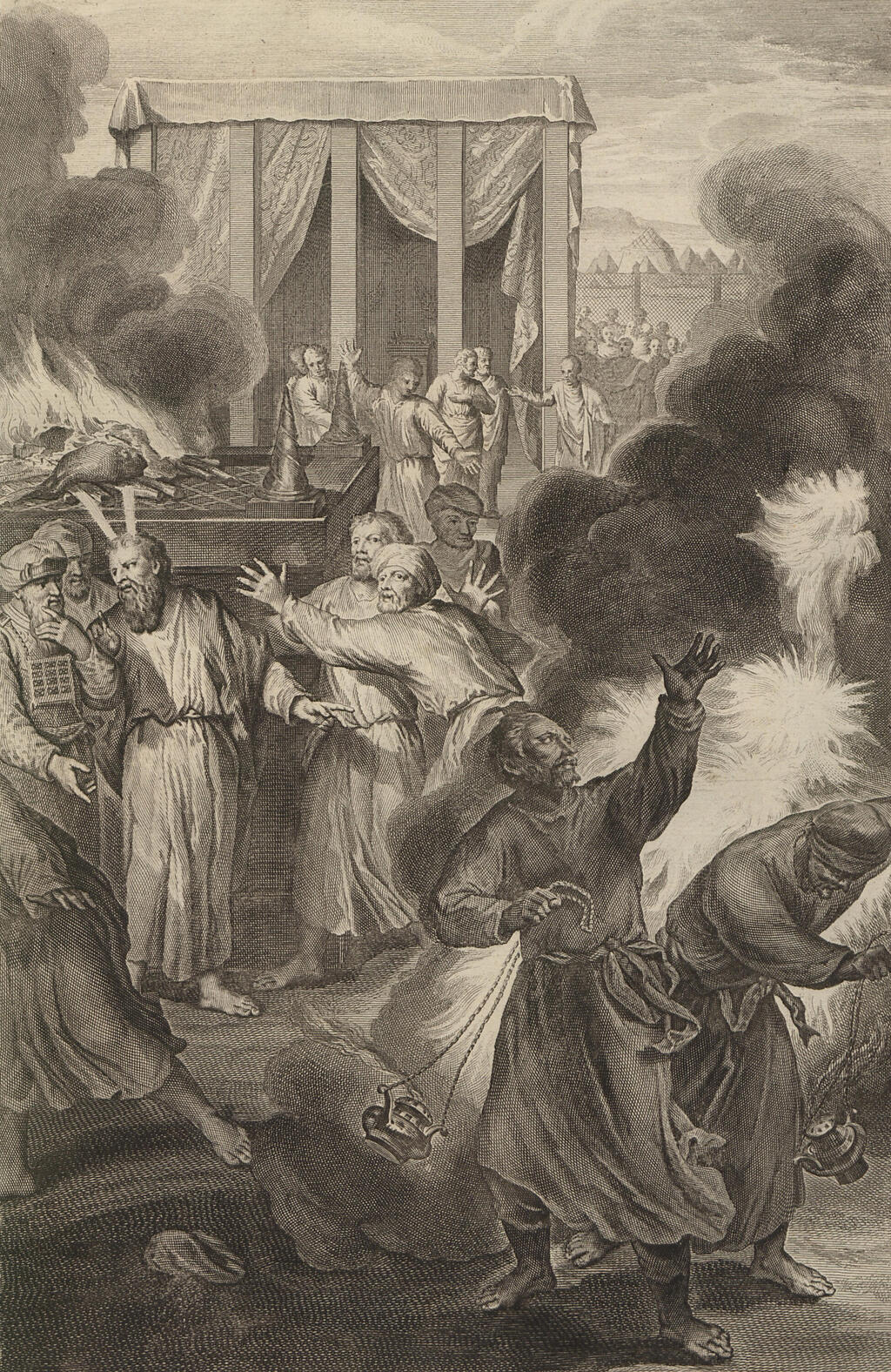
Nadab and Abihu consumed by fire from the Lord; illustration from 'Figures de la Bible' published by P. de Hondt in The Hague in 1728
(Photo: National Library of Poland, Public domain, via Wikimedia Commons)
This aligns with Aristotle’s philosophical concept of moderation, the Golden Mean: virtue lies not in extremes but in balance. Courage, when unbalanced, becomes recklessness. Initiative, when unchecked, becomes harmful.
In managerial terms, not every initiative is a virtue. Initiative without boundaries is a risk.
Modern leadership likes to speak about empowerment, freedom and thinking outside the box — and rightly so. But there is a fine line between empowerment and loss of control, between initiative and rule-breaking, between passion and a hidden ego that seeks to dictate the way forward.
The message of the Akedah is clear: not everything that feels right is right. There are moments when true greatness lies in the ability to stop.
I have seen this repeatedly in the business world. Large projects, especially high-potential ones, begin with good intentions — and then begin to drift. Often for good reasons: a bit more budget, another adjustment, another “small” deviation. Without clear boundaries, it quickly becomes a bottomless pit. That is why experienced managers define not only the goal, but also the limits of deviation in advance.
This is evident in the global business arena as well. United Airlines recently announced significant price increases on domestic flights, partly due to rising energy costs. It is not a “pleasant” decision, but it reflects a simple principle: the ability to set limits, even when it is unpopular. An organization that fails to do so may pay a far heavier price.
The real managerial question is not only how talented your people are, but whether they know how to operate within a framework. Do they know when to stop? Do they understand that not every boundary is meant to be broken?
Because, ultimately, organizations do not collapse due to a lack of talent — they collapse when talent operates without discipline.
And the greatest tragedy? Sometimes, those are exactly your best people.