

In the weekly Torah portion Beha'alotcha, the frameworks of the previous portions seem to be breached. We encounter the famous verses: "And it came to pass when the Ark journeyed, Moses said: Arise, Lord, and let Your enemies be scattered, and let them that hate You flee before You. And when it rested, he said: Return, Lord, to the tens of thousands (revavot) of the families of Israel".
These verses are uniquely bracketed by inverted "Nun" Hebrew letters before and after them and the Talmud quotes Rabban Shimon ben Gamliel, stating that in the future, this specific section is destined to be uprooted from here and written in its proper place. But where is its actual place? Rav Ashi answers that it fundamentally belongs in the section of the banners detailing the camps and military formations that marched into the land.
Gallery
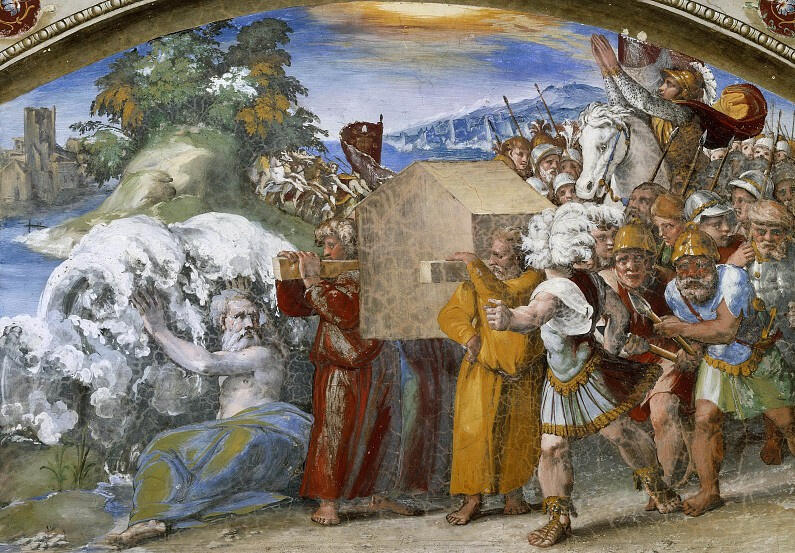
The painting 'Israelites Crossing the Jordan Carrying the Ark of the Covenant' by Raphaelin 1500, which hangs in the Vatican
(Photo: Wikimedia Commons)
Identity versus mission
In the first chapter of the Book of Numbers, a military census establishes the camp's structure around the central Tabernacle. The Levites are explicitly appointed over the "Tabernacle of the Testimony" - to carry it, camp around it, and guard it. In the second chapter, the order of tribes is listed differently, because the focus shifts to the journey, the triumphant march into the Land.
Almost unnoticeably, the spiritual center's name changes from chapter to chapter. In the first chapter, it is called the "Tabernacle" or the "Tabernacle of the Testimony." In the second chapter, it is termed the "Tent of Meeting."
This reflects two different stages. The Book of Numbers begins by building a nation through a military formation around a Tabernacle containing the "Testimony" - the Tablets of the Covenant written by God. Therefore, the Levites are entrusted with the Tabernacle, carrying it and keeping its charge. The purpose is not to guard or protect a holy object; it is a rooted center that actively builds identity. This identity-building begins with Reuben, the natural firstborn, because identity is built from natural birthright and roots. The "Testimony" signifies the unique identity of those carrying the values of the Tablets, testifying about Israel.
The second chapter changes the language and order of the tribes because it marks the next phase. It begins with Judah's camp, who "shall journey first," shifting the core question from "who are we" to "where are we going." Only after a solid identity is constructed can a mission truly begin, as a mission without identity inevitably falls apart. Consequently, the text transitions to the "Tent of Meeting" - the designated place for convening everyone. The identity-establishing Tabernacle is simultaneously a center that summons, gathers, plans and motivates.
The Two Faces of Chapter 10
Reflecting these two aspects, in this week’s torah portion, the tenth chapter is fundamentally divided into two parts. The first part outlines the command to make silver trumpets for summoning the congregation or the leaders to the "Tent of Meeting." In the second part, the cloud ascends, Judah journeys first, the Tabernacle is dismantled, and the Levites carry its parts in the center of the advancing column.
Suddenly, an unexpected drama unfolds: the Ark of the Covenant journeys three days ahead of the camp to seek a resting place. Contrary to the plan where the Tent of Meeting travels in the middle, and unlike earlier descriptions where Levites carry the sanctuary, the Ark suddenly advances ahead. Rashi distinguishes between this advancing Ark containing the broken Tablets and the central Ark with whole ones, while other commentators suggest there was only one Ark, taking this unique first journey. Either way the focal point forcefully shifts to the vanguard, pulling the camp forward.
This sudden breakout was intended to mark a destination. The Ark advancing three days ahead has functionally already entered the Land of Israel to scatter enemies ahead of Israel's arrival. It signals exactly where divine values engraved on the tablets will spark a revolution. The rare Hebrew word “revavot," meaning "tens of thousands," is a military term, as it is said in the blessing to Rebecca: “Our sister, may you become thousands upon myriads (revava), and may your descendants possess the gate of their enemies."
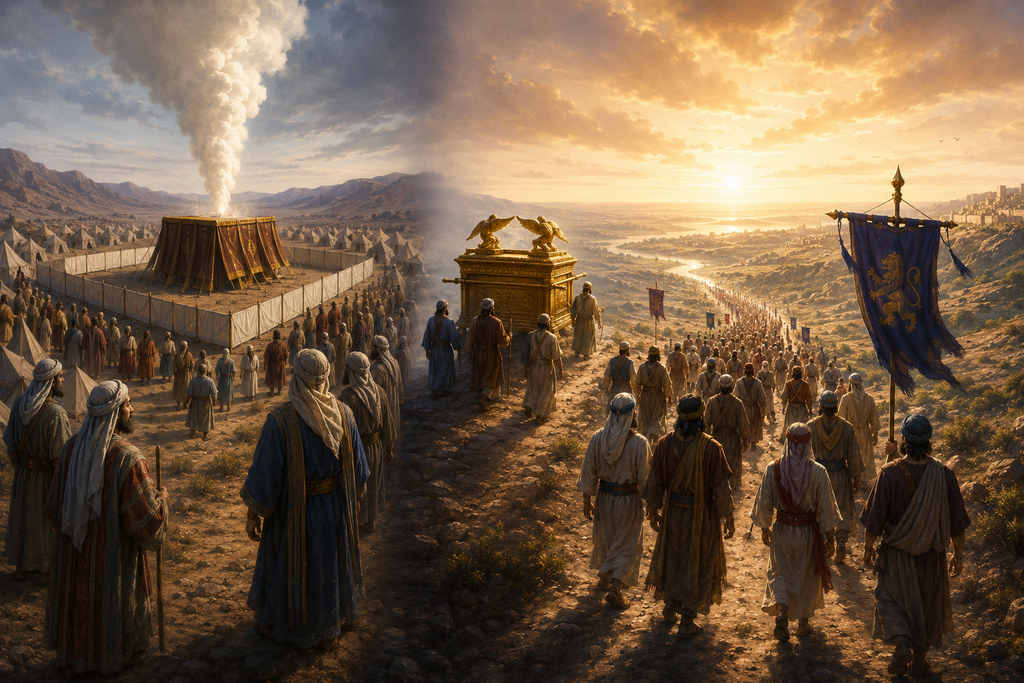
(Photo: Illustration generated by ChatGPT)
The vision is that the tens of thousands of Israel's army eventually return to settle their homeland. Therefore when taking out the Torah scroll for reading the prayer places 'When the Ark journeyed' alongside the verse from the book of Isaiah (2:3): “For Torah shall go forth from Zion and the word of the Lord from Jerusalem."
The danger of disconnection
Herein lies an enormous danger: when the Ark detaches, divine values lunge ahead of the people. The Tabernacle, still in the camp, risks remaining just an empty physical structure. In chapter 11, plans unravel as the nation complains, lusts for meat, and weeps "every man at the door of his tent," showing society on the verge of total collapse. Despite all efforts, something forcefully pulls the people backward because their values, having bolted forward, detached from them. Moreover, they completely failed to notice another significant change: the protective cloud that was supposed to shift from over the Tabernacle did not go forward as planned to mark the right way, but instead rested over the entire nation itself.
The nation failed to perceive this change and its calling that they now must take responsibility upon themselves. So they complained, and longed to return to Egypt as slaves devoid of responsibility.
We see a parallel misunderstanding of Holiness in the Book of Samuel, where Israel brings the Ark to battle against the Philistines. Israel cheers, and the Philistines heavily dread the arriving "mighty gods." However, they lose the war and the Ark is captured. The Ark is absolutely not a military amulet; it contains God's word and is meant to elevate the human spirit. In Samuel, they attempted to use holiness for victory without internal, human, change.
Back to Beha'alotecha: due to the shift from national resilience to weeping at private tents of lust and personal worry, 70 elders are urgently brought to the Tent of Meeting to be the right bridge and to reconnect the people to Torah values. They are not a substitute for the Ark. Seventy symbolizes a broad spectrum of humanity, of the people, of diverse opinions that interpret differently the same spirit that comes from Moses. They are meant to fill the void created when the Ark bursts forward.
The Ark marks where they are going; the elders must mediate the event, serve as a prism for the spirit, and connect the people across their full spectrum on the way to rest and inheritance.