

A Jewish student in Australia testified that what began as a “low level of hum of antisemitism” on campus developed into more extreme expressions, including Nazi salutes and labels such as “baby killer.” Excerpts from the student’s testimony and other testimonies from Jewish Australians were published by Australia’s ABC.
Liat, a student at the Australian National University (ANU) in Canberra, testified Monday before the Royal Commission into Antisemitism and Social Cohesion, as part of hearings examining hostility directed at Jewish students and faculty members at universities across the country since the Oct. 7, 2023, Hamas terrorist attack. The commission was established following the Bondi Hanukkah massacre, in which 15 people were killed.
Liat, who chose not to reveal her full identity due to security concerns, said she grew up in a Jewish community with a strong connection to Zionism, which she described as the right of Jews to self-determination in their historic homeland. She said that when she began studying at the university in 2022, she tried to become involved in campus activities and approached the Middle East student club.
She was surprised to be told "you're not Middle Eastern, you're Jewish" and that it was not the right club for her.
Later, she said, she was exposed to antisemitic comments presented as jokes.
Liat described "a low level hum of antisemitism" in the form of "unsavoury jokes" like people mentioning big noses and Jews being good with money.
“I didn't feel that I was capable of pushing back against that, regardless of how inappropriate it was,” she told members of the commission.
However, she said the atmosphere on campus changed significantly after Hamas’ attack on Israel on October 7, 2023. Liat said she felt "numb horror and terrible foreboding" about what was to come on campus.
According to Liat, some of her non-Jewish friends distanced themselves from her, and one told her he could no longer be friends with her because she was a Zionist.
“I was very taken aback and deeply hurt,” she said.
Violent riots against Jews in Melbourne, Australia
(Video: Shani Shimon)


Liat said a protest encampment against Israel that was set up on the university campus for 110 days created a sense of distress and insecurity among Jewish students. She said protesters at the encampment called her and other Jewish students “baby killers” and “supporters of genocide.”
“I'm also a pretty small person and, I think in that sense, I felt very physically unsafe,” Liat told the commission.
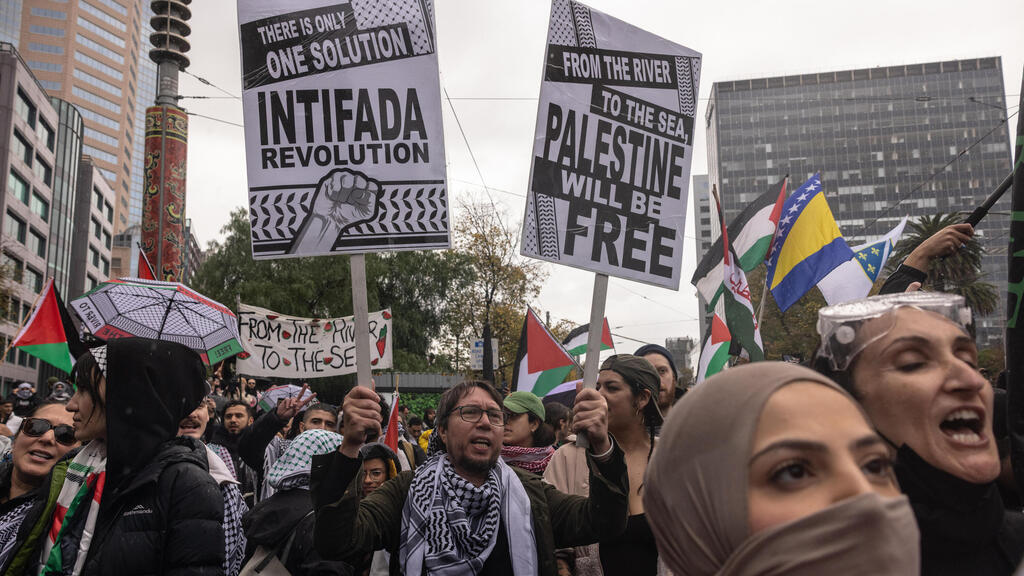
She stressed that the use of a Palestinian flag is not necessarily antisemitic, but said the widespread use of certain symbols and slogans created an atmosphere that enabled antisemitic expressions.
She specifically mentioned the key slogans that caused distress were "intifada revolution" and "from the river to the sea Palestine will be free".
Liat added that during the period of protests, she began hiding her Jewish identity in her daily life on campus as best she could, such as not giving her real name when she bought a coffee on campus.
“That series of micro calculations that you make every single day in every single instance is exhausting,” she said.
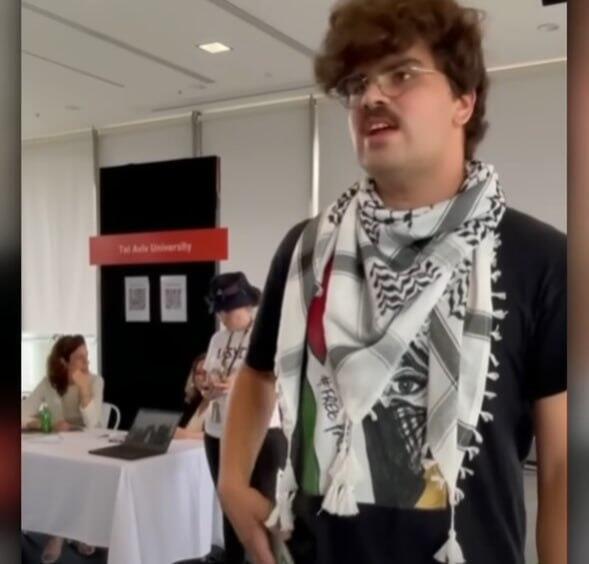
Pro-Palestinian protesters inside the University of Sydney
(Photo: YouTube screenshot)
Liat said that during a counter-protest organized by Jewish students at the university, a person unaffiliated with the institution arrived and performed a Nazi salute toward them. She also testified that during a Zoom meeting of the student association, other students told her that while she was speaking, people directed Nazi salutes at her and made a gesture imitating Adolf Hitler’s mustache.
“I was scared,” Liat said after her testimony. “Living by yourself is hard enough. When you're confronted with what is a surge of hatred against you and your community it's very difficult.”
The hearing also included testimony from a researcher and former lecturer at the University of New South Wales (UNSW), who was identified by the pseudonym ACJ. He said that during a business class he was teaching, four students performed Nazi salutes toward him.
“I was incredibly shocked and offended and threatened,” he told the commission.
He said the fact that his grandparents were Holocaust survivors and that his family had experienced persecution and pogroms in Poland made the incident especially profound for him.
“So when someone does a Nazi salute at me it feel like they want to kill me,” he said.
According to ACJ, the university’s response was “offensive” because it limited itself to verbally warning the students and did not treat the incident as a criminal offense. He said he reported the incident to police himself, and afterward he was no longer offered casual teaching positions at the university.