

We are used to thinking that power means movement. That leadership is measured by presence, that influence requires direct control and that the greater the challenge, the more a leader must be everywhere, make every decision and be involved in every detail.
But one of the most surprising insights into leadership appears in the Torah portion of Balak — and, quite unexpectedly, through an ox.
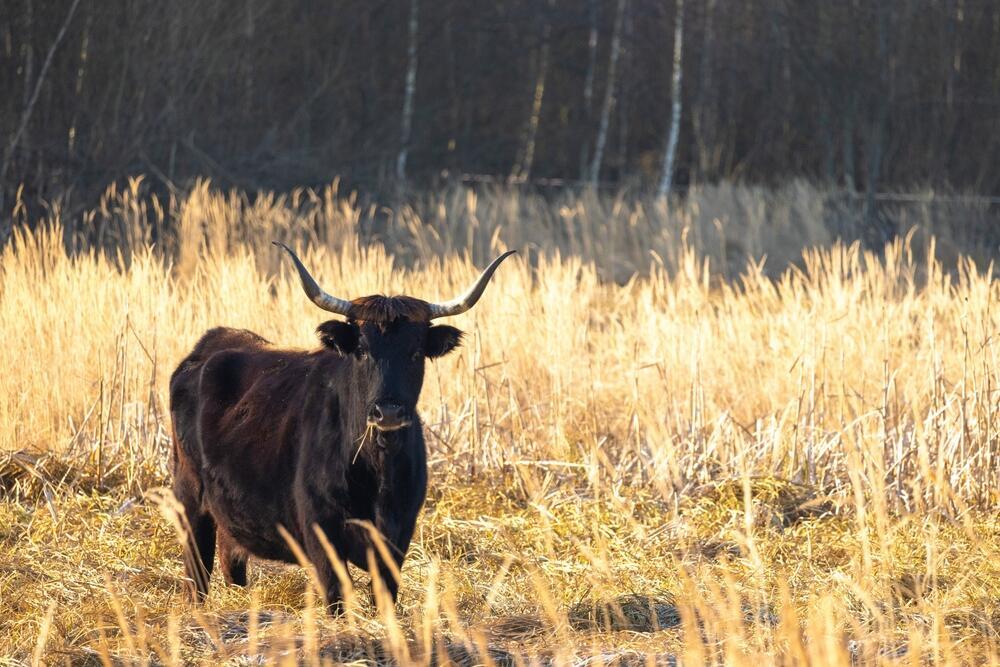
An ox
(Photo: Viliam.M/Shutterstock)
When the elders of Moab look at the people of Israel, they say: “Now this multitude will lick up all that is around us, as the ox licks up the grass of the field.” The image is not obvious. An ox is not a predator. It does not chase its enemies or charge across great distances. Why, then, was it chosen to describe the strength of the people of Israel?
Rabbi Isaac Arama, author of “Akedat Yitzchak,” pauses over this question and offers an especially original and profound interpretation. He says that for years he struggled to understand the meaning of the metaphor, until he watched cattle grazing in a field. He noticed something interesting: The ox barely moves its body. It stands in place, but its long tongue stretches to the sides, curves like a sickle, gathers the grass around it and brings it in. The body remains steady, but its influence reaches far.
On the surface, this is a biological description. In fact, it is one of the deepest ideas about leadership.
We tend to think influence requires constant movement. The larger the organization, the more complex the market and the greater the challenges, the more it seems a manager must be in every meeting, every decision and every center of activity. But Rabbi Isaac Arama suggests the opposite: Strength is not the ability to reach every place, but the ability to have an impact even in places where you are not present.
This may be one of the most important distinctions in modern management. Weak managers run from event to event. They respond to every crisis, answer every message, attend every discussion and try to be present in every arena. Their center of gravity is always outside themselves.
Strong leaders, by contrast, build systems. They develop a shared language, organizational culture, values, processes and decision-making mechanisms that continue to function even when they are not in the room. They do not need to be everywhere, because their influence is already there.
In this sense, the ox’s tongue becomes an extraordinary metaphor for leadership. It is not the horns that symbolize power, but the tongue.
The philosopher Hans-Georg Gadamer wrote that people live within language no less than they live within reality. The language we use shapes how we think, act and understand the world. Leadership, in this sense, begins long before decisions are made. It begins with words, values, narrative and organizational language.
Vision, culture, trust and shared language are the invisible tools through which leaders exert influence from afar.
As a CEO, I have had to work over the years with teams in Korea, London, New York, San Francisco, Germany, China and Israel. Management was not based in one place, employees worked across time zones and the organizational culture had to remain consistent despite the distance.
The central challenge was not only to manage meetings or meet revenue targets. It was to create a shared language — to establish mechanisms, regular meetings, values and ways of working that would allow people to make decisions even when the CEO was on the other side of the world.
In retrospect, I understood that global leadership is not the ability to be everywhere. It is the ability to ensure that the organization functions properly even when you are not there. That requires discipline, strong management, trust and, above all, sustained investment in organizational culture.
Financial markets teach the same principle. A single decision by the U.S. Federal Reserve, or even the expectation of an interest rate increase, can affect markets around the world. The strengthening of the dollar recently, against the backdrop of expectations for further rate hikes in the United States, affects companies, investors, countries and currencies worldwide.
The interest rate itself does not move from country to country, but its influence reaches far. In a sense, this, too, is the “tongue” Rabbi Isaac Arama describes — power that operates far beyond the place where it is located.
Perhaps this was also Moab’s real fear. They were not afraid only of Israel’s army. A boundary can be placed against an army. They feared a people capable of exerting influence far beyond its physical location — a people whose ideas, values and culture were already operating in the surrounding space.
In one of the songs I wrote, “Roots With Wings,” these lines appear:
“I have roots deep in the earth,
and wings facing the great wind.
What remains after me is not only the road,
but the seeds left behind to grow.”
Perhaps that is precisely the challenge of leadership: not only to reach the next destination, not only to be present in every discussion or make every decision, but to build roots deep enough and wings broad enough so that the organization continues to move even when the leader is not everywhere.
Rabbi Isaac Arama’s management lesson is simple but profound: Do not ask how far you can go. Ask how far your influence reaches even when you remain in place.
Because true leadership is not measured by the number of meetings, flights or decisions a leader makes personally. It is measured by the ability to build an idea, a language and a culture that continue to operate even when the leader is not in the room. In the end, great leaders are not those who are everywhere — but those whose influence is everywhere.
- Ziv Elul is a partner at the venture capital firm BGV and serves as an investor and board member for several startups and investment funds.