

Throughout history, the weekly Torah portion of Korach has generated numerous interpretations regarding the true motives behind the rebellion of Korach, Dathan and Abiram and the 250 leaders they gathered. Commentators have suggested the dispute was driven by honor, greed, religious fanaticism or ecstasy, nepotism, or simply an urge to instigate conflict. Historically, numerous commentaries viewed this narrative as a reflection of the specific issues or personalities troubling their own generation of Jews. However, I would suggest that the Torah uses this story to depict a profound struggle against the "continuous present," urging us to break free and move forward.
The defiance of 'Lo Na'aleh'
The core of this resistance is found in the response of Dathan and Abiram. When summoned by Moses, rather than simply saying "we will not come," they replied with a surprising phrase: "We will not go up" (Lo Na'aleh), and complained that Moses had taken them out of Egypt - ironically and diabolically calling Egypt a land flowing with milk and honey, only to let them die in the wilderness, and failing to bring them to an inheritance of fields and vineyards.
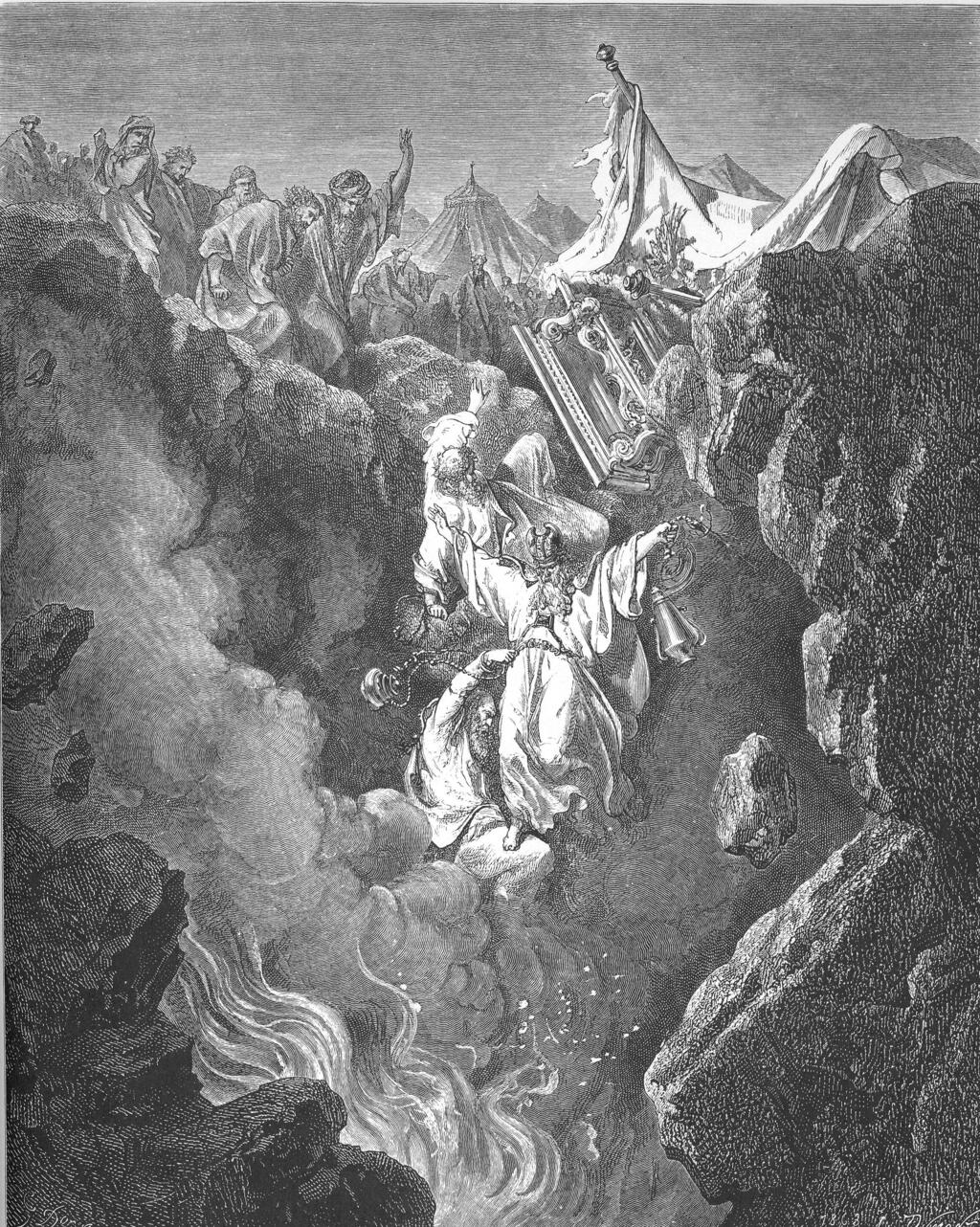
The death of Korah, Dathan, and Abiram by Gustave Doré, 1866
(Photo: Wikimedia Commons)
Their use of the word "go up" represents a deep defiance against the central theme of the Book of Numbers: the physical and spiritual ascent to the Land of Israel. While the Midrash connects Dathan and Abiram to the quarreling Hebrews in Egypt, an alternative view suggests that Dathan and Abiram, began the wilderness journey as young men, so they were exempt from the decree of dying in the wilderness, which applied to all those who were above the age of 20 at the time of the sin of the spies. Therefore, their declaration is a dramatic refusal to participate in the nation's upward movement toward the future. They were not eternal troublemakers, but rather frustrated individuals worn out by years of aimless wandering. Through venomous rhetoric, they sought to transform the nation's hope into despair. As a result, they suffer the ultimate inversion of ascent: the earth swallows them, and they go down into the abyss.
Tragically, they lost their patience just as the journey is nearing its end. Dathan and Abiram's demand for a "field and vineyard" uses terminology the Israelites specifically employed when they were very close to entering the Land. Once the Israelites requested from Edom and Sihon, King of the Amorites, permission to pass through their kingdoms on the way to the Land, they promised "we will not pass through fields or vineyards." Dathan and Abiram's language reveals the deep despair of people who can sense the finish line but interpret every delay as a leadership failure, giving up right before the end.
In the later census, Dathan and Abiram are mentioned as Reubenites who died, implying they were originally meant to inherit the Land. And the story of Zelophehad's daughters requesting a portion of the land in their fathers name, while mentioning that he was not part of Korach’s rebellion, also hints that, under normal circumstances, Korach's followers would have received their portion.
Endurance vs. short-sightedness
This dynamic is a recurring human tragedy. The difference between a good basketball player and a truly great one is revealed in the final minute under immense fatigue by showing who stays focused and who yields. Life, however, has neither a clock to tell us the game is almost over, nor a final series that can be won in four games - or five. True leadership and nation-building require immense endurance and demand that we not yield to the exhaustion of long processes.
It appears that the remaining members of the tribe of Reuben also were lacking in patience and endurance - and not only Dathan and Abiram. The tribe of Reuben showed a lack of patience by settling prematurely on the eastern bank of the Jordan River, prioritizing immediate grazing area suitable for the livestock they possessed at that time, over the Promised Land, a land flowing with milk and honey. As Rashi explains, their haste ultimately cost them a much brighter future.
Today’s challenge
Today, we find ourselves over two and a half years into a grueling, multi-front war, following a global pandemic and intense internal division. Our primary challenge is to continue forging a path and ascending toward a better future, refusing to surrender to physical or spiritual fatigue. We must actively support our soldiers, our defenders on the front lines and those holding down the family and fort at home. We must ignore the modern echoes of Dathan and Abiram - voices that promote cheap populism, inflame spirits and highlight only what we have not yet achieved. If we maintain our endurance, these destructive voices will fade, and our future will be secured. Am Yisrael Chai.