

As we conclude the Book of Numbers with the double portion of Matot-Masei, numerous events unfold in rapid succession: the laws of vows, the Midianite war, laws of purity, the journeys of the Israelites, and the division of the land. Today, I want to focus on the tribes of Reuben and Gad requesting their inheritance on the eastern bank of the Jordan River, and the severe pushback they received.
Seeing that the eastern bank was ideal grazing land for their vast herds, Reuben and Gad approached Moses and the leaders, asking: "Let this land be given to your servants as a possession; do not take us across the Jordan." Moses responds blisteringly: "Shall your brothers go to war while you sit here!? Why do you dissuade the hearts of the Children of Israel?" He compares them to the spies who destroyed the national morale, calling them a "culture of sinful men" who will "destroy this entire people." The tribes quickly counteroffer: they will build pens for their flocks but serve as the military vanguard until the entire land is conquered. Moses agrees to this condition.
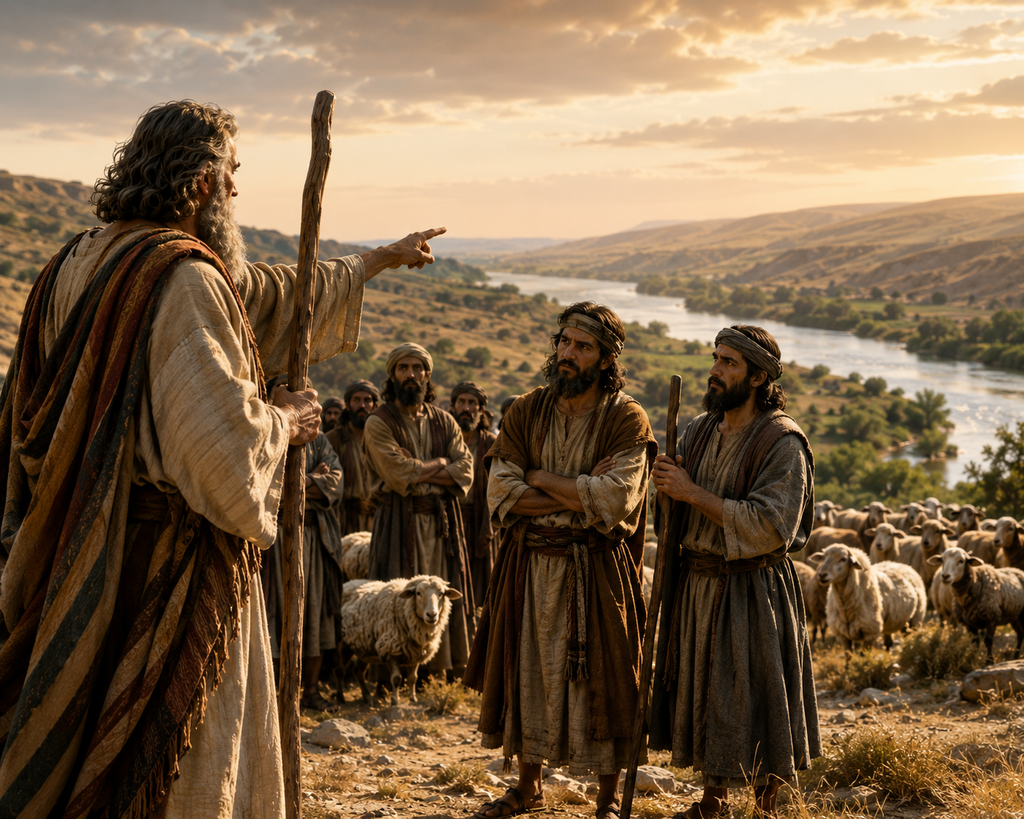
(Illustration: Generated using ChatGPT)
Don Isaac Abarbanel suggests that this request came at this specific time and not earlier, right after the conquest of the east bank, because the Midianite war provided them with their vast livestock. However, building on last week's theme of the "public voice," I propose that their request posed a grave danger that demanded public pushback to prevent its normalization. This time, Moses provides that voice for the people, building an additional layer upon the foundation Phinehas had established, so this is the reason for placing the event after the portions of Balak and Phinehas.
The story of the newly emerging public voice begins in Chapter 20. Following decades of silence, the people complain at Kadesh, leading Moses to strike the rock. The nation mourns Aaron, faces Edom’s stubborn refusal of passage, endures the serpent plague, and collectively vows to God after fighting the King of Arad. Finally, their voice bursts forth joyously and cooperatively in the "Song of the Well." Throughout all these events, the public voice reflects the nation's collective spirit, for better or for worse.
In contrast, in Chapter 25, a new challenge had arisen as a relatively small part of the people attempted to normalize disgraceful practices like prostitution and idolatry. The verses describe everyone weeping silently at the Tent of Meeting but not responding actively. Everyone was afraid to protest until Phinehas shattered the complacency, stepping up to stop a small faction's hostile takeover of the dormant majority's voice.
From there, the Torah amplifies the voices of the daughters of Tzelofchad claiming their rightful inheritance. Fittingly, our current portion opens with the laws of vows, highlighting the profound power of an individual's commitment to their just word.
With all this background, we get to Reuben’s and Gad’s request. Why does Moses attack their seemingly economic application so harshly? Why accuse them of trying to "destroy this entire people," especially when they had a ready compromise and didn't completely evade the national mission?
Last week's census provides another vital clue for the situation. The southern camp of Reuben, Simeon, and Gad had lost about 30% of its population over forty years, while the other camps grew. Moses might have suspected their economic excuse was merely a cover for their diminished military capacity. Furthermore, by explicitly mentioning the Eshkol Valley - where the spies had gathered giant fruits - Moses implies that Reuben and Gad feared agriculture and permanent settlement. He suspected they retained an "exilic" mentality, preferring movable wealth like sheep for an easy escape.
Ultimately, Moses feared their request would undermine national resilience and the willingness to mobilize. This was another battle for the public spirit. As Saadia Gaon explains Moses's warning: "You will destroy this nation if they remain silent before you." The loud minority once again threatened to overpower the silent majority.
But why would the other tribes remain silent? And why wasn't Simeon - their camp partner - included in the request?
Simeon was far from the national consensus. As recalled, Phinehas rose up against the leader of the tribe of Simeon, who brought a non-Israelite woman into his tent in the heart of the camp. Simeon, who was trying to force foreign norms into the Israeli narrative, from their perspective, could have cast suspicion upon them that they were seeking to remain outside of Western Israel because they wished to assimilate among the surrounding peoples and integrate into their culture. Knowing Simeon was a red flag, Reuben and Gad purposely excluded them from this new initiative, and presented a secretly tempting economic proposal to all the tribes: if we stay on the east side, the rest of you will receive much larger portions on the west side.
Here lies a new kind of danger: silencing the righteous public voice through temptation. It is incredibly hard to protest a bad idea when it benefits you financially. Moses, having learned from Phinehas’s zealotry, recognized this trap. This event was placed here because we needed Phinehas to teach Moses that one must confront groups because they may harm the community at large; we needed the Midianite war to show that everyone must draft; and we needed the daughters of Tzelofchad to realize the power of speaking up. Moses knew he must absolutely refuse to normalize a situation where two tribes opt out of the collective Israeli story.
Even if it expands territorial control, we cannot trade core values - especially the supreme value of true national unity and shared destiny - for convenient coalition agreements.
Historically, this economic split likely caused more harm than good. Exodus 23 outlines a gradual conquest to prevent the land from becoming desolate, but strictly warns against making covenants with the remaining Canaanites who will become a "snare." After all, tragically, the divided tribes failed to drive out all the Canaanites, adopted their abominations, and suffered devastating destruction and exile.
Had Reuben, Gad, and half of Menashe (who was joined by Moses) settled on the western side with everyone else, the united demographic and military strength might have overcome the challenges of a gradual conquest, altering Jewish history completely. As we build the Third State of Israel, we must not repeat these historical mistakes by anchoring physical, ideological, or practical separations into our laws and society.