


This week, we read the portion of Vayetzei, which means “He left.” It is one of my favorite portions. It has everything in it. It has romance, it has business, it has leadership. It would make a great movie.
In addition to the stories, or maybe from the stories, the portion is jam-packed with lessons for us to learn and implement. The challenge is choosing which ones to write about.

As always, I got great inspiration from my friend Rabbi Efrem Goldberg and his weekly Torah lesson. So let’s jump in.
The portion begins with Jacob, as he is running away from his brother Esau, resting in a place called Charan.
As a reminder, he is running away because in last week’s portion, Jacob cheats his brother and father by impersonating his brother and stealing his blessing from their father Isaac.
So Jacob is resting and the portion tells us that he has a dream about a ladder and on the ladder are angels who are climbing up and down the ladder.
The first question is what is the significance of a ladder? What can we learn from this dream?
A beautiful thought I heard was that a ladder, by definition, can’t stand up straight. It always has to be on a slant. As a result, wherever you are on the ladder, if you look straight up, you won’t see anyone and if you look straight down, you also won’t see anyone. On a ladder, no one is directly above or beneath you.
This is, of course, a lesson for life. As we climb the ladder of life, whether that’s in personal growth, in professional success or any other area, it’s not about comparing yourself to others.
We often define our success by the successes or failures of others. The lesson here is that successfully climbing the ladder doesn’t entail looking at who is above and who is beneath you. Also, like on a ladder, you could be on a step, but that step is irrelevant without context.
Are you on your way up or on your way down? Someone might be on a higher step, but they started at the top and are on the way down, while you are on a lower step than them but started all the way at the bottom and are on your way up.
Like in life, it’ll always be easier to come down the ladder than to climb up it. When you’re struggling in life, it means you’re climbing and when things are too easy, you might be going downhill. Also, in life, like on a ladder, you cannot stand still or you will fall. So many lessons from a simple detail of his dream, a ladder.

So what happens next is nothing short of bizarre. In this dream, God appears to Jacob and promises him that He will have his back. “I am Hashem, the God of your father Abraham's [house] and the God of Isaac's [house]: the ground on which you are lying I will assign to you and to your offspring. Your descendants shall be as the dust of the earth; you shall spread out to the west and to the east, to the north and to the south. All the families of the earth shall bless themselves by you and your descendants. Remember, I am with you: I will protect you wherever you go and will bring you back to this land. I will not leave you until I have done what I have promised you."
Then Jacob wakes up and does something super strange. He makes a deal with God. “Jacob then made a vow, saying, "If God remains with me, protecting me on this journey that I am making and giving me bread to eat and clothing to wear, and I return safe to my father's house— Hashem shall be my God.”
What is going on here? What is Jacob asking for here? Why is he negotiating with God? God just said he’d have his back, so why the deal-making? I heard a stunning idea that I have never noticed before, but now that I see it, I can’t unsee it.
I’ll remind you, Jacob has just cheated his father and brother. How did he do it? He wore clothing that resembled Esau’s clothing, so his blind father Isaac would think he’s Esau and give him his blessing.
He also went hunting for food, something Esau was known for, and brought Isaac that food to trick him into thinking he was Esau, not Jacob. In other words, Jacob used clothing and food to trick his father, Isaac.
Hold that thought. In Judaism, there is something called Mida Keneged Mida, or Measure for measure. What it basically means is that God interacts with us the way we interact with others. He treats us the way we treat others. He behaves toward us the way we behave toward others.
Now, let’s go back to what Jacob is negotiating with God. “If God remains with me, protecting me on this journey that I am making and giving me bread to eat and clothing to wear, and I return safe to my father's house— Hashem shall be my God.”
Jacob is asking God to give him food and clothing and to let him go back to his father. Why specifically food and clothing? Why doesn’t he ask God for money? Or crop. Or cattle. Or anything else. Why clothing and food?
Now that we understand the principle of Mida Keneged Mida, the answer is clear. Jacob is asking God NOT to treat him the way he treated his father.
He used food to trick his father? Now he is asking God not to punish him using food. He used clothing to trick his father? Now he’s asking God not to use clothing to punish him.
Here’s the interesting part. Indeed, if you study Jacob’s life, you will notice something you may never have noticed before. All of his troubles somehow connect to food and clothing.
The list is long but what does Jacob make for his son, Joseph? Clothing. A multi color coat. When the brothers sell Joseph to slavery and tell Jacob that Joseph is dead; what do they use to deceive Jacob? Clothing. What does Joseph do when Potifar’s wife tries to seduce him? He runs away and leaves his garment behind. Clothing. The list goes on. Clothing is a major part of all of Jacob’s hardships.
And what about food? Well, his suffering begins with a famine, which is what led his sons down to Egypt in the first place.
The brothers sell Joseph to food merchants. In prison, Joseph encounters the ministers of Pharaoh. Which ministers? The ones in charge of food. Joseph is responsible for the food in Egypt. Again, the list goes on.
Jacob knows that he used food and clothing to deceive his father, and God, as God does, punishes Jacob using food and clothing. Fascinating.
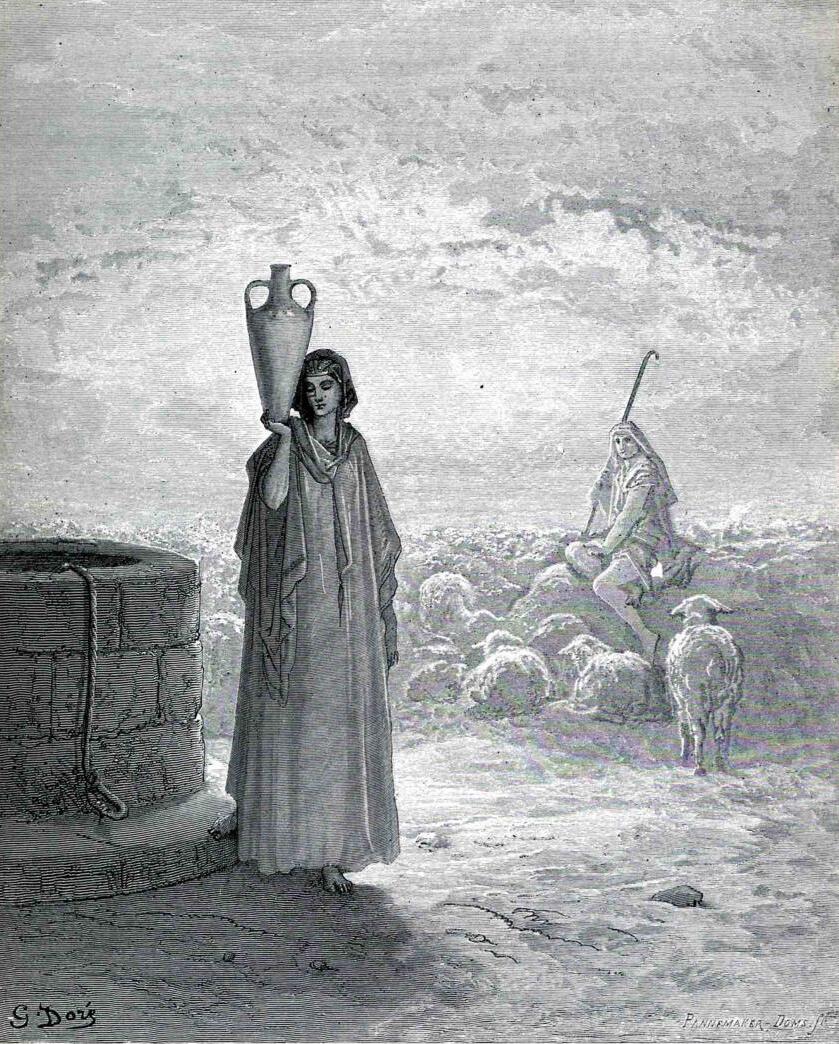
Jacob and Rachel
(Illustration: Gustave Doré)
What comes next? Jacob falls in love with Rachel and wishes to marry her. Rachel’s father makes Jacob work for seven years as his servant.
The Torah says something very strange and unprecedented. It says that Jacob loved Rachel so much, that those seven years felt like days.
Besides the romantic description, what are we to learn from those words “Yamim Achadim”, “Few days.” Achadim comes from the word Achad, which means one.
Jacob teaches us here how to cope with life’s challenges, one day at a time. How did Jacob work for seven years before he was able to marry the love of his life? How did he cope? One day at a time.
We all have our challenges in life, but whatever you struggle with, the best way to overcome is to take one day at a time. Loved that.
What happens next is that Lavan tricks Jacob and instead of letting him marry Rachel after the seven years, he gives him his other daughter to marry, Leah, the older of the two sisters.
When Jacob discovers the deceit, he asks Lavan why he cheated him. Lavan’s answer brings us back to the principle we mentioned above about a measure for a measure. Lavan answers Jacob, “Here we don’t do that. We don’t give the younger one before the older one.” This is a clear jab at Jacob who tricked his father and pretended to be the older son.
Again, he used deceit to get the blessing of the older brother, and now he’s reminded by Lavan that that is not acceptable behavior.
There is so much more to say about this portion, but I’ll just share one more thing I heard from Rabbi Goldberg.
 Hillel FuldPhoto: Maayan Hoffman
Toward the end of the portion, the Torah says, “Early in the morning, Lavan kissed his sons and daughters and bade them goodbye; then Lavan left on his journey homeward. Jacob went on his way, and messengers of God encountered him.”
So Lavan went homeward, or as the Torah more literally says, “He went back to his place.” And Jacob? “Halach ledarko”, he went on his way, or on a journey.
Why the different language? Lavan went back to his place and Jacob went on his way.
The lesson here is that Lavan had the chance to leverage the fact that he had the righteous Jacob in his presence for all those years. He could have learned from him, grown from him. But he doesn’t. He goes right back to his place, right back to where he started. No growth. No path to greatness. Nothing.
Jacob? Jacob goes on his way. He wasn’t satisfied to go back to his place. He understood and is teaching us that life is a journey and you never reach your destination.
A life of meaning is a life of growth. A life of purpose means never standing still. “The purpose of life is to live a life of purpose.”
Like a ladder, like a bicycle, you cannot stand still because not moving forward means you will fall. When climbing, it’s tough, but when you accomplish your goal, there is nothing more satisfying.
“If life is easy, you’re living it wrong.” - Ari Fuld
Shabbat shalom.