

“It’s been an incredibly difficult two years,” says Phil Rosenberg, president of the Board of Deputies of British Jews. “I think our Jewish identity is being worn far more heavily these days given the pain of it all.” The war in the Middle East, he says, has had a profound impact on British Jewish society.
“The October 7 terror attack was felt very personally, not least because there were British Jews who were killed in the initial massacre and people with British connections held hostage,” Rosenberg says.
“And in the war that followed, the devastation in Gaza was very painful to watch. Then there was the vitriol that surrounded the whole conflict, and the massive rise in antisemitism culminating in deadly attacks.”
The shooting at Bondi Beach during Hanukkah celebrations and the terror attack on a synagogue in Manchester on Yom Kippur, combined with the events of the past two years, have had far-reaching consequences for Britain’s estimated 300,000 Jews.
According to a BBC report, the combined impact of the October 7 attacks, the war in Gaza and a sharp rise in antisemitic incidents has driven what many British Jews describe as the most profound shift in community life in decades.
It is hard to recall a moment since the 1967 Middle East war that has so clearly altered daily life for British Jews. How secure people feel, how connected they feel to the wider community and how openly they express their Jewish identity have all shifted. At the same time, discourse around Israel has become more polarized, revealing a generational divide that is increasingly visible.
Opinion across the community remains deeply diverse, but many British Jews describe a shared sense that life has fundamentally changed.
A rise in fear and antisemitism
“There was an extent to which it felt like Jewish friends were more likely to understand,” says Ben Dory, 33, who lives in London. “I have ended up making more Jewish friends and also being more involved with the Jewish community.”
Dory has taken on a larger role at his synagogue and become more active in campaigning against antisemitism, driven in part by a growing sense of insecurity.
“I know Jewish people who, if they are going to the synagogue, will keep their kippah in their pocket until the moment they’re through the door, and take it off the moment that they leave,” he says.
After the Bondi Beach shooting, Dory said he was “horrified, but not surprised,” describing it as part of a broader “global frenzy of antisemitism”.
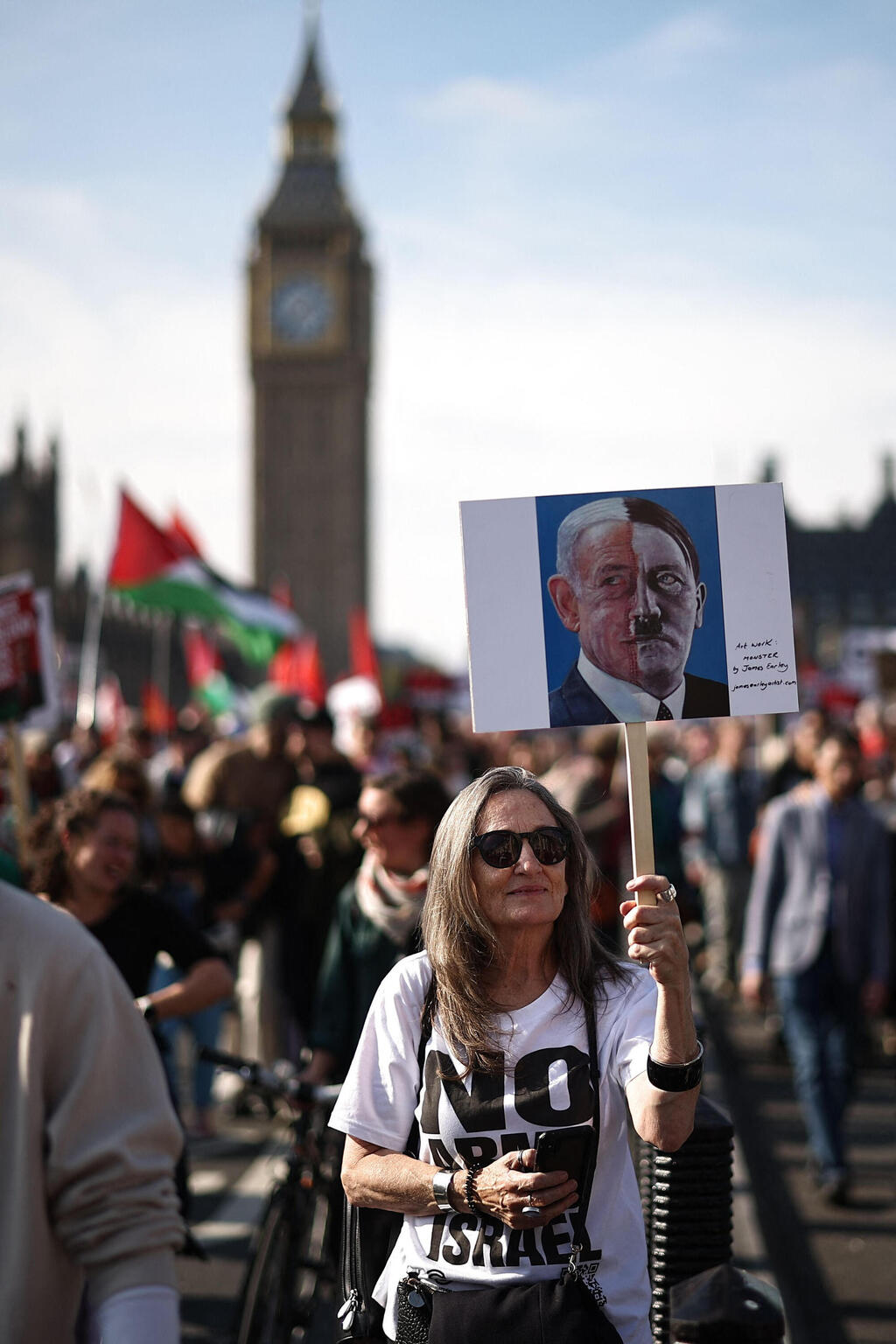
(Photo: Henry Nicholls / AFP)
“It’s long been the case that gatherings related to Israel haven’t felt safe,” he says. “But now Jews feel they are under a constant threat, even at non-political cultural and religious gatherings.”
Official data underscore that concern. There were 1,543 hate crimes targeting Jewish people in England and Wales in the year to March 2023. By March 2024, that figure had risen to 3,282, according to the Home Office. Data for the following year is incomplete, but the Community Security Trust says antisemitic incidents over the past two years are the highest since it began keeping records nearly four decades ago.
“The Jewish people that I know are more than ever conscious of the need for a safe Israel in case they need to escape there,” Dory says.
That sense of vulnerability is echoed by Dame Louise Ellman, a former Labour MP and joint independent chair of the Board of Deputies.
“I’ve never felt as vulnerable as a Jew as I do now,” she says. “And this feeling I find is replicated among everyone I speak to in the Jewish community.”
Ellman left Labour in 2019 over concerns about antisemitism, rejoining in 2021. She had deep personal ties to the Heaton Park synagogue in north Manchester, where she was married and where her son’s bar mitzvah was held.
That same synagogue was the site of an attack in October that left two people dead and three seriously injured.
“People are increasingly concerned, feeling edgy and feeling alone,” Ellman says. “I find this very distressing.”
She says recent events have strengthened her support for Israel, while acknowledging that younger Jews often see the issue differently.
A different conclusion among younger Jews
One of those younger voices is Tash Hyman, a 33-year-old theater director from London. She says the past two years have deepened her connection to her Jewish identity, but not her support for Israel.
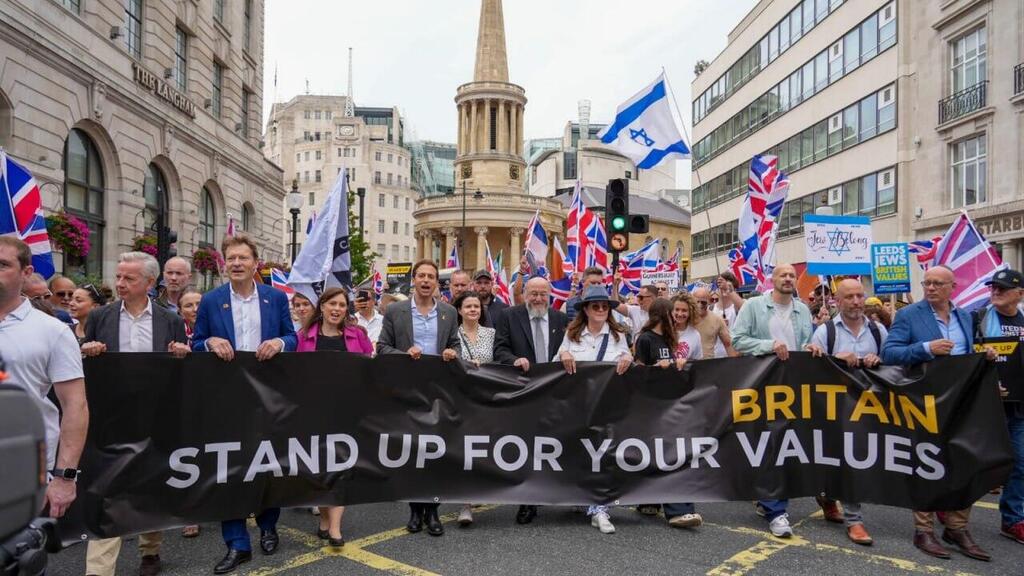
Pro-Israeli protest in London
(Photo: Robert Midgley)
“I grew up in a religious context where my Jewishness was very much entwined with the state of Israel, but I really started to interrogate that,” she says. “The bottom line for me now is that the actions of the state of Israel make me feel less safe, not more safe.
“It makes me less safe in the UK because of what they are doing in Gaza.”
Hyman rejects the idea of Israel as a “safe haven” for British Jews. She says it is important for Jews who oppose Israel’s actions to speak out, because many assume Jews support the war.
She still attends synagogue, but has increasingly surrounded herself with people who share her political views.
“It does certainly feel like there’s a polarising and there’s a real inability to have that conversation across the divide, because the divide is so big,” she says.
About 1,200 people were killed in the Hamas attacks on Israel on 7 October 2023, and more than 250 were taken hostage. Since then, Gaza’s Hamas-run health ministry says more than 70,000 Palestinians have been killed in Israeli military operations.
A widening generational divide
Data from the Institute for Jewish Policy Research suggests a growing generational gap in attitudes toward Israel. In a survey of 4,822 British Jews over 16, published in October, 64 percent overall identified as Zionist. Among those aged 20 to 30, that figure fell to 47 percent, while 20 percent described themselves as non-Zionist and 24 percent as anti-Zionist.
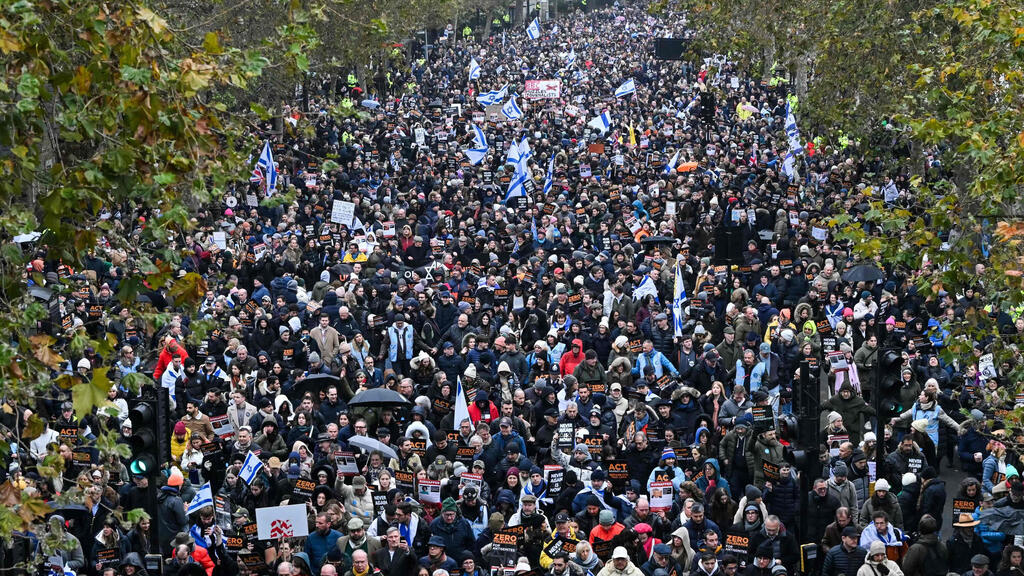
A protest against antisemitism in London
(Photo: Justin Tallis/ AFP)
The proportion of Jews identifying as anti-Zionist has increased in all age groups since 2022, but the gap between younger and older Jews has widened. Among those aged 50 to 59, 7 percent identified as anti-Zionist in 2024, compared with 24 percent of those aged 20 to 29.
Robert Cohen, a PhD student at King’s College London, has researched British Jews who are critical of Israel’s actions in Gaza. He interviewed 21 people between February 2023 and October 2024.
He says some younger Jews are motivated by what he calls their “British Jewish ethics” combined with “Gen Z sensibilities”.
“We know Gen Z are characterised by authenticity, being super-inclusive, being very big on justice issues,” he says. “And I could see among my research cohort there was a merging of those things with the ethics of their Jewish upbringing.”
Others, including Dory, suggest the generational divide may reflect a weaker connection to the Holocaust among younger Jews.
Cohen also says some of those he interviewed felt compelled to express opposition alongside other Jews who would understand them, such as within the “Jewish bloc” at pro-Palestinian marches.
“Some were clearly disturbed by the fact that they could see a complete collapse in empathy towards the Jewish Israeli victims of what happened on 7 October,” he says.
Many paid a personal price for taking that stance, falling out with friends or family.
‘My friend group turned away from me’
Lavona Zarum, 21, was born in Israel and raised in London. At the time of the 7 October attacks, she was a student and newly appointed president of the Jewish Society at the University of Aberdeen.
“I had quite a few people walk away,” she says. “The girls in my main friend group, slowly over that summer, all turned away from me.”
She recalls feeling isolated and struggling to speak with non-Jewish students about the attacks and the war. She was particularly disturbed by social media posts calling for a “globalised intifada”.
“I kind of retreated within myself,” she says.
Zarum later visited Israel through a fellowship program, touring sites attacked by Hamas.
“People spoke kindly and listened and shared ideas in spite of some differences in opinion,” she says.
“The world was a bit more antisemitic than I had allowed myself to believe before,” she adds. “But it’s taught me to enter into discussions being more intentional and thoughtful, and also backing myself up.”
Discord within the community
The Board of Deputies itself has faced internal tensions. Earlier this year, 36 members signed an open letter published in the Financial Times criticizing Israel’s government and its failure to free hostages.
Five members were suspended after a committee ruled the letter created the misleading impression it represented the board as a whole.
For some, however, the letter marked a turning point, bringing private debates into public view.
Rosenberg says debate has always existed within the board, but his main concern now is safety and identity.
“We have a whole range of activities to confront antisemitism,” he says. “But we also believe that the community needs not just to be seeing itself, and to be seen, through the prism of pain.”
He notes that Jewish life in Britain is often publicly marked only through Holocaust remembrance.
“That’s not the whole experience of Jews,” he says.
The past two years, Rosenberg adds, have made it harder to celebrate Jewish contributions to British life.
“Right now, as a Jew in Britain, it can feel hard to feel good about things and hard to feel positive,” he says.
Looking ahead, Cohen believes the trajectory of the Middle East conflict will shape whether divisions deepen.
For Dory, the immediate concern is security.
“I think that the future of Jewish people in the UK is on a real knife edge,” he says.
“And how Britain as a country chooses to respond to this challenge in the very short term will be incredibly important for whether Britain in the long term can continue to be a place that Jews feel safe.”