

Dedicated to the men and women of the IDF and those who worked tirelessly alongside them, who believed and persisted in finding the body of Rani Gvili of blessed memory.
At the very beginning of the redemption narrative, Hashem instructed Moses to request permission from Pharaoh to journey three days into the wilderness to bring sacrifices to God. Despite Moses’s initial fears that the Israelites would not listen to him, the Torah explicitly records that after he performed the signs, "The people believed; and when they heard that Hashem had taken note of the Israelites... they bowed low in homage" (Exodus 4:31).
This raises a difficult question regarding the events in this week’s parashah. If the people had already believed, why does the Torah state after the splitting of the Sea of Reeds: "Thus Israel saw the great power which Hashem had wielded against Egypt... and they believed in Hashem and in Moses His servant" (Exodus 14:31)? Why was there a need to reaffirm belief in Moses?
A careful reading reveals that along the process of plagues and redemption, a deep rift developed between Moses and the people, shaking their trust. Following Moses’s first encounter with Pharaoh, the situation deteriorated; Pharaoh stopped providing straw but demanded the same quota of bricks. The people, crushed by cruel bondage, turned on Moses and Aaron, blaming them for making them "loathsome to Pharaoh" and putting a sword in his hands to kill them.
Furthermore, Moses’s leadership appeared ambiguous. His negotiations with Pharaoh were multi-layered and involved requesting only a limited three-day journey rather than full redemption. With the sudden U-turn after they were sent out from Egypt and had already set out into the desert, Moses appeared to be improvising rather than executing an orderly plan.
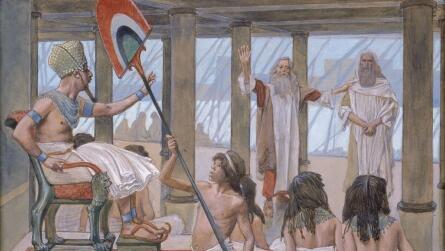
(Photo: Wikimedia Commons)
Compounding this was the "question mark" regarding Moses’s identity. He grew up in Pharaoh’s palace, not among his brethren. He spent decades in Midian and married a Midianite priest’s daughter. He only reappeared in Egypt at age eighty. Consequently, the people were unsure who this man was or if he was truly one of them. Their initial belief was conditional on immediate results, and when those results were delayed, faith evaporated.
To understand the renewal of faith at the Sea of Reeds, we must define what "belief" (Emunah) actually means. Looking back at the first mention of belief in the Torah regarding Abraham, we see that after God promised him offspring as numerous as the stars, "He put his belief in Hashem" (Genesis 15:6). Immediately following this, God reveals the difficult future: four hundred years of slavery before returning to the Land.
From this, we learn that true faith is the willingness to respond to a future that cannot yet be seen, and to live as though the plan has already begun to be realized. Abraham trusted the long-term plan despite the predicted ups and downs. The Israelites, however, lacked this long-term perspective. When they could not see how to move forward, they lost faith.
The splitting of the sea was the turning point. In the Torah, water represents a boundary of lack of control, uncertainty, and chaos, evoking the primordial abyss or the Flood. "Dry land," conversely, represents stability and human control. The miracle was not just a rescue; it demonstrated that a blocked, threatening reality could become an open road.
Crossing the sea signified a change of life-regime. It became clear that there was an operative plan. Moses was not merely improvising; his plan involved a total disconnection from Egypt, relegating slavery to the past. This restored faith in "Moses His servant" because it proved he held a detailed vision for what came next.
Hogg’s Social Identity Theory of Leadership suggests that groups trust leaders who embody the "prototype" of the group’s identity, the "we". Moses, with his foreign upbringing, did not embody the "we" of the enslaved Israelites. However, Moses represented the "we" of the future. The “we” of a free people in formation.
"They had faith in Hashem and in Moses His servant" marks the moment the people accepted a new consciousness. They realized that their identity was being formed through the journey, and Moses, who had crossed boundaries of identity throughout his life, was the ultimate leader for this transition. He was finally perceived as the address for the emerging "we" - a nation that would eventually establish an exemplary, multi-tribal society in its homeland.
Faith, therefore, suspends short-term pessimism. It is not naïveté; it is optimism combined with a conscious decision to advance the future, much like the pioneers who built the Land of Israel despite uncertainty. Emunah is acting with the deep recognition that though questions will arise, we will reach the destination with determination. It is a decision to live in trust that the good future will be realized, because we will bring it about.