

In the opening chapters of the Book of Exodus, particularly in Parashat Va’era, a single demand resonates through the narrative of the plagues: “Shalakh et ami” (“Let My people go”) or “Shalakh ami v’ya’avduni” (“Let My people go that they may serve Me”). This demand follows the outline established at the burning bush, where Moses is instructed to approach the King of Egypt with the elders and request a three-day journey into the wilderness to sacrifice to God. While the request appears limited in scope, it sets the stage for a profound transformation in international politics and the universal concept of liberty.
The linguistic key: strategic ambiguity
At the heart of this confrontation is the Hebrew root ש־ל־ח (sh-l-kh), which carries distinct meanings based on its grammatical form. Simple Form: In many verses, the simple verb form conveys an ordinary mission or "sending." Hard Form: When used in the "hard" verb form - indicated by a dagesh (a dot) in the letter ל - the word denotes a dramatic break or an emancipatory release from slavery.
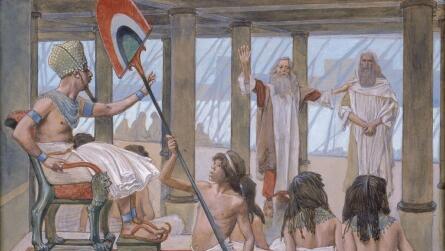
Moses Speaks to Pharaoh by James Tissot at the Jewish Museum, New York
(Photo: Wikimedia Commons)
Moses uses this linguistic duality to employ strategic ambiguity. Officially, he does not declare that the departure is permanent; instead, he frames it as a journey for a religious festival. This is not a crude deception but a tool of realpolitik. It allows Pharaoh to maintain an illusion of control before his advisors, presenting the event as a temporary permit rather than a total loss of his slave labor force. However, the absence of any mention of returning to Egypt hints at the true plan for final emancipation, a plan that surely did not escape Pharaoh's notice.
Purpose of the plagues: beyond destruction
The plagues serve a dual purpose that goes beyond the mere rescue of the Israelites. On one hand, the plagues are designed to humiliate Pharaoh, a ruler who viewed himself as a god, by demonstrating God’s absolute sovereignty. On the other hand, God explicitly states that He could have destroyed Egypt instantly but chose to keep Pharaoh standing. This preservation indicates that Egypt has a role in the future. The overarching goal is to create a "shift in consciousness" - a formative moment that introduces the concept of free choice and liberty as a global idea.
The process forces the enslaving power to recognize their wrongful path and repair the "identity-theft" they caused, rather than simply being annihilated.
Dialogue as a political tool
Moses’ approach is a sophisticated political strategy involving dialogue and sanctions. The plagues act as a tool to keep the dialogue alive in order to change public opinion within Egypt. The goal is that Pharaoh, cornered by his own people's pressure, is forced to utter the words of liberation with full awareness. That the tyrant himself becomes an involuntary player in birthing a new value system of freedom.
Indeed, after the plague of lice, the Egyptian magicians are convinced of God's power. Then by the plague of hail, some of Pharaoh’s courtiers begin to fear God's word and take precautions.
The dialogue, though not always transparent, allows for movement toward liberation without forcing Pharaoh to admit to his total collapse immediately.
The breaking point and the 'internet shutdown'
Therefore when Pharaoh realizes the true extent of the plan, he breaks off contact. His command to Moses, “Be gone from me! Beware, do not see my face again” mirrors a modern-day intentional internet shutdown by a regime. This refusal to continue dialogue is a telltale sign that the end of the regime's control is near. Eventually, the Egyptians urge the Israelites to leave, fearing their own destruction.
'V'ya'avduni': The essence of redemption
The phrase “V’ya’avduni” (“that they may serve Me”) is as crucial as the demand for release. While Pharaoh views it as a pretext for a temporary religious excursion, for Moses and God it represents the essence of redemption. Redemption is not just about leaving a place of stress; it is about building a framework of belonging with positive content. Actually, by celebrating for God and receiving the Torah, the Israelites will create a distinct identity. This adoption of God's values leads to a consciousness of freedom so profound that, as free people, they will no longer have any desire or reason to return to Egypt.
V'ya'avduni is the organizing axis of an alternative order that transforms the Exodus from a mere technical exit into a change in national identity and the world order.
Geopolitical implications: A new regional architecture
The Torah’s approach to the Exodus offers significant insights into modern geopolitics. As a functioning state and economy are vital for regional stability, the goal was not the disappearance of Egypt. Instead, the objective was the creation of a situation where there is public recognition of the values of freedom by the enslaving regime.
A stable order is built not only by weakening an enemy but by offering an alternative axis that can organize society and life. This alternative includes a growing economy, functioning institutions, a clear sense of identity and moral boundaries and connectivity to the "good side" of the world.
Political redemption requires more than just power; it necessitates dialogue, the creation of a lasting narrative, and a new center of identity and law. As the journey continues, the people of Israel are tasked with actively shaping this new identity, championing true freedom not only for themselves but for all of humanity.