


Holocaust survivor Nina Bassat, a board member of the Melbourne Holocaust Museum Foundation and former president of both the Jewish Community Council of Victoria and the Executive Council of Australian Jewry, testified Wednesday before Australia’s Royal Commission on Antisemitism and Social Cohesion.
In testimony published in part by The Australian Jewish News, Bassat sharply criticized the conduct of the country’s political leaders since the October 7, 2023, Hamas terrorist attack on Israel and warned against the use of the term “genocide” in discussions of the war in Gaza.
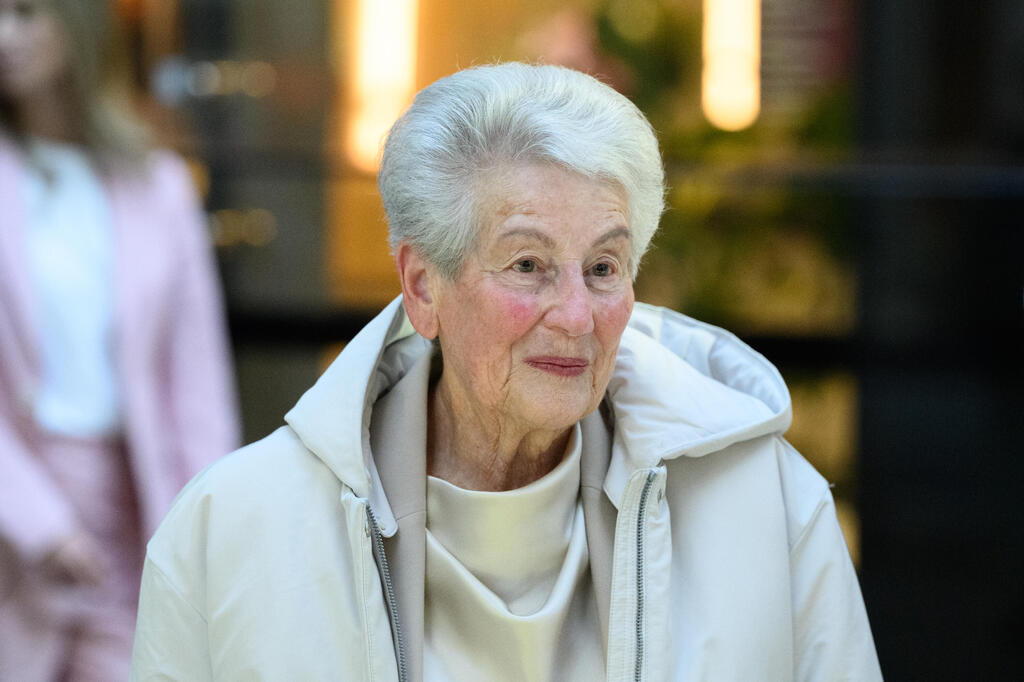
Bassat, 87, arrived in Australia in 1949 after surviving the Holocaust in a ghetto and in hiding in Poland, followed by two years in a displaced persons camp in Germany. Only four members of her extended family survived.
In her testimony, Bassat described changes in Australian society since October 7 and said the country had lost the sense of empathy and social cohesion that had characterized it for decades.
“We have lost the power to be kind and the power to interact with civility,” she said.
She warned that unless Australians could see one another as human beings rather than members of opposing camps, the country would be unable to rebuild the social cohesion it had lost.
For 74 years, she said, Australia had been “a paradigm of multiculturalism,” where people’s backgrounds and religions did not matter and they could simply “get on” with one another.
“But that changed abruptly after October 2023,” she said. “We’ve [Australian society] become very divisive. We’ve put labels on each other. We no longer treat each other as just another human being.”
Bassat was in Israel on October 7, 2023. Two days later, she watched footage of the pro-Palestinian demonstration at the Sydney Opera House and said she struggled to understand how it could take place while Israel was still dealing with the aftermath of the Hamas attack.
“I was shattered, and I couldn’t understand it,” she testified. “I just cannot understand how it could have happened.”
Israel had not yet had time to bury its dead, she said, and was already facing condemnation.
“I couldn’t understand that lack of empathy. I was shattered by the lack of humanity,” Bassat said.
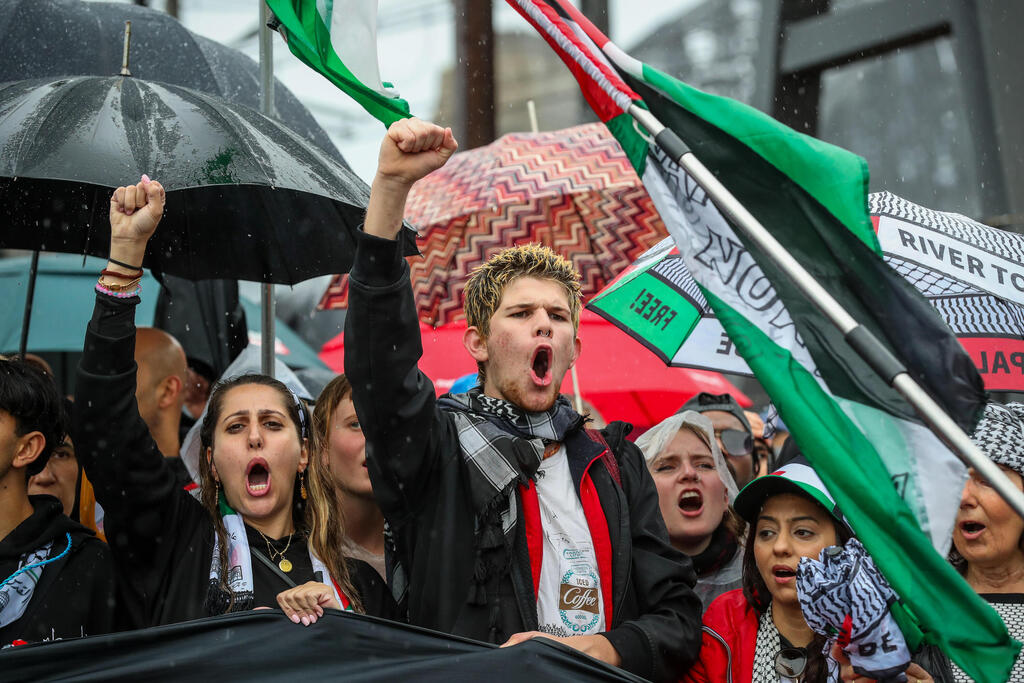
Pro-Palestinian protest in Sydney
(Photo: Lisa Maree Williams/Getty Images)
In response to the atmosphere that followed, Bassat joined about 100 other Australian Holocaust survivors in signing an open letter in November 2023 calling on Australians to condemn antisemitism and hatred.
“The atmosphere was so incredibly reminiscent of the rhetoric of Germany in the 1930s,” she said.
She said it did not frighten her personally but made her fear for Australia’s future.
“We had never, ever envisaged that Australia … would become Europe of the 1930s,” she said. “It was to me incomprehensible.”
Bassat told the commission that antisemitism was not merely a problem for the Jewish community but for society as a whole.
While antisemitism causes “individual pain and communal pain” for Jews, she said, “it is not a Jewish problem,” because a society that tolerates bullying and vilification “depraves itself” and damages the values of the broader population.
“It is our pain,” she said, “but it is Australia’s shame.”
One of the most forceful parts of her testimony focused on the conduct of the country’s leaders.
Bassat said many in the Jewish community had felt “betrayed” by what she described as the near-total absence of voices from the federal government, state governments and local authorities condemning antisemitism after October 7.
“There was a great silence,” she said. “I expect more from leaders. That is what leadership is. Leadership is noticing the vacuum, getting up there and saying what has to be said.”
She described hateful speech as “corrosive” and said it was damaging “the fabric of what I thought Australian life was.”
Leaders, she said, should have made clear that such behavior was unacceptable, but failed to do so.
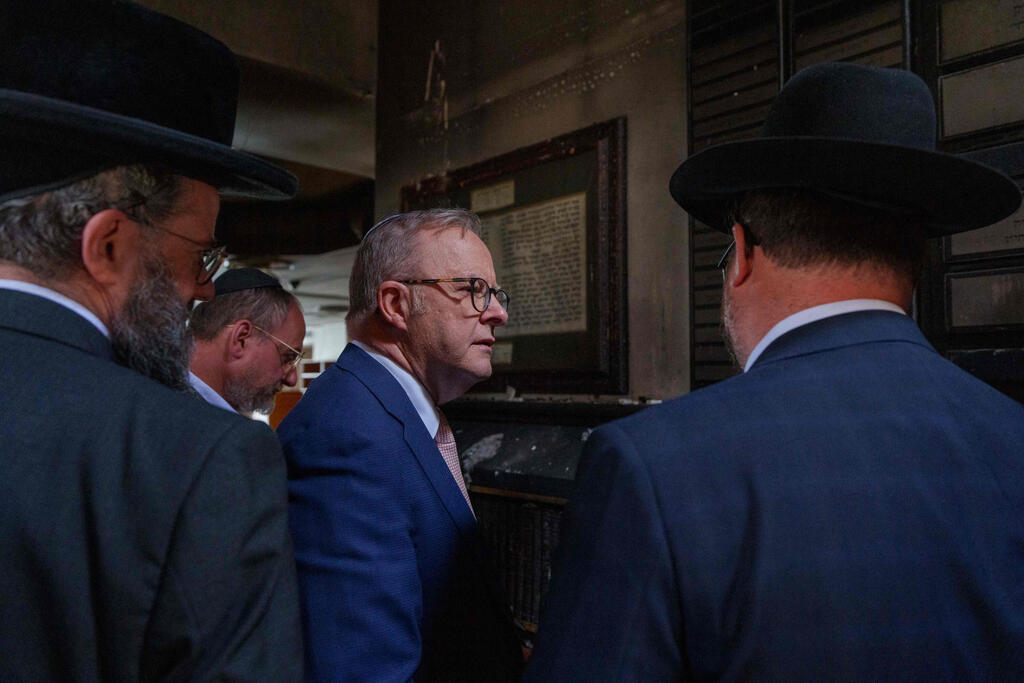
Australian Prime Minister Anthony Albanese visits a synagogue in Melbourne that was set on fire about a year and a half ago
(Photo: AFP / Department of the Prime Minister and Cabinet / Australia)
Asked about the idea that silence and inaction are “the best friends of evil,” Bassat agreed and compared it with people who lived near the crematoria during the Holocaust and said nothing.
“That is complicity,” she said. “That is beyond silence.”
She stressed, however, that speaking out against the Nazis during the Holocaust could cost people their lives, yet some still chose to do so.
“So it can be done,” Bassat said.
Bassat also addressed the use of terms such as “freedom of speech” and “the right to protest,” which she said were being invoked in troubling ways.
“Language has become perverted,” she said, adding that such terms were being used “with a disingenuity that I find alarming.”
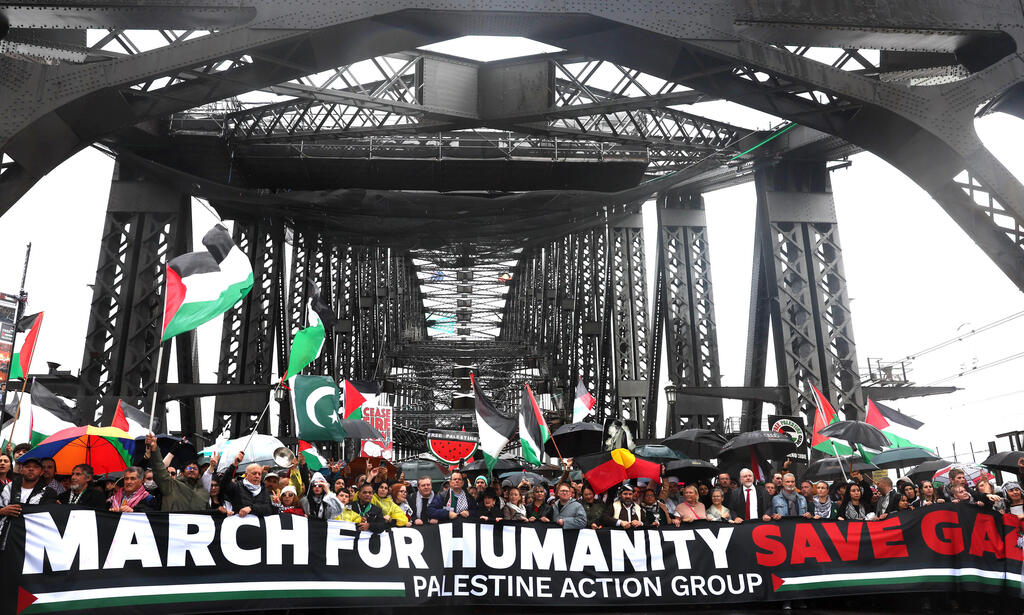
Anti-Israel protest
(Photo: Izhar Khan/Getty Images)
Freedom of speech and the right to protest are not absolute, she said.
“You have to observe the freedom of other people when you use those freedoms for yourself. You do not have blank license.”
Bassat devoted a significant part of her testimony to the use of the term “genocide” in connection with the war in Gaza.
She described genocide as “a very specific, defined United Nations accepted legal term,” and said it could not be used “with gay abandon.”
Bassat cited Raphael Lemkin, who coined the term “genocide” in the wake of the Holocaust, and said it refers to the systematic destruction of a population with state backing and proven intent at the highest levels, rather than to all deaths in war, however tragic.
“The word genocide brings into sharp focus what it means to be one of 100,000 children who survived when one and a half million were murdered,” she said. “That knowledge has guided my life. That is what genocide means.”