

For Sandy Cardin, the moment that demanded action came well before October 7 - during Israel’s judicial reform debate in the summer of 2023.
Listening to the way Jews spoke about one another, particularly inside Israel, left him deeply unsettled.
Sandy Cardin, founder of the Global Jewry initiative
(Photo: Yaron Brenner)


“The language that was being used - that was the straw that broke the camel’s back,” Cardin said. “Someone had to stand up and say: Enough. We are one family.”
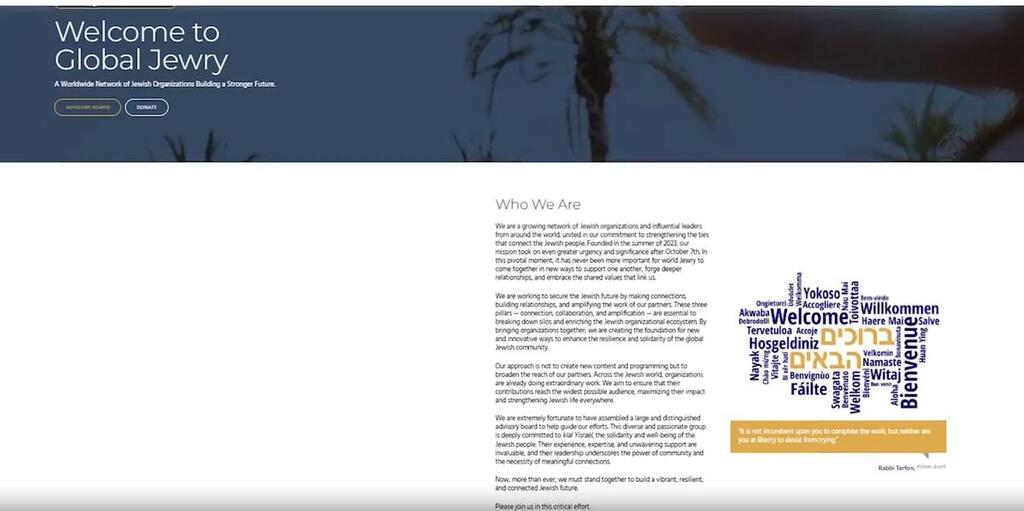
That realization led him to found Global Jewry, an initiative launched without a formal blueprint or strategic roadmap. Its initial purpose was simple: to rebuild solidarity and a sense of connection across a Jewish world increasingly pulled apart by polarization.
Over time, the project evolved. Rather than addressing individuals, Global Jewry focused on the organizational level - a marketplace of thousands of Jewish institutions worldwide — creating a global platform where organizations could communicate, cooperate and, ideally, collaborate on the issues facing the Jewish people.
Unity without unanimity
At the heart of Cardin’s thinking is a principle he returns to repeatedly: unity does not mean agreement.
“Like in a family, everyone has the right to be themselves,” he said. “Everyone has the right to their own opinions. But we have to respect one another and care about one another.”
That distinction has become especially relevant as tensions deepen between Israel and the Diaspora. Many Israelis express growing frustration with Jews abroad who emphasize their Jewish identity while distancing themselves from Zionism - a position widely experienced in Israel as a rupture.
Cardin understands that frustration, but resists framing Jewish belonging through ideological labels.
“At Global Jewry, we don’t talk in terms of Zionists or anti-Zionists,” he said. “We ask a different question: are you part of the Jewish people? If you are, then you have a responsibility to the larger whole.”


Sandy Cardin, founder of the Global Jewry initiative
Different Jews, he acknowledged, will hold different views about Israel, the Diaspora and contemporary Jewish life. The challenge, he said, is knowing when to set those disagreements aside in order to safeguard a shared future.
Institutions must serve peoplehood - not the other way around
Cardin also points to a widening gap between Jews and traditional institutions. Many people, he said, feel deeply connected to Jewish values and ethics, yet increasingly alienated from institutional frameworks.
“That’s exactly the point,” he said. “Institutions were created to connect Jews to one another. Somewhere along the way, they became more important than the people themselves.”
Over time, institutions developed their own identities, financial responsibilities and survival instincts — sometimes at the expense of Jewish peoplehood. Reversing that imbalance, Cardin argues, is essential.
“We have to remember why these institutions exist,” he said. “Not just to keep themselves alive, but to strengthen Jewish solidarity.”
A message for leaders in Israel and beyond
Asked about expectations from Israeli leadership, including Prime Minister Benjamin Netanyahu and senior ministers, Cardin was careful but direct.
Leadership in Israel, he said, carries responsibility not only toward Israeli citizens, but toward the Jewish people globally.
“In the same way Jews in the Diaspora have responsibilities to Israel, Israeli leaders have responsibilities that extend beyond their borders,” he said. “They have a responsibility to the Jewish family as a whole.”
The work of rebuilding unity, he added, is slow and often frustrating. Jewish cohesion has been a challenge for thousands of years. But difficulty, he said, is not an excuse for disengagement.
Quoting Rabbi Tarfon, Cardin offered a reminder: “It is not upon you to finish the task, but neither are you free to desist from it.”
Trust, he said, is the missing ingredient — and the prerequisite for resolving anything else. Without rebuilding mutual respect, no political or ideological conflict can be meaningfully addressed.
October 8 as proof of possibility
Despite his concern, Cardin remains cautiously optimistic. He points to October 8 — the day after the Hamas massacre — when Jewish communities around the world responded with an immediate and instinctive sense of shared fate.
“That connection was there,” he said. “We’re not inventing it. We just have to bring it back to the foreground — and practice it.”
For Cardin, Global Jewry is not about slogans, but repetition: practicing respect, responsibility and peoplehood until they become reflexes again.
“If we talk about being a family, if we act like one,” he said, “step by step, we can get there.”