


“I’m Jewish and of Syrian descent. That means I’m technically a Jewish Arab. When I meditate, I never reach inner peace. The Jewish part of me says, ‘Oh God, everyone hates me,’ and the Arab part answers: ‘Yes! You should die.’”
That bit, from Olga Namer’s stand-up, became a hit on social media against the backdrop of the troubling situation facing Jews, particularly in New York, since the October 7 massacre. In another clip from a public event, in which she mocks mayor-elect Zohran Mamdani as he sits in the audience, she tells him to his face: “I’m a Syrian Jew, so I’m sure you like at least half of me.” She then compared him to Moses: “You’re like Moses. You also cause an exodus of Jews — to Florida.”

The bit is highly characteristic of Namer’s stand-up: blunt, honest and deeply connected to her Jewish identity. For nearly a decade, she has performed at New York’s iconic comedy clubs, and she also travels for shows in Florida and elsewhere in the United States. She has performed in London and nearly performed in Israel, but at the last minute decided to focus on her family visit to the country. She will likely perform here in the future.
Has your act changed since the October 7 attack in Israel and the attacks on Jews in the United States?
“I tell the same jokes, but I admit that sometimes it scares me. It depends a lot on the audience. There are jokes or bits that can be very funny in one room with one kind of audience, but I wouldn’t do them in a room where I feel it could go to worse places. I have an old joke about coming home after my divorce and having to share a room with my sister again. I describe how we start fighting over territory in the room, setting boundaries and accusing each other of ‘occupying’ areas. I’m basically joking that neither of us is willing to compromise on a ‘two-state solution’ inside one bedroom, and every incursion is a declaration of war. I told that bit at a show in London, and someone wrote a letter to the venue owners saying I was ‘disgusting’ and that she didn’t want ‘baby killers’ performing there. To me, it’s ridiculous, and I really don’t care about reactions like that, but I understand that it exists and that sometimes maybe you need to drop certain bits in specific rooms.”
“It’s not only in the context of Israel,” she said. “The same bit about Trump can end with wild laughter and an audience having a great time in one place, and cause controversy and shouting in another. I want to make people laugh, but in the room there is a diverse audience, and sometimes what makes one person laugh upsets another.”
Namer, who grew up in an Orthodox religious home in Brooklyn, clearly feels the shift in the atmosphere toward Jews in New York. “Even when I introduce myself onstage and say I’m Jewish, there are sometimes bad reactions from the audience. When I continue into the bit where I say I’m a Syrian Jew, some people say, ‘You’re one of the good ones.’ It shows the mindset of some people in the city,” she said. “If I feel the audience is good and going with me, I don’t limit myself, and I feel freest when I perform for a Jewish audience. With them, I love telling jokes with Jewish nuances only they can understand, but most of the time I perform for a mixed audience — Jews and non-Jews.”
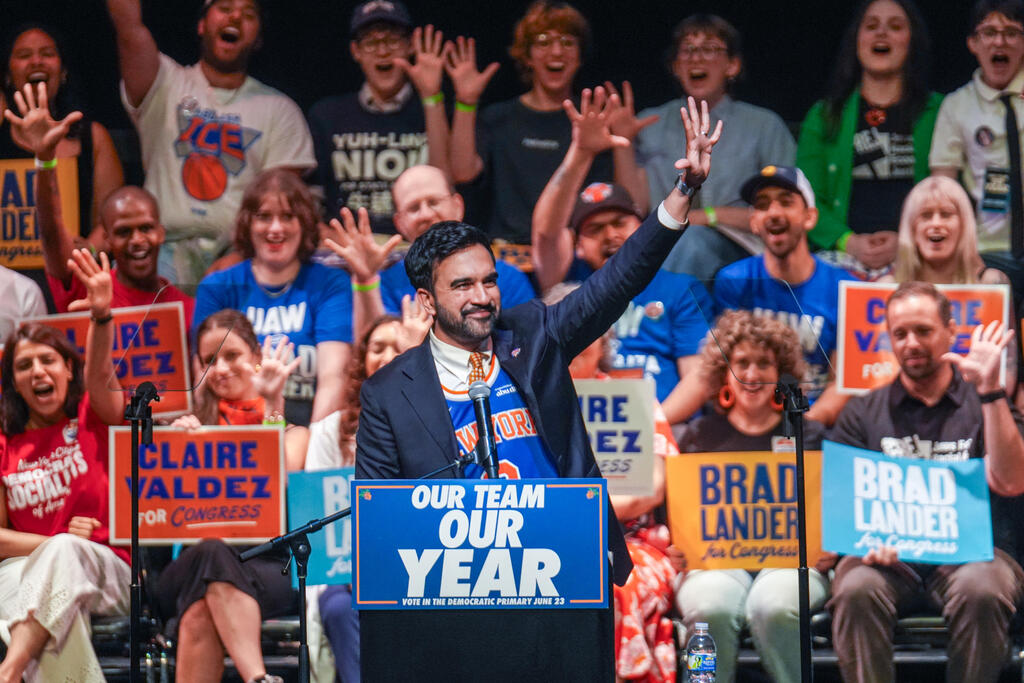
New York City Mayor Zohran Mamdani
(Photo: AP Photo/Ryan Murphy)
In one case, she was supposed to take part in a show where some of the proceeds were intended for IDF soldiers in need of trauma treatment, but after a protest, the artists were placed on a “blacklist” and the show was eventually canceled.
“What was the great crime? Helping people with post-trauma? Supporting efforts to free the hostages? Helping victims of the war? A lot of people think it’s messed up to behave that way and make blacklists, but they were afraid it would cause more problems, so it was canceled,” she said. “A lot of people also attacked me after my video against Mamdani was published. They labeled me a ‘Zionist,’ and I also lost friends I had known for years over exactly that. But I see it as a good thing: I understood who they really were, and I think everything that happened and is happening has strengthened the Jewish community itself. I think everything that happened marked me as a Jew, and I really began performing more and more for Jewish audiences.”
‘I don’t want to talk about blow jobs anymore’
Namer married at 17 and divorced at 20, and essentially left the Orthodox world. “I’m less religious than I was when I was younger, but I still keep kosher, go to family meals and celebrate the holidays,” she said. “I think Sephardic Judaism makes it more possible for all kinds of people, more religious or less religious, to meet in the same synagogue and pray together, even if afterward everyone does what they want and what feels right to them.”
Your act also includes harsh things about your family, as well as material about dating and sex. How is that received in the community where you grew up?
“My father hasn’t seen the show. My mother follows me on social media, but we don’t talk about it. There were times when I was a little embarrassed by videos that came out, but this is my career and this is what I do in life — I write and make people laugh. I lost childhood friends who stayed more within the original community. I chose a different lifestyle and haven’t remarried since my divorce at 20. Now I dated a Jewish guy, and my father thought it was because of the stand-up, so he was a little more positive toward the show. In any case, I’m more selective about what I post on social media, and sometimes if it’s too ‘dirty’ I prefer not to post it and try to write ‘cleaner.’ I’m starting to feel it’s less cool to deal with that kind of material. I’m older now and I don’t want to talk about blow jobs and sex. It’s part of life, but in an hourlong show there may be 10 minutes about sex, and I don’t want that to be the main thing.”
“When male comedians talk about sex, they can get away with it or manage not to tie it directly to themselves,” she added. “With women, it’s different. People think it’s literally my personal life, but of course it’s stand-up — maybe based on something, but certainly not matching reality. Sometimes I forget that people believe my jokes. I want to make people laugh, and sometimes I get very far from the truth in order to have a good punchline. It doesn’t mean that’s what happened to me in real life.”
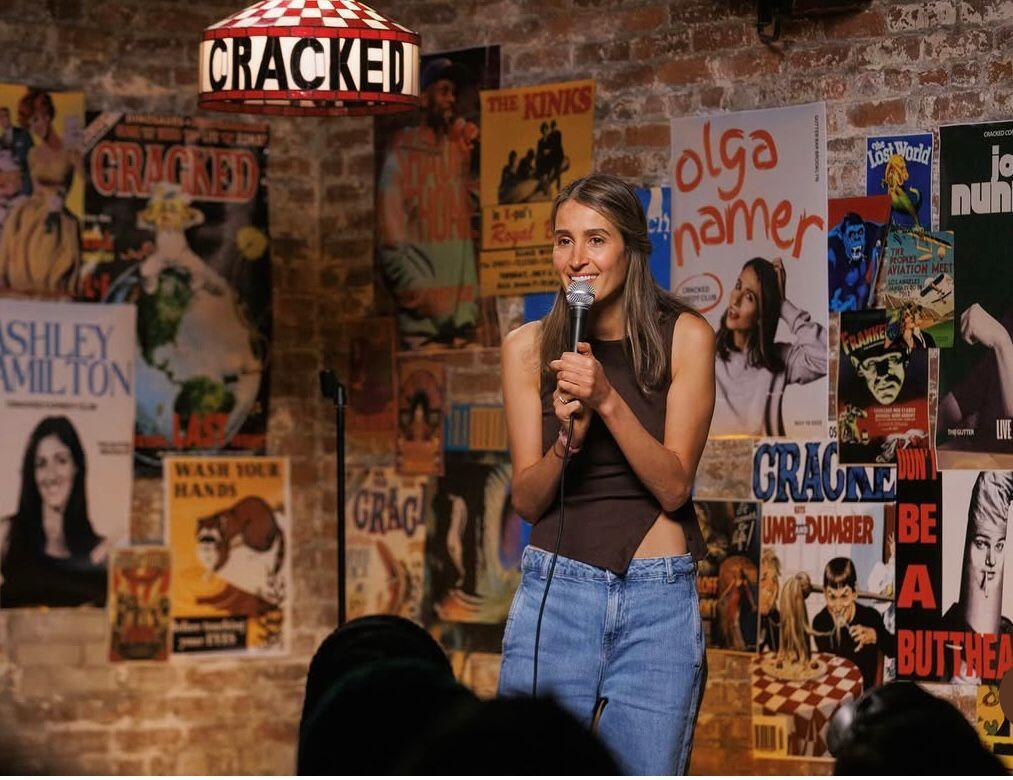
Olga Namer
(Photo: Private album)
Doing everything for Israel
Namer may want to write “cleaner,” but perhaps her most famous joke features another Jewish woman: Monica Lewinsky. Namer says, in extreme humor, that she is so patriotic and cares so deeply about Israel-U.S. relations that she would be willing to do for the president of the United States what Monica Lewinsky did for Bill Clinton in the 1990s — and even more — all just to ensure continued American support, funding and weapons for Israel.
“Once, after one of the shows, a woman of Palestinian descent came up to me and told me that bit was bad. I asked her: ‘You wouldn’t put a *** in your mouth for Palestine?’ She answered no, and I said: ‘Then you don’t love Palestine enough.’ When I say Jews would do anything for Israel, Jews understand it immediately. That’s how most of us grew up. My father is proud of me for that.”
Namer says she writes for 18 minutes every day — “chai minutes,” she jokes, using the Hebrew word associated with the number 18 and life — in an effort to come up with new material for her act.
“A lot of times I think of something, I have a direction but no punchline — and then I go to an open mic, and there, onstage, it suddenly comes to me. My brain tries to save it. I’m under constant pressure to refresh and write new material. I’ll probably always write about family, religion and dating, but maybe in a cleaner way.”
What is the next step?
“I want to do more shows, be stronger on social media, and my big dream is television. I really want to write a series about ‘bad girls’ in an ulpana,” she said, referring to a religious girls’ high school. “There were many of us in our teens who wore skirts at school, but in the evening we were completely different. The whole dynamic between the girls, the competitiveness, the family backgrounds and the relationship with religion — there is great material here. I hope I write it well and can take it to television.”