

Can ten days in Israel change the way an American college student sees the Jewish state? For hundreds of non-Jewish student leaders, the answer may be yes. Through Jewish National Fund-USA's Caravan for Democracy, students from across the United States are given the opportunity to experience Israel beyond the headlines, meet Israelis from different backgrounds and discover a country that is often very different from the one portrayed on social media.
Since its launch in 2012, the fully subsidized, ten-day program has brought more than 700 students from over 120 American universities to Israel. Speaking with ynet Global, Dr. Logan Levkoff explained that the goal is not simply to educate students about Israel, but to encourage independent thinking, meaningful conversations and relationships that continue long after participants return home. "It has been an absolute joy to witness how 10 days in Israel can change people's minds," she said.
Dr. Logan Levkoff interview at ynet podcast studio


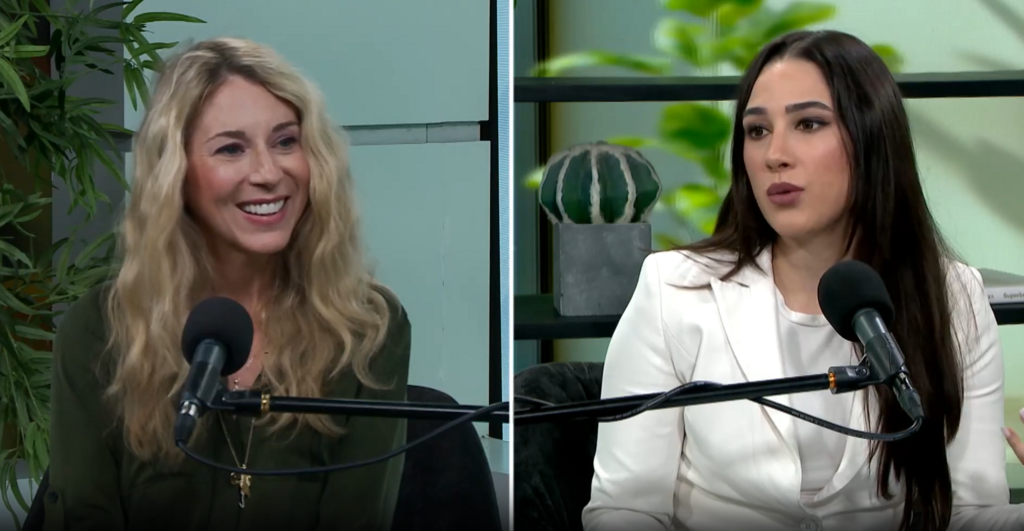
According to Levkoff, many participants arrive with preconceived ideas shaped by years of news coverage and online debates. What surprises them most, however, is often something remarkably ordinary: Israeli everyday life. "They see that Israeli life looks a lot like American life," she explained, describing people going to work, attending school and spending time with friends. Yet the experience also exposes students to the country's complexities. "They come to Israel with 50 questions, they leave with 500 more," she said, emphasizing that the program is not designed to provide simple answers to difficult questions.
Some experiences, however, have an impact far beyond what organizers anticipate. Levkoff recalled one former participant who approached her nearly a year after visiting Israel with unexpected news: she had decided to convert to Judaism. When Levkoff asked what had inspired the decision, the student recalled a Shabbat evening during the trip. "It was the first time I felt God," she told her. Levkoff stressed that religious conversion is neither the objective nor an expectation of the program, but the encounter illustrated just how deeply personal the experience can become.
The connections extend beyond individual transformations. Participants have developed friendships with Israelis, established academic and professional relationships and, in some cases, returned to Israel for further studies. Levkoff also described how the program brings together American students with opposing political views, giving them an opportunity to discover shared values through experiences and conversations. At a time when political polarization often makes dialogue difficult, she believes these unexpected connections are among the program's most meaningful achievements.
The challenge becomes particularly significant when students return to American campuses, where discussions about Israel can be highly contentious. Some participants, Levkoff acknowledged, face criticism even before departing for Israel, while others encounter hostility after sharing their experiences. But she believes firsthand knowledge gives them a different perspective. She recalled students challenging professors and questioning claims about Israel based on what they had personally witnessed. "That was not what I saw. I was just there," she said, describing the kind of response students have brought back to campus discussions.
Dr. Logan Levkoff
The program welcomes non-Jewish student leaders from diverse backgrounds, including Christian and Muslim participants. Recruitment takes place through universities, organizations, alumni recommendations and public nominations. Levkoff explained that organizers are looking for students who are willing to question assumptions, engage with complexity and share their experiences with others. For her, the most important conversations are not necessarily about politics, but about human connections and understanding what everyday life is like for people their own age in Israel.
With the next Caravan for Democracy mission scheduled for December, Levkoff hopes the experience will continue to inspire students to challenge simplistic narratives and build lasting relationships. Asked what single challenge she would give the next group of participants, her response was immediate: "I don't have to give them a challenge to take home because everyone leaves here challenged." Whether that means speaking up on campus, changing perceptions or finding a way back to Israel, she believes the real impact begins when the students return home.
For Levkoff, the message is ultimately about the power of personal experience in a world increasingly shaped by online narratives. Rather than relying solely on arguments, statistics or social media, she believes there is no substitute for meeting people face-to-face. And sometimes, ten days on the ground can open conversations that years of debate never could.