

This week, we read the double portion of Tazria-Metzora, which deals extensively with the laws of Tzara’at (often translated as leprosy).
These chapters cover the entire process, starting from the initial diagnosis of the lesion on the skin, through various intermediate stages of isolation and monitoring, and concluding with the procedures of purification.
Gallery

Rehearsal of Passover sacrifice ceremony held by the Temple Mount faithful and Temple activists in 2023
(Photo: Eitan Elhadez Barak)
The Priest (Kohen) as the protagonist
For two full chapters, the Kohen appears nearly 100 times. He is the one who sees, quarantines the afflicted, declares them impure, and eventually purifies both the person and their belongings. When a person is healed, the Torah describes how the Kohen goes out to the area "outside the camp." This suggests a leader who does not simply wait for people to come to him but "goes out to the people" to personally verify if the healing process has begun.
Beyond the spiritual-physiological diagnosis, the Kohen serves as an agent of transition, who guides the individual from the outside back in, from impurity to purity, and from isolation back to a life of action within the community. In this context, "purity" is not merely a new personal healing status, but an institutional recognition that the individual is ready to function within society again.
The rise of the 'parrot' Kohen
Given this biblical backdrop of absolute authority, the Mishna in Tractate Negaim presents a startling development: "All are fit (authorized) to see (rule on) the lesions (negaim), but the declaration of impurity and purity is in the hands of the Kohen."
The Mishna explains that while anyone, even a non-Kohen, can diagnose the “leprosy” and other lesions, the formal declaration must still be recited by the Kohen. The Kohen is told exactly what to say: "Say 'impure'" and he says "impure"; "Say 'pure'," and he says "pure." While this preserves the technical requirement of the Kohen's declarative prerogative, it essentially empties his role of its substance. He becomes a mere herald or a "parrot," repeating the words of an expert who actually understands.
In Midrash Torat Kohanim the scenario described as an "Erudite Israelite" examines the plague and instructs the “fool" (shoteh) Kohen what to say. This evolution suggests that the reality on the ground had changed; expert Kohanim were no longer available, and the community could not be left to the whims of an unlearned leadership.
Economic and professional decay
What led to this decline in the Kohen’s expertise? A clue is found in Midrash Tanhuma. Citing the prophet Ezekiel, who lamented that "her priests have abused My law. Between the sacred and the profane they did not distinguish, and between the impure and the pure they did not make known" the Midarash says: “But the gifts (terumah) of the Tabernacle, the Holy One Blessed be He called it by His own name, as it is stated: 'And they shall take for Me an offering (terumah)'."
The issue appears to be economic. While Kohanim were entitled to terumah (gifts or tithes) from the harvest, there were parts of their job that offered no direct financial reward. If a Kohen had to travel to a remote house in the north or south of the country to inspect a case of “leprosy,” there was no one to fund that effort. Consequently, over time, the Kohanim neglected the knowledge that did not yield a profit. They focused on the "holy" work of the Sanctuary while abandoning the public service meant to serve the people in their everyday lives.
This created a sharp contrast between "funding for infrastructure" like the Temple, and securing funding and status for Kohens that stayed among their own “holy” colleagues versus serving the public.
A warning for leadership
The image of the "fool Kohen" serves as a modern warning for any religious or political leader, judge or official. If a person in a position of power requires a chain of interlocutors, political operatives, clerks, assistants or committees to interpret reality for them because they are ignorant of the law or disconnected from the "real world," their formal authority becomes hollow.
Public trust cannot be sustained by a title alone. When everyone can see that the person in charge either lacks actual competence or is separated from the people or matters of the day, the "shell" of formal authority eventually crumbles. The technical requirement for the Kohen to speak might remain, but the public embarrassment of his ignorance and irrelevance is a "wake-up call" that his significant influence is evaporating. It is not only personal. The hollowing, growing irrelevance and ensuing irreverence it invites is institutional. The Kohen and the Priesthood is just not what it once was and it should serve as a warning.
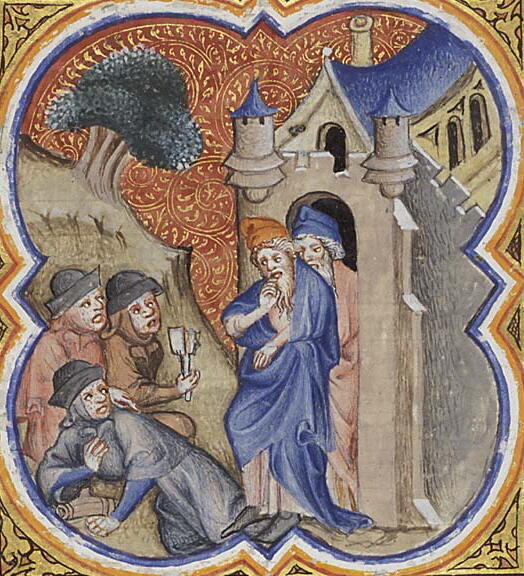
Four lepers bring the news to the guards at the gate of Samaria
(Illustration: illustrator of Petrus Comestor's 'Bible Historiale', France, 1372)
Salvation from the outcasts
This theme of disconnected leadership reaches its peak in this week's Haftarah reading in 2 Kings 6-7. During a horrific famine in Samaria caused by an Aramean siege, the king and his high officials were paralyzed. When the prophet Elisha predicted an abundance of food within 24 hours, the king’s "shalish" - a high-ranking official - mocked the prophecy, refusing to believe change was possible.
Ultimately, salvation did not come from the palace or the priesthood, but from four lepers sitting outside the city gates. Driven by hunger and having nothing to lose, they entered the Aramean camp only to find it miraculously abandoned. After initially looting for themselves, they realized they could not keep this knowledge a secret, and brought the news to the city.
When the political or religious leadership and bureaucracy are disconnected from reality, ignoring changes in the real world, legal field, the economy or technology, it is often the "outcasts" and the marginalized who see the truth and bring redemption. When this happens, the old, stagnant systems collapse. As the Haftarah concludes, the skeptical official who represented the detached establishment was trampled by the people at the gate, unable to survive the shift in reality he failed to foresee.