

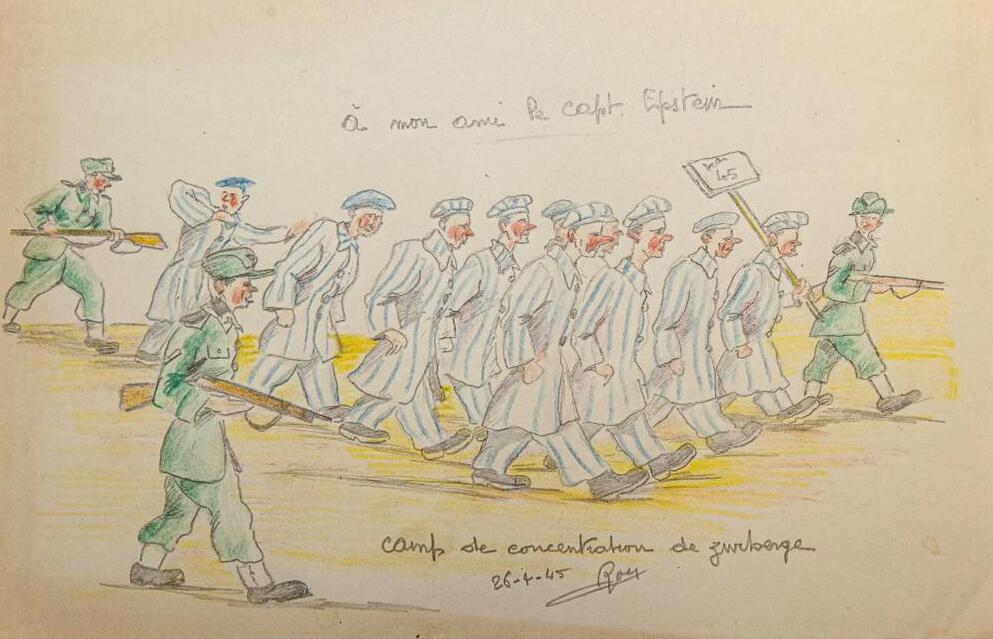
More than 20 rare sketches from a Nazi concentration camp, discovered by chance in a closet in a private home in Westchester County, New York, are now being displayed for the first time in an exhibition at Manhattan University. The drawings were created by Marcel Roux, a member of the French Resistance, after his liberation from the Langenstein-Zwieberge camp in Germany. They were originally given as a gift to U.S. Army doctor Capt. William Epstein.
The works were preserved in an old leather portfolio and forgotten in the doctor’s home for decades. Epstein, who served during World War II, later returned to New York and worked as a hospital physician in Manhattan. After his death in 1990, his widow, Ruth, left the home, and in 1993 the property was purchased by Kenneth and Helen Orce.
While renovating their new home, the couple discovered the leather portfolio in one of the closets. It bore a single inscription with Epstein’s name and a request to return it “to Field Hospital No. 20.” Inside were the drawings, along with postcards, wartime photographs and personal notes. The Orces contacted Epstein’s widow to ask whether she wanted the portfolio returned, but she declined.
Several years later, the couple reached out to the art archives at Yad Vashem, Israel’s Holocaust memorial in Jerusalem, to verify the origin of the works. Representatives confirmed that the drawings were indeed by Roux, who was not Jewish and survived nearly three years in Sachsenhausen before being transferred to Buchenwald and ultimately to Langenstein-Zwieberge. Following the authentication, Kenneth Orces, a retired attorney and alumnus of Manhattan University, decided to donate the collection to the Catholic university in the Bronx.
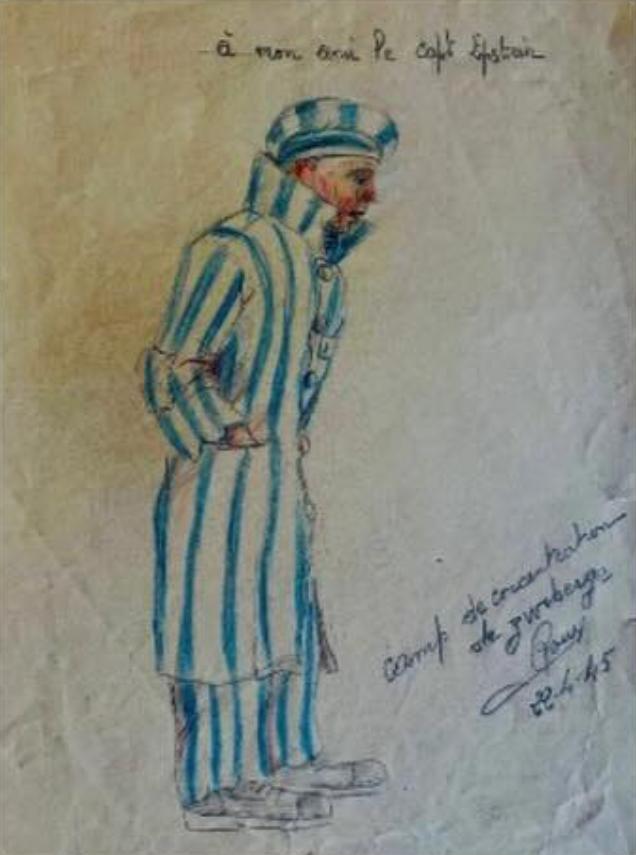
Sketch of a concentration camp prisoner
(Photo: Marcel Roux via Manhattan University)
The sketches themselves document life inside the camp, including long lines for food, a striped-uniformed prisoner being beaten by guards, and emaciated victims of starvation lying on the ground. Professor Mehnaz Afridi, director of the Center for Holocaust, Genocide and Interfaith Education at Manhattan University, noted that Roux used colored pencils on graph paper to create the drawings. She also pointed to the mystery surrounding the materials available to him — as he was not a professional artist — raising questions about how he obtained drawing paper and pencils amid the ruins in the days following liberation.
Afridi said Roux sought to present, visually, everything he had endured in the camp. She added that he was desperate to tell his story, and that drawing was the only way he could do so, dedicating the works in French to his friend, Epstein. The sketches, believed to have been created quickly, now serve as rare testimony to the horrors endured by prisoners in the final moments before their return to freedom.
First published: 13:59, 04.13.26