

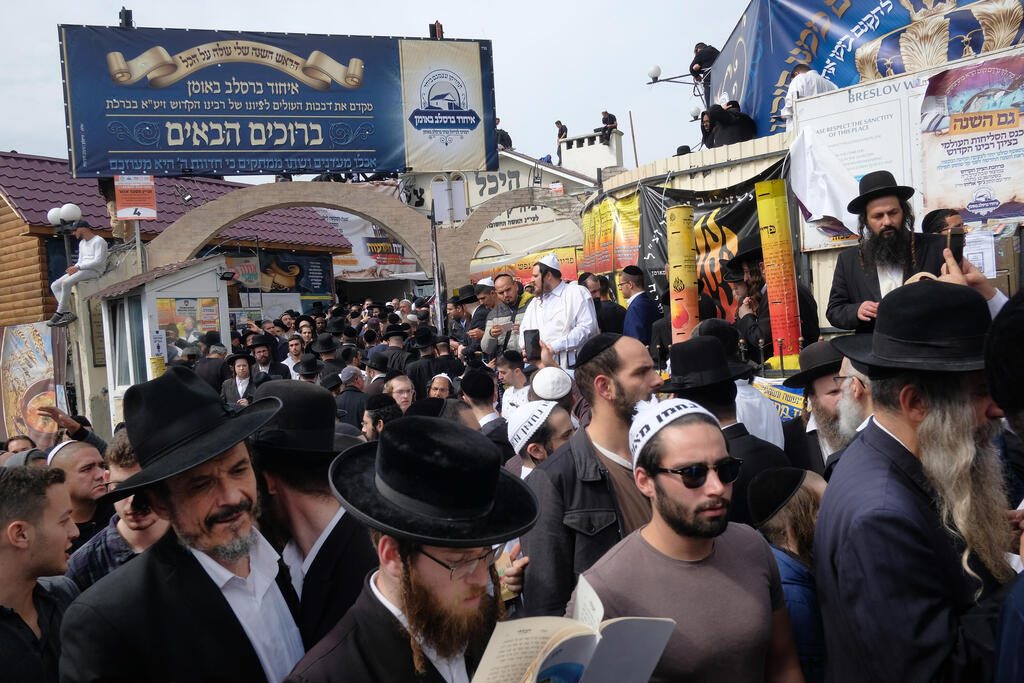
For generations of Breslov Hasidim, spending Rosh Hashanah in Uman, Ukraine, near the grave of Rabbi Nachman of Breslov has been one of the most important events of the year. But in recent years, simply getting there has become increasingly difficult.
First came the coronavirus pandemic and the closure of international borders. Then Russia’s invasion of Ukraine shut the country’s airports and turned the journey into a complicated overland trek.
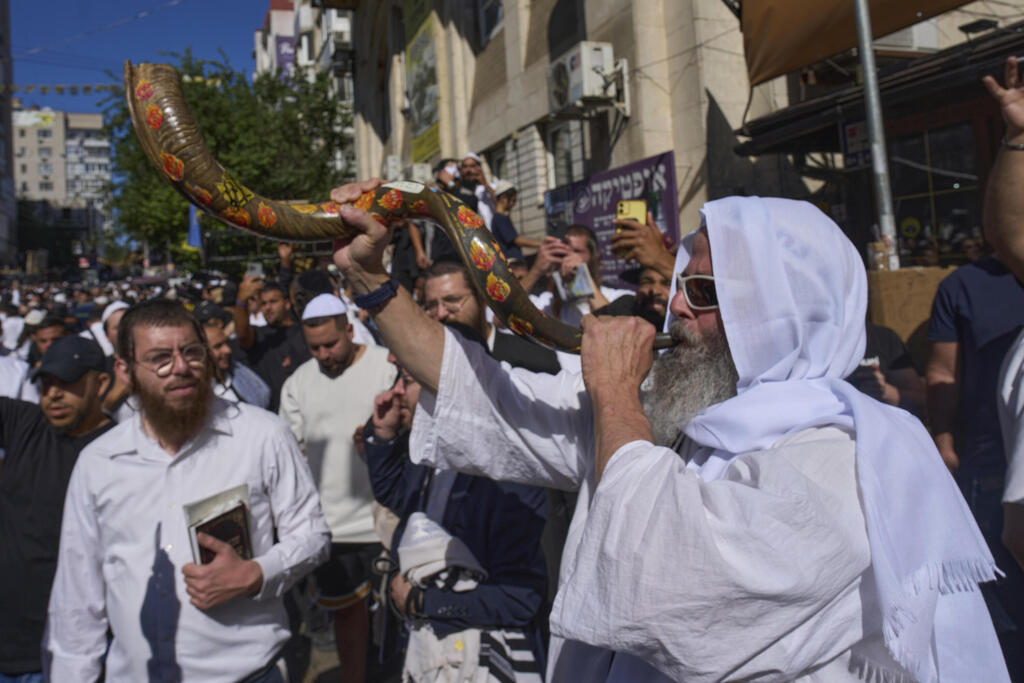
Now another concern is keeping some worshippers in Israel: fears among draft-age men that they could be arrested or face legal proceedings over alleged draft evasion after leaving the country and returning home.
Against that backdrop, hundreds of Breslov Hasidim are preparing to spend Rosh Hashanah at the Adama V’Shamayim farm in Yavne’el, near the Sea of Galilee, in an attempt to recreate the atmosphere and schedule of Uman without leaving Israel.
For many Breslov followers, the difficulties involved in reaching Uman are themselves part of the spiritual experience. Some believe that the harder the journey, the greater the merit in reaching Rabbi Nachman’s grave for the holiday.
But organizers of the Israeli gathering say there is also a need to provide an alternative for those who cannot make the journey, whether because of the war, family circumstances or concerns connected to their military draft status.
Organizers are preparing tents, vacation cabins and large communal sleeping areas for the expected participants.
“Uman is always special, and all the preparations around it are exciting,” said Nachman Ravani, one of the organizers together with Rikdusha Productions.
“This year we are holding a kibbutz for people who, for all kinds of reasons, cannot make it to Uman, or for families where the father travels and the children and wife stay at home,” he said.
“We follow what is happening in Uman and do everything here at the same times, according to their schedule, including tashlich at the farm. The idea is to create the atmosphere of Uman here.”
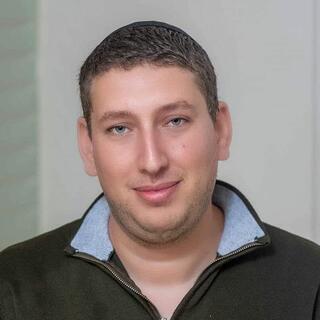
The prayers will be led by Rabbi Yanki Zilberman, who served as a cantor in Uman for 20 years.
Zilberman said soldiers are also expected to attend the gathering. He himself will spend the holiday between reserve-duty rotations, after serving in Gaza and ahead of another deployment in Lebanon.
“This year I’m not traveling to Uman,” he said. “The truth is that in recent years, since the war began, I haven’t gone.”
“Last year I was serving in the reserves in Gaza, and this year I finished reserve duty two days ago. Immediately after Yom Kippur I begin another reserve stint in Lebanon.”
“So this year I’m taking the opportunity to be with this wonderful group here, which essentially recreates Uman in the prayers, the times, the way the food is served, the singing and tashlich. We will do everything at the same time it is happening in Uman.”
Zilberman said those who spend the holiday in Yavne’el will experience the same prayers, sermons and timetable followed by worshippers in Uman.
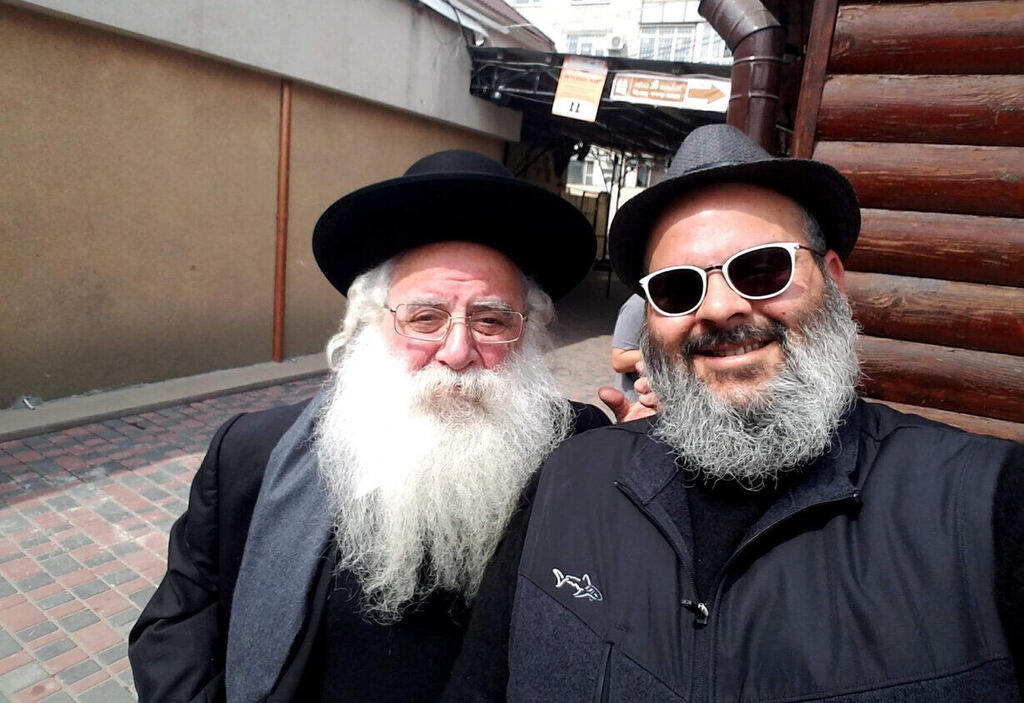
Yanki (right) and his father, Rabbi Haim Zilberman, in Uman
“Whoever is here feels the same prayers, the same sermons and the same atmosphere, only with more experiences,” he said.
“And of course, this is the Land of Israel, our place, the place of our forefathers. There is nothing more blessed than that.”
The challenges involved in reaching Uman have changed repeatedly in recent years.
Since Ukrainian airspace was closed because of the war, pilgrims have been forced to fly to neighboring countries and continue by road or rail. According to Zilberman, some worshippers are prepared to endure extraordinary journeys in order to reach Rabbi Nachman’s grave.
“Every year since coronavirus and since the war in Ukraine, we hear about more and more international crises that make reaching Uman difficult,” he said.
“We hear about people walking through entire forests, taking three trains, each lasting half a day, and doing everything possible to reach the tzaddik.”
For some Israeli worshippers this year, however, the dilemma is not only how difficult the journey will be, but whether leaving the country could expose them to trouble when they return.
Young men whose military draft status is unresolved may fear arrest or other legal consequences over alleged draft evasion after coming back to Israel, making the traditional pilgrimage a potentially much more consequential decision.
Zilberman said he does not believe the growing obstacles diminish the significance of Uman itself.
“Who am I to prevent people from reaching Rabbi Nachman?” he said. “There is no doubt that there is meaning in a person making an effort and facing trials on the way to the tzaddik.”
“Just last week we heard that a bridge connecting the route to Uman was blown up, once again making the journey harder and creating traffic jams.”
At the same time, he argues that Breslov spirituality does not depend entirely on physical proximity to the gravesite.
(Photo: Sean Gallup / Getty Images)
Zilberman, who served as director of Kyiv’s Jewish community for nearly two decades, recalled that in the early 2000s several rabbis argued, based on historical maps, that Rabbi Nachman’s exact burial place was not precisely beneath the site identified today.
“They gave an answer that still holds today, and probably will until the Messiah comes,” he said.
“Where several Jews came and believed that the Rebbe was there, and prayed, asked and cried with all their hearts, the Rebbe became present there. The Rebbe comes there.”
For Zilberman, the same principle can apply to the gathering in northern Israel.
“And that is true here as well,” he said.
“When we are a group of hundreds of Jews who come and believe with all their souls, first of all that we are in the Holy Land, which Rabbi Nachman spoke about endlessly, about the sanctity of the Land of Israel and how important and great it is, and when we believe that our Rebbe is here with us too, that he himself is with us in the prayers, then he is with us.”
Zilberman said his years in Uman included leading prayers and delivering the sermon before the blowing of the shofar, a moment he describes as the spiritual high point of the year.
“For many years I was a cantor in Uman, and I also gave the sermons there before the shofar blowing,” he said.
“That is the peak of the year, the sermon before the shofar. I have been doing it for many years, and every year I get emotional all over again.”
The organizers say the Yavne’el event is not intended only for committed Breslov Hasidim, but for a broader range of Israelis seeking to experience the communal atmosphere associated with Uman.
“I invite everyone, because it is an experience,” Zilberman said.
“The most liberal people, the most open people, people who love music, people who love singing together, people who eat together with generosity and wish one another a good and sweet year.”
“From the level of the catering to everything people are working so hard to provide so that it will be comfortable, it really is worth coming.”