


London Metropolitan Police Commissioner Mark Rowley warned that Britain’s Jewish community is facing “the gravest threat in its history.” He accused social media platforms of spreading a “plague” of antisemitism that cannot be solved through police enforcement alone.
Rowley made the remarks days after an attack in London this week in which two Jewish men, ages 76 and 34, were stabbed in the northwest neighborhood of Golders Green. The incident is being treated as an antisemitic hate crime.
Cries of 'shame' as London police commissioner speaks at the site of the antisemitic stabbing of 2 Jewish men


In an interview with Times Radio over the weekend, Rowley said Jews had become the focus of a “ghastly Venn diagram" of hatred, targeted by extremists on the far left and far right, terrorist organizations and hostile state actors. He said police can deal only with the “symptoms,” while governments over the years have failed to address the “disease” itself.
Rowley praised the officers who arrested the attacker, calling them heroes, after they faced public criticism for being unable to subdue him on their own and needing help from Jewish passersby. He called for a broad national discussion on the scale of hostility toward Jews, and stressed the need for an immediate reinforcement of security forces, including the recruitment of about 300 additional officers and the deployment of permanent forces in Jewish residential areas in northwest London.
Gallery

Scene of the stabbing of two Jewish men in the London neighborhood of Golders Green
(Photo: Justin Tallis / AFP)
According to Rowley, current data show that one in six young people in Britain questions the official narrative of the Holocaust, a figure he said reflects the depth of the problem. “When you combine hate crimes, terrorism and hostile state activity, together with the spread of ideology online, you get a very dangerous picture,” he said.
Rowley added that social media platforms are “normalizing” antisemitism and making it part of mainstream discourse. “This is no longer a matter of a handful of extremists, but an entrenched phenomenon that is not being challenged enough in the public arena.”
“Every racist or extremist or terrorist group has a list of people they hate because they all create an ‘other’ who they want to blame everything on and visit everything on. The ghastly fact is that Jews are on everybody’s list, all of those hateful groups, whether you’re extreme right, whether you’re extreme left, whether you’re Islamist terrorist, whether you’re right-wing terrorist, and some hostile states as well now with some sort of Iranian-related threats," he said.
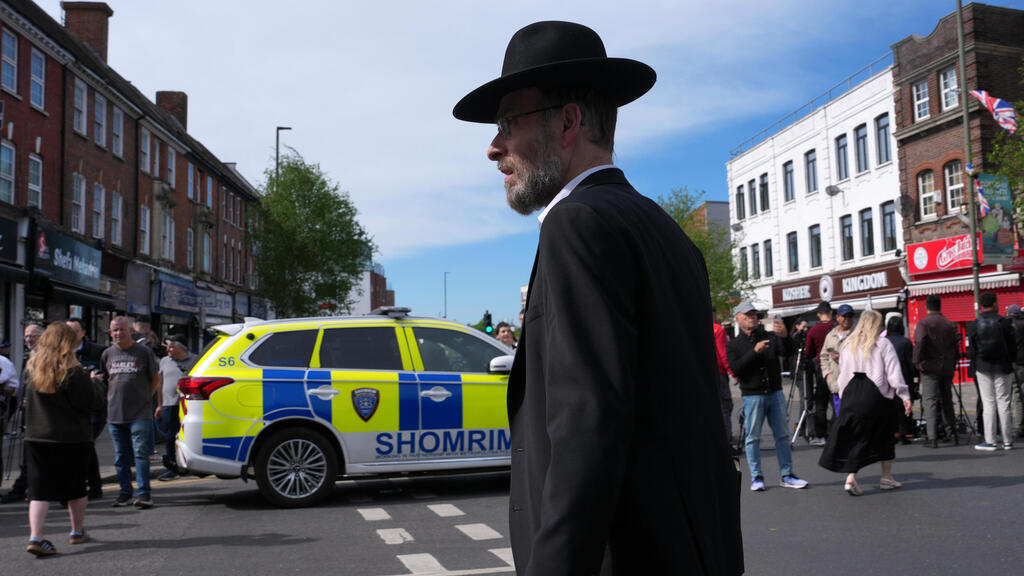
The scene of the stabbing attack in the Golders Green neighborhood of London
(Photo: Kin Cheung/AP)
He concluded that current efforts focus on treating the symptoms of antisemitism, but that the root of the problem must be addressed to prevent hatred from spreading in the future. He expressed genuine concern that unless the issue is confronted, Jews in Britain will find themselves not only under strain, but in real danger.
Other figures also voiced concern. Sara Khan, a human rights activist and former head of the Home Office’s counterextremism unit, warned of a national democratic emergency and argued that successive British governments had ignored the rise of antisemitism for years. She said Jews are “the canary in the coal mine” — an early warning sign of approaching danger — and the first to be harmed by broader processes threatening society as a whole.
Khan stressed the need for legislative action and systemic approaches. She argued that government inaction could lead to a growing number of antisemitic incidents, calling for a deeper understanding of the severe implications of these phenomena for society as a whole.