

For the third consecutive Saturday, a small café on Jerusalem's Agrippas Street has found itself at the center of one of the city's most enduring fault lines: the struggle over public life on the Sabbath.
Each week, dozens of ultra-Orthodox demonstrators have gathered outside Café Basimta, protesting its decision to remain open on Saturdays. Inside, patrons sip coffee while supporters of the café arrive to show solidarity, turning the business into both a neighborhood gathering place and a symbol in the broader debate over religion and state in Israel.
Police disperse ultra-Orthodox protesters outside Café Basimta in Jerusalem
(Video: Liran Tamari, Alex Kolomoisky)


The protests were organized by activists from the Edah HaChareidis, an umbrella organization representing several anti-Zionist ultra-Orthodox communities in Jerusalem. While the group is known for leading some of the city's most hard-line religious demonstrations and generally rejects the legitimacy of the State of Israel, organizers say the campaign has also drawn support from figures associated with the ultra-Orthodox political mainstream, including Jerusalem Deputy Mayor Tzahi Brim and City Council member Yochanan Weitzman.
At the heart of the dispute is the café's decision to operate on Shabbat, when observant Jews refrain from work and commercial activity. Although Israel has no nationwide law prohibiting businesses from opening on Saturdays, the issue is often regulated locally and remains one of the country's most contentious religious and political questions. Jerusalem, home to large secular, religious Zionist and ultra-Orthodox populations, has long maintained an uneasy balance over Sabbath commerce.
"This isn't just Sabbath desecration. It's a finger in the eye," protest organizers, who spoke on condition of anonymity, said.
They argued that the Mahane Yehuda market and nearby Agrippas Street have historically served predominantly ultra-Orthodox, religious Zionist and traditionally observant communities, with businesses typically remaining closed on Saturdays.
"Mayor Moshe Lion has turned Mahane Yehuda into Jerusalem's entertainment district on weekends," they said. "Ultra-Orthodox residents live on both sides of the café. They're trying to bring Sabbath desecration into our neighborhood, and once that begins it can spread."
The organizers also alleged that the café is operating without a business license and that local zoning regulations do not permit the sale of prepared food at the site.
"They say we're the lawbreakers," one organizer said. "But he's the one breaking the law."
Gallery
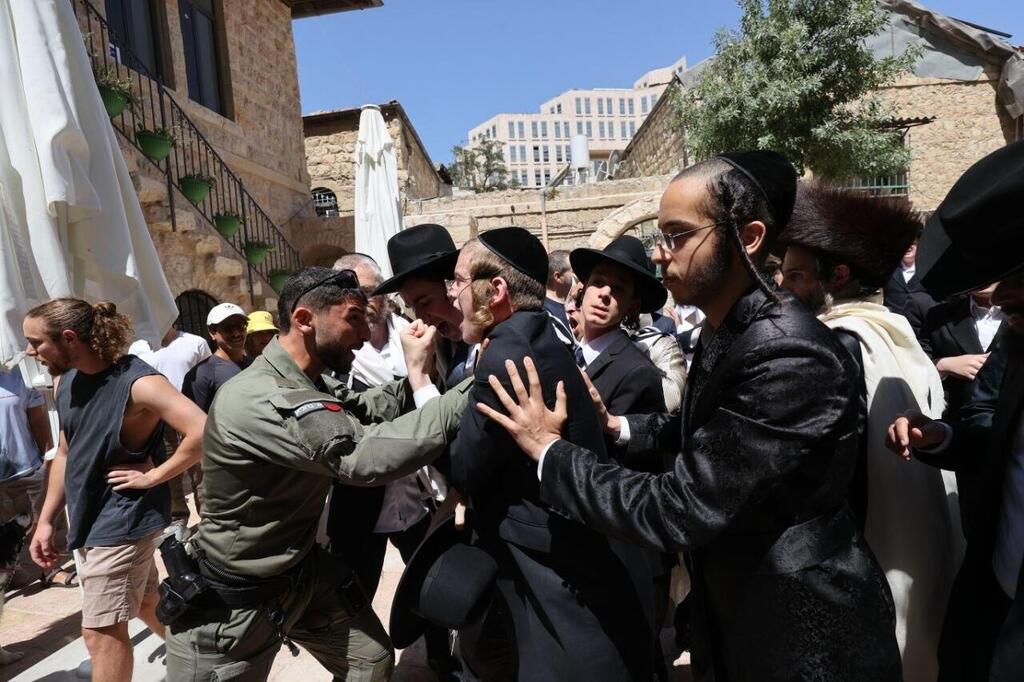
Police disperse ultra-Orthodox protesters outside Café Basimta in Jerusalem
(Photo: Alex Kolomoisky)
The protesters also alleged that the café is owned by Christian missionaries, a claim that has intensified opposition among some religious groups.
Asked whether the demonstrations themselves bring additional police officers, journalists and photographers into the area on Shabbat, organizers said leading ultra-Orthodox rabbis had ruled that protesting Sabbath violations does not itself constitute a religious prohibition.
"There are rulings from all the leading rabbis, including Rabbi Yosef Shalom Elyashiv, that there is no prohibition," one organizer said. "We're protesting someone else's Sabbath desecration. We didn't invite the police. They decided to come."
Jerusalem Deputy Mayor Yitzchak Meir (Tzahi) Brim, who has participated in the demonstrations, said the city must preserve what he described as Jerusalem's delicate religious balance.
"We cannot stand by in the face of such harm," Brim said. "Precisely in a place where maintaining the balance is so sensitive, any attempt to change reality by force could ignite unnecessary division. Jerusalem is the Holy City, and the Sabbath is its lifeblood. We will use every tool at our disposal to preserve Jerusalem's Jewish character and the sanctity of the Sabbath."
City Council member Yechiel Weitzman, who represents the Ger Hasidic dynasty, said the café was operating without a license "in the heart of an ultra-Orthodox area" and harming the sanctity of the Sabbath.
"I believe the Sabbath should be preserved throughout Jerusalem," he said. "But in another neighborhood there might be fewer demonstrators. Here it's right next to people's homes, so they come out to protest."
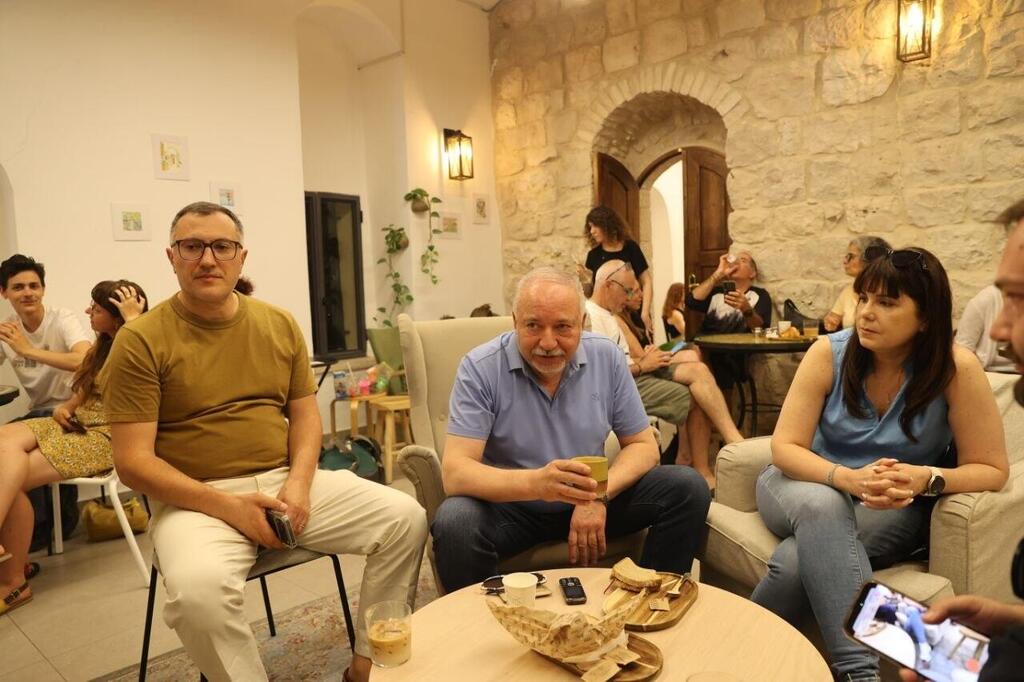
Yisrael Beitenu Chairman Avigdor Liberman (center) visits Café Basimta in Jerusalem to show support for the business amid protests over its decision to remain open on the Sabbath
(Photo: Alex Kolomoisky)
The Committee for the Sanctity of Jerusalem, the Edah HaChareidis body coordinating the demonstrations, accused Mayor Moshe Lion of promoting what it described as the secularization of Jerusalem.
"The café is breaching the boundaries that have protected the sanctity of the Sabbath in these ultra-Orthodox, religious and traditional neighborhoods," the group said in a statement. "This is an aggressive step by Mayor Moshe Lion as part of a broader effort to secularize Jerusalem, particularly its city center. The protest will continue with greater intensity and expand to additional communities that observe the Torah and commandments. We will not relent until this offense is removed."
Café owner Yoel Ben David rejected the protesters' characterization of the neighborhood.
"This is not an ultra-Orthodox or religious area. It's mixed," he said. "There are secular neighbors in the next building and there are ultra-Orthodox residents, but this isn't Mea Shearim."
Responding to claims that the business lacks a license, Ben David said many new businesses begin operating while completing final municipal approval processes.
"The municipality allows businesses to begin operating while they're still completing the final approvals," he said. "We're working with the city, and all the permits should be completed soon."
Ben David acknowledged that the company operating the café is owned by Jews for Jesus, an evangelical Christian organization whose mission includes sharing its belief that Jesus is the Jewish Messiah. The group is widely viewed by mainstream Jewish religious authorities in Israel as engaging in missionary activity.
"The company that operates the café is owned by Jews for Jesus, and I am also a Jew for Jesus," Ben David said. "I'm not hiding that. But we're a café. There are no crosses on the walls or anything like that. Anyone who wants to talk about it is welcome, and anyone who just wants to come for coffee is welcome too."