

More than half a century before Theodor Herzl published The Jewish State, a Sephardic rabbi living on the banks of the Danube was already writing about Jewish national representation, international diplomacy, land purchases, organized immigration to the Land of Israel and the revival of Hebrew.
His name was Rabbi Judah Alkalai.
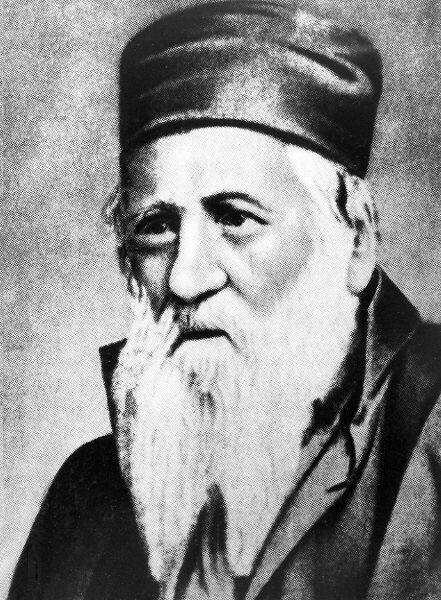
Today, 148 years after his death, Alkalai remains a relatively marginal figure in the popular story of Zionism. Yet many of the ideas he advanced decades before Herzl would later become central features of political Zionism. The connection is made even more intriguing by one biographical detail: Herzl’s grandfather was a member of Alkalai’s synagogue.
In 1865, when Alkalai was already an elderly man and many of his contemporaries remained unconvinced by his ideas, he wrote what reads almost like a testament to future generations.
“For 25 years a fire has burned within me, the love of the desirable land desired by our holy ancestors, and I cry aloud for the settlement of the land,” he wrote. Even though he heard that some rabbis opposed such efforts, he added, “I did not retreat, for I said: Let this be written for the final generation.”
Roughly three decades later, Herzl published The Jewish State. In 1897, he convened the First Zionist Congress in Basel. But long before then, Alkalai had already formulated several ideas that would become pillars of modern political Zionism.
An annual memorial ceremony will be held Tuesday to mark the anniversary of his death, offering an opportunity to ask why one of the most original early thinkers of the Jewish return to Zion is remembered by so few.
From Sarajevo to Zemun
Alkalai was born in Sarajevo in 1798 to a Sephardic family descended from Jews expelled from Spain. From 1825, he served as a prayer leader and teacher in the Sephardic community of Zemun, known then as Semlin and today part of Serbia, and later became the community’s rabbi.
Zemun was an unusual place in which to develop such ideas. Sitting close to Belgrade on the frontier between the Ottoman and Habsburg worlds, it lay in a region where different peoples were struggling for national independence. Alkalai was surrounded not simply by Jewish communities, but by political movements seeking to transform national identity into statehood.
Another formative encounter came in 1839, when he met Rabbi Judah Bibas of Corfu in Bucharest. Alkalai subsequently developed one of the most distinctive concepts in his thought: that teshuvah, usually understood as personal religious repentance or return, could also possess a national meaning.
There was, he argued, a “general return”: the return of the Jewish people to their land.
The idea marked a profound shift. Redemption was no longer something Jews were merely expected to await. It became a process in which they were expected to act.
In 1843, Alkalai published Minhat Yehuda, setting out a practical program for Jewish return and settlement. He expanded on those ideas in numerous later writings.
Don’t wait for a miracle
Jews had prayed for Zion for centuries. Rabbis had written extensively about redemption and the Messiah, and individuals and communities had moved to the Land of Israel long before Alkalai.
His innovation was to turn that yearning into something resembling a national plan.
Alkalai spoke of organizing the Jewish people, creating a representative body, conducting diplomacy with major powers, raising money, purchasing land, establishing agricultural communities, developing commerce and productive labor, and reviving Hebrew as a language capable of uniting Jews from different countries.
In one of his most striking formulations, Alkalai wrote that only two things stood in the way of the “general return”: “the permission of the kings of the earth and the expenses of the journey.”
In a single sentence, redemption became almost a diplomatic and financial program. International legitimacy was needed, and so was money.
Alkalai did not regard such human action as a rejection of faith. On the contrary, he believed divine providence operated through people, governments and historical events. The human task was to recognize an opening and act upon it.
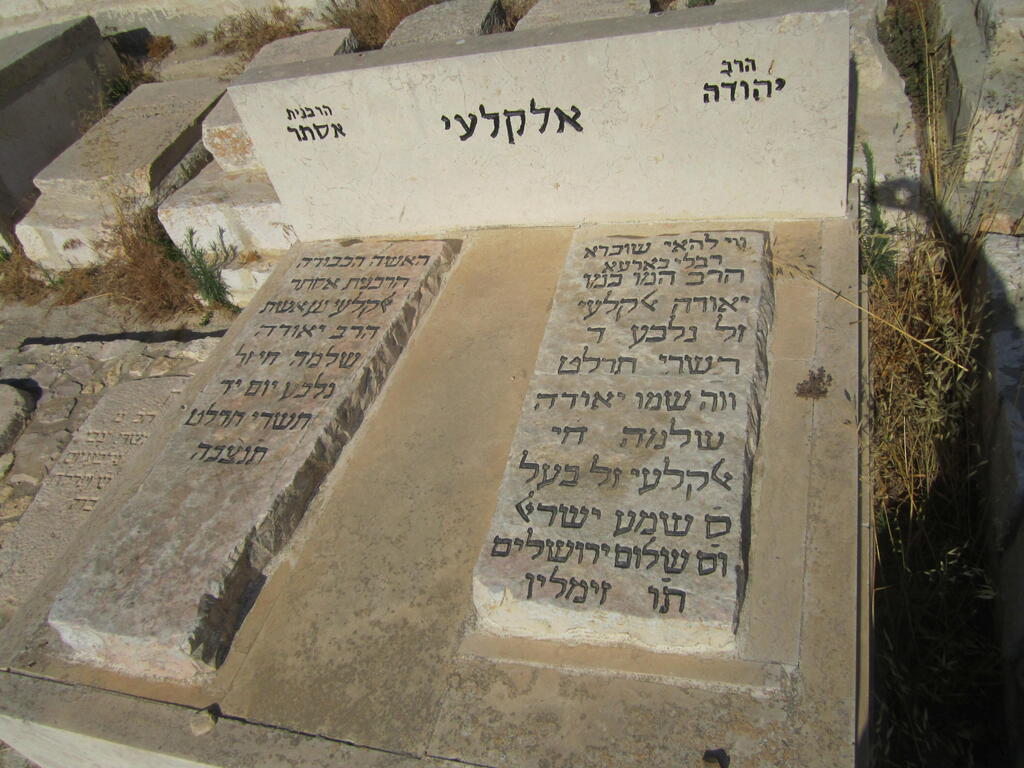
The grave of Rabbi Judah Alkalai and his wife Esther on the Mount of Olives
(Photo:Wikipedia)
That outlook also shaped the way he viewed the upheavals around him. The national movements of Serbs, Greeks and other peoples made a deep impression on him. If they could organize to establish national frameworks of their own, he asked, why should the Jews not do the same?
The Damascus Affair of 1840 also became an important turning point. Alkalai watched as prominent Jewish leaders, including Moses Montefiore and Adolphe Crémieux, intervened internationally on behalf of the Jews of Damascus after they were falsely accused of ritual murder.
For Alkalai, the episode demonstrated that international Jewish solidarity already existed. If Jewish leaders could mobilize governments and influence foreign capitals to protect one endangered community, then perhaps they could also act on behalf of the Jewish people’s political future.
He spent years trying to persuade rabbis, philanthropists and communal leaders. He traveled through Europe, established societies devoted to settlement in the Land of Israel, published his ideas and repeatedly appealed to influential Jews.
Much of the response was discouraging. Some rabbis rejected the notion that human beings should actively initiate redemption, while many liberal Jews in Europe felt little enthusiasm for renewed Jewish nationalism at precisely the moment they were gaining civil rights in their countries of residence.
Alkalai persisted.
“If reason does not do it,” he wrote, “time will.”
Herzl’s grandfather sat in his synagogue
Then comes one of the more intriguing connections in the story.
Among the worshippers in Alkalai’s synagogue in Zemun was Simon Loeb Herzl, the grandfather of Theodor Herzl. He served as a synagogue official and blew the shofar during the High Holy Days in Alkalai’s congregation.
His son, Jakob Herzl, later moved to Pest, where Theodor Herzl was born in 1860. The family moved to Vienna only in 1878.
Did Herzl hear stories from his grandfather about Alkalai and his plans for the Jewish return to the Land of Israel? It is certainly plausible, but there is no evidence establishing a direct intellectual influence.
Nor is such a claim necessary to appreciate the historical connection.
The grandfather of the man who would eventually found the Zionist Organization worshipped in the synagogue of a rabbi who, decades earlier, had already called for Jewish national representation, international diplomacy and organized settlement in the Land of Israel.
The connection gained a symbolic new chapter last month when the remains of Simon and Rivka Herzl were brought from Zemun to Israel and reburied on Mount Herzl, near their grandson.
A family circle that began along the Danube thus closed in Jerusalem.
He eventually followed his own call
Alkalai did not merely urge others to move to the Land of Israel.
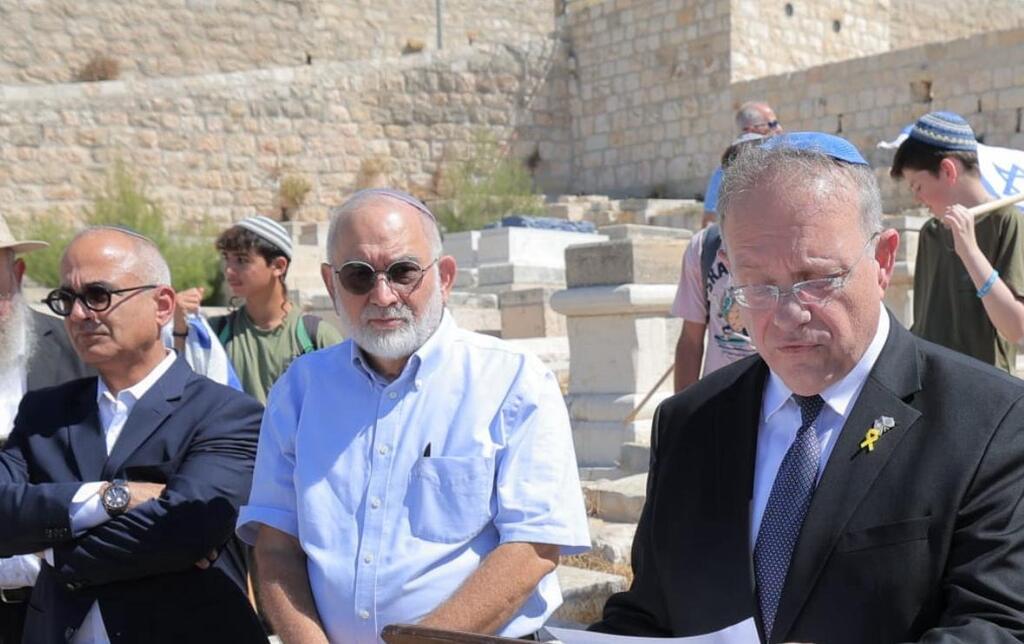
From right: Yaakov Hagoel, chairman of the World Zionist Organization; Prof. Yitzhak Kraus; and attorney Rami Simani, a member of the Herzl Forum and one of the organizers of the Rabbi Judah Alkalai memorial event
(Photo: Omri Segan)
In 1871, already in his 70s, he traveled there to examine settlement possibilities. In 1874, he and his wife Esther moved permanently to the country. Four years later, he died in Jerusalem and was buried on the Mount of Olives.
Herzl was 18 at the time. The two never met.
Yet when The Jewish State appeared in 1896 and the First Zionist Congress convened a year later, Alkalai’s writings already contained striking parallels: national representation, Jewish organization across borders, diplomacy with world powers, systematic financing, land purchases and the creation of practical foundations for national life in the Land of Israel.
They were not the same doctrine, the same man or the same historical moment. But they shared one fundamental breakthrough: the movement from hope to action.
Why Alkalai still matters
Remembering Rabbi Judah Alkalai does not require taking anything away from Herzl.
Herzl transformed an idea into an international political movement and gave political Zionism an organizational force it had never previously possessed.
Alkalai matters for a different reason. His life shows that Zionism did not suddenly appear with one book, one congress or one individual. Its intellectual roots were broader, older and more diverse.
Among those roots was a Sephardic rabbi in the Balkans who combined traditional Jewish learning with close attention to the nationalist movements of his own age. He saw no contradiction between faith and politics, redemption and diplomacy, or Zion and productive labor.
For him, the Land of Israel was not merely a destination toward which Jews should pray. It was a practical responsibility.
Many of his contemporaries did not listen.
So Alkalai wrote for another audience: “Let this be written for the final generation.”
A century and a half later, that generation may finally be ready to read him.
- Rabbi Prof. Yitzhak Kraus researches the thought of Rabbi Judah Alkalai at Bar-Ilan University