

The First Temple, built by King Solomon in the 10th century BCE, became far more than a religious and administrative center. It developed into a meta-historical axis around which the consciousness of the Jewish people was shaped.
The differences between the account of its construction in the Book of Kings and the version presented in the Book of Chronicles reveal how the Temple’s absolute sanctity was built, layer by layer. Chronicles, written during the Second Temple period, regards the Temple as the center of everything, an event whose importance eclipses even the Exodus from Egypt.
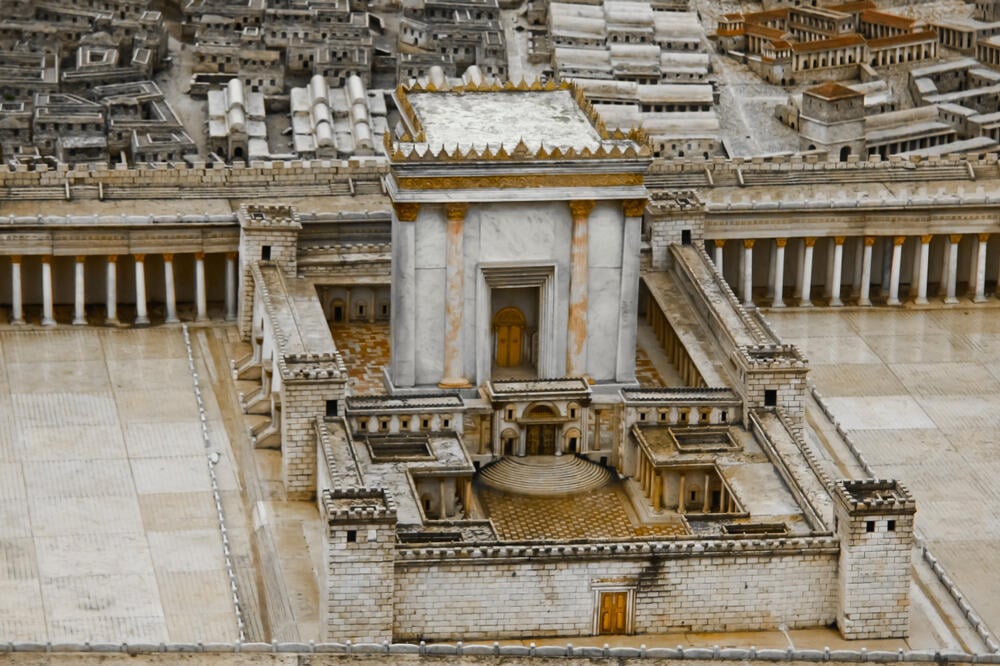
To elevate the Temple, the later author reshaped the character of its builder, Solomon, into a model of perfection. Chronicles also explains why David was denied the privilege of building it: “But God said unto me: Thou shalt not build a house for My name, because thou art a man of war, and hast shed blood” (I Chronicles 28:3).
The distinction gives precedence to Solomon, the man associated with peace and prosperity.
In describing Solomon’s reign, Chronicles omits the bloody succession struggle, disregards his marriages to foreign women and overlooks the heavy burden he imposed on his people. That burden was later invoked by his son Rehoboam: “My father made your yoke heavy, but I will add to your yoke; my father chastised you with whips, but I will chastise you with scorpions” (I Kings 12:11).
According to the Book of Kings, these failures helped bring about the division of the kingdom.
Chronicles effectively ignores the kingdom’s division. Moreover, while Solomon’s wisdom in Kings is human, judicial and scientific, in Chronicles it is directed almost entirely toward one purpose: the construction and glorification of the Temple.
Solomon is presented as the ideal human being, worthy of building a sanctuary intended to embody the belief that the Temple was eternal.
That belief, which eventually became both a religious and a security doctrine, received its most decisive historical reinforcement during the reign of King Hezekiah, when the Assyrian king Sennacherib invaded Judah in 701 BCE.
Archaeological findings, the Book of Kings and Assyrian records indicate that the region of Lachish was devastated, Judah’s fortified cities were captured and Sennacherib boasted that he had trapped Hezekiah “like a bird in a cage.”
Jerusalem was also harmed, but escaped total destruction and exile after Hezekiah paid the Assyrian king an enormous tribute. He was even forced to strip material from the Temple:
“So the king of Assyria appointed unto Hezekiah king of Judah three hundred talents of silver and thirty talents of gold. And Hezekiah gave him all the silver that was found in the house of the LORD, and in the treasures of the king’s house. At that time did Hezekiah cut off the gold from the doors of the temple of the LORD, and from the door-posts which Hezekiah king of Judah had overlaid, and gave it to the king of Assyria” (II Kings 18:14-16).
Military pressures elsewhere in the Assyrian Empire also compelled Sennacherib to return north.
Yet in the collective consciousness, the contrast was striking. The neighboring Kingdom of Israel had been erased by Assyria roughly 20 years earlier, in 722 BCE, while Jerusalem and its Temple remained standing.
Their survival was interpreted as decisive proof that Jerusalem and its sanctuary enjoyed divine protection.
The prophet Isaiah reinforced that understanding by depicting Assyria as merely an instrument in God’s hand. Its wars against other peoples, including Judah, took place as part of a divine mission to punish them: “O Asshur, the rod of Mine anger, in whose hand as a staff is Mine indignation!” (Isaiah 10:5).
Isaiah also prophesied that the Assyrian king would be punished for his hubris, for believing that his empire had been created by his own power.
By contrast, the biblical account emphasizes that God guarded His Temple and saved Jerusalem from exile: “For I will defend this city to save it, for Mine own sake, and for My servant David’s sake” (Isaiah 37:35).
The psalmists similarly declared: “And He built His sanctuary like the heights, like the earth which He hath founded for ever” (Psalms 78:69), and, “They that trust in the LORD are as Mount Zion, which cannot be moved, but abideth for ever” (Psalms 125:1).
For a century, the belief that the Temple was Jerusalem’s physical insurance policy became deeply entrenched.
Jeremiah shattered the illusion
The prophet Jeremiah sought to break that illusion with an almost anarchic boldness.
Standing in the Temple courtyard before crowds of pilgrims, he confronted them with words that sounded like treason against both the monarchy and religion:
“Behold, ye trust in lying words, that cannot profit. Will ye steal, murder, and commit adultery, and swear falsely, and offer unto Baal, and walk after other gods whom ye have not known, and come and stand before Me in this house, whereupon My name is called, and say: ‘We are delivered,’ that ye may do all these abominations? Is this house, whereupon My name is called, become a den of robbers in your eyes?” (Jeremiah 7:8-11).
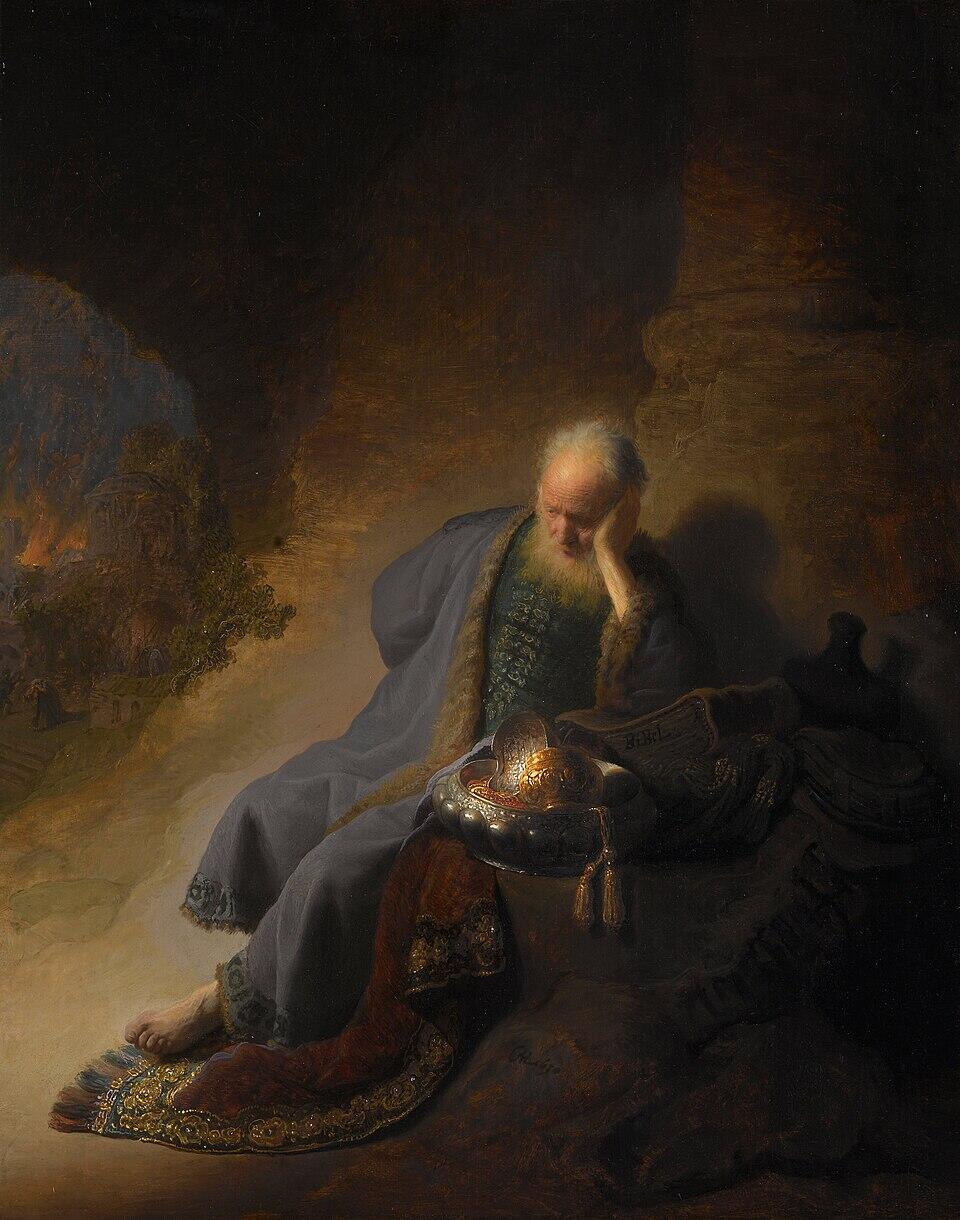
Jeremiah lamenting the destruction of Jerusalem, a 17th-century painting by Rembrandt
Jeremiah challenged the magical understanding of ritual. He made clear that stones possessed no independent sanctity and that the people’s continued presence in the land depended entirely on moral conditions, including the protection of the stranger, the orphan and the widow.
To demonstrate that no sanctuary was immune from destruction, he cited a historical precedent: the destruction of the Tabernacle at Shiloh by the Philistines in the 11th century BCE.
“Therefore will I do unto the house, whereupon My name is called, wherein ye trust, and unto the place which I gave to you and to your fathers, as I have done to Shiloh” (Jeremiah 7:14).
Jeremiah’s words destabilized the prevailing conception that the Temple could not possibly be destroyed. The people and the authorities treated him as a false prophet, placed him on trial and declared that he deserved death.
Only the intervention of Ahikam son of Shaphan prevented his execution.
The people refused to listen. The belief in the Temple’s immunity had become a psychological shield too powerful to allow doubt to penetrate it.
This psychological mechanism, the search for supernatural immunity during war and crisis, did not disappear with the ancient world.
In her masterful novel History: A Novel, Elsa Morante describes with psychological precision the feelings of Rome’s residents during World War II. Air raid sirens sounded repeatedly, but the residents of the San Lorenzo district remained convinced that Rome would never be struck because it was protected by the pope, whom they called the capital’s “air defense.”
Rome, and San Lorenzo in particular, was ultimately devastated by Allied bombing.
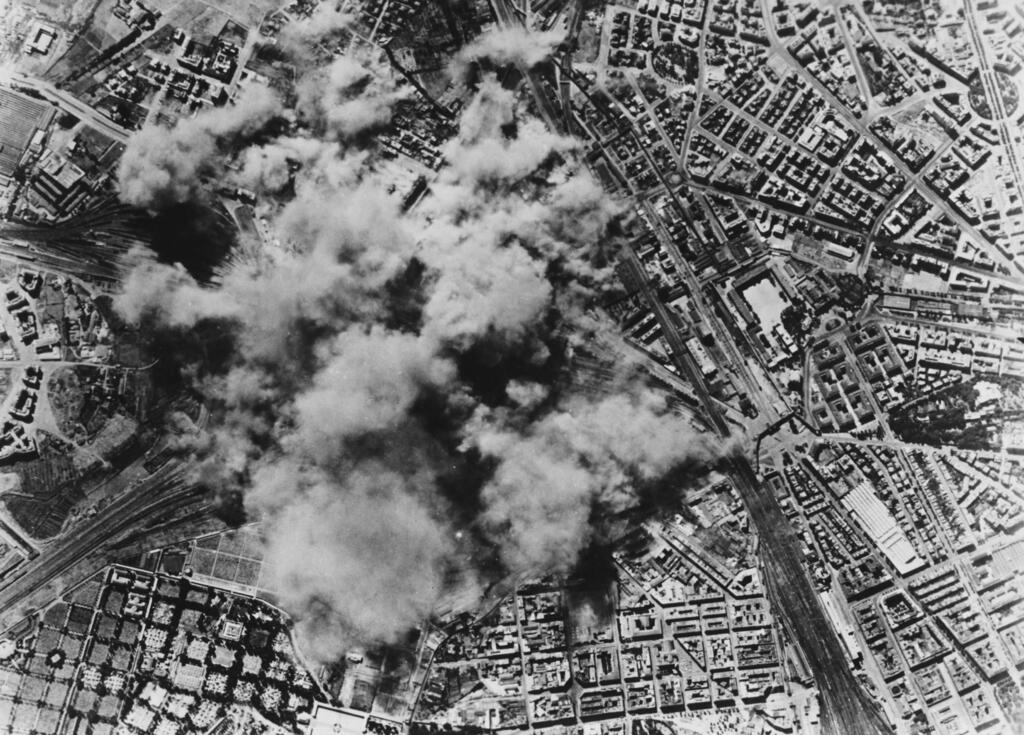
Allied bombing of Rome during World War II, July 19, 1943
(Photo: Keystone / Hulton Archive / Getty Images)
Jerusalem met a similar fate in 586 BCE. The Temple was burned, the doctrine of immunity collapsed and the people were sent into exile.
Yet at that moment, amid the ashes of destruction and exile, the dynamic miracle of Jewish existence began.
Exile did not bring annihilation. Instead, it produced a moment of disillusionment and set in motion an unprecedented spiritual revolution.
The prophet Ezekiel, writing by the rivers of Babylon, redefined the relationship between place and divinity. He introduced the revolutionary notion of a mikdash me’at, a “little sanctuary,” later interpreted by the sages as the synagogue.
The understanding that God was to be served not only through burnt offerings but through prayer, the “service of the heart,” transferred sanctity from geography to text and time.
The status of Shabbat grew stronger in exile. It came to be regarded as equivalent to the Temple, a sanctuary within time that was portable and indestructible, expressing the eternal covenant:
“Moreover also I gave them My sabbaths, to be a sign between Me and them, that they might know that I am the LORD that sanctify them” (Ezekiel 20:12).
The idea that God could be worshipped without a Temple and in any location helped develop a universal understanding of divinity, detached from any single earthly place and dwelling instead among the people.
The process reached its culmination in the concept of the Shekhinah, the divine presence, which became synonymous with God’s presence among Israel.
As the Midrash teaches: “Wherever Israel was exiled, the Divine Presence was exiled with them.”
By the Second Temple’s destruction, the mechanism was ready
Following Cyrus’ declaration and the return to Zion, the Second Temple was built.
When it too was destroyed, in 70 CE, the mechanism for Jewish survival without a Temple was already in place.
The sages relate that Rabban Yohanan ben Zakkai, displaying political courage and thinking beyond the accepted boundaries of his time, escaped besieged Jerusalem in a coffin and established a new center at Yavne to replace Jerusalem.
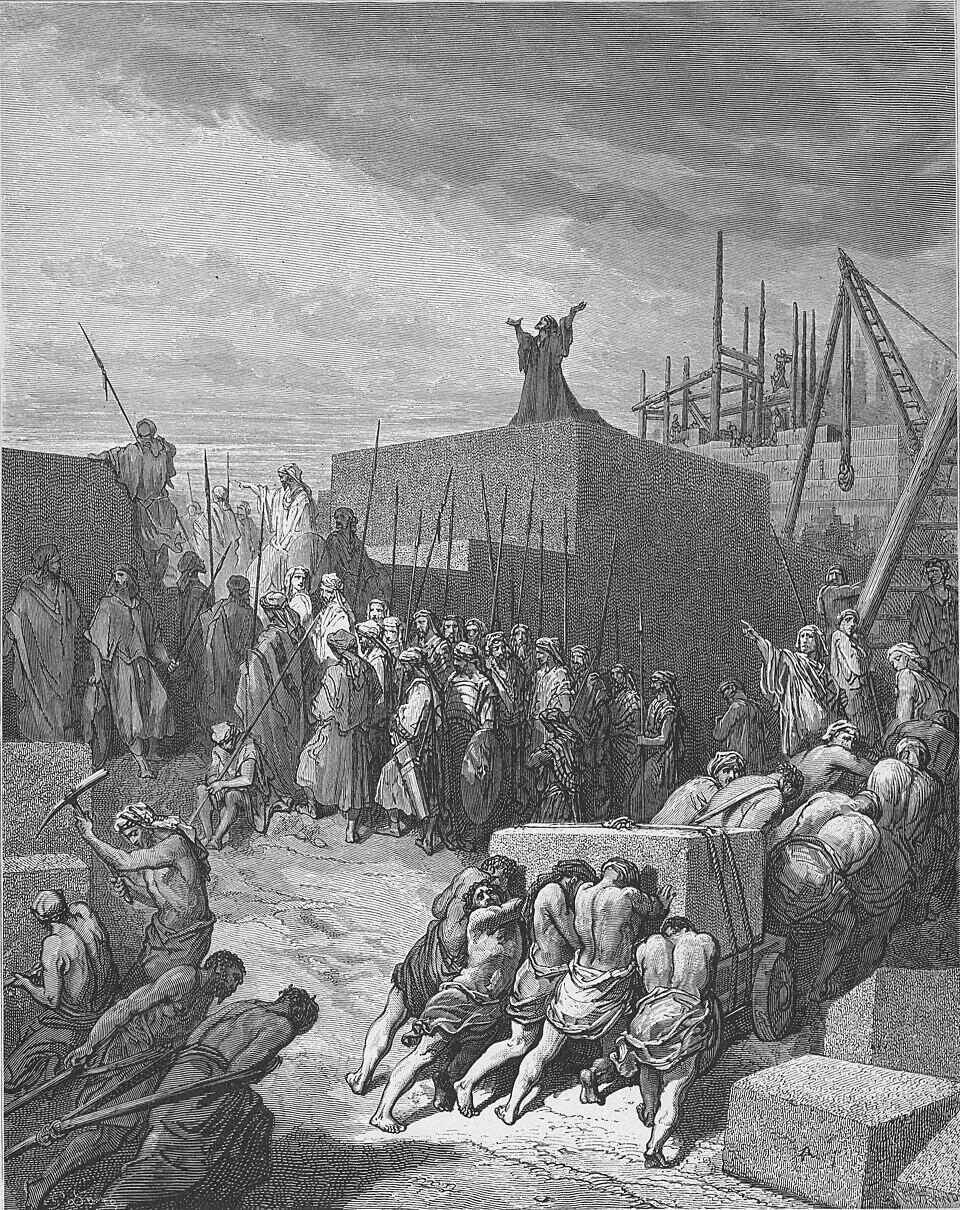
The rebuilding of the Temple begins, an engraving by Gustave Doré
He and his students transmitted the Oral Torah to future generations, creating a dynamic, evolving and living body of law that eliminated the dependence on sacrificial worship and priestly intermediaries.
Paradoxically, accepting the physical death of the structure gave Jewish civilization its enduring life.
Biblical history and Jewish existence offer a lesson that resonates particularly on Tisha B’Av.
Entrenchment in a doctrine of immunity, whether embodied in the stones of a Temple or in modern security theories, inevitably weakens defenses and prepares the way for disaster.
Doubt, constant scrutiny and a willingness to awaken the moral compass at the expense of external ritual are the true safeguards.
Rupture may be catastrophic. But once the stones are released, destruction can also become the birth of the next stage in the evolution of the spirit.
- The writer is a biblical scholar