

At the end of the previous Torah portion, God commanded Moses: "Ascend these heights of Abarim to Mount Nebo... and view the land of Canaan... You shall die on the mountain... because you broke faith with Me... at the waters of Meribath-kadesh" (Deut. 32:49-51).
Naturally, we expect Moses to comply immediately. Instead, this week’s Torah reading opens with Moses postponing God's command, turning first to bless Israel: "This is the blessing with which Moses... bade the Israelites farewell…." Only afterward does he ascend the mountain.
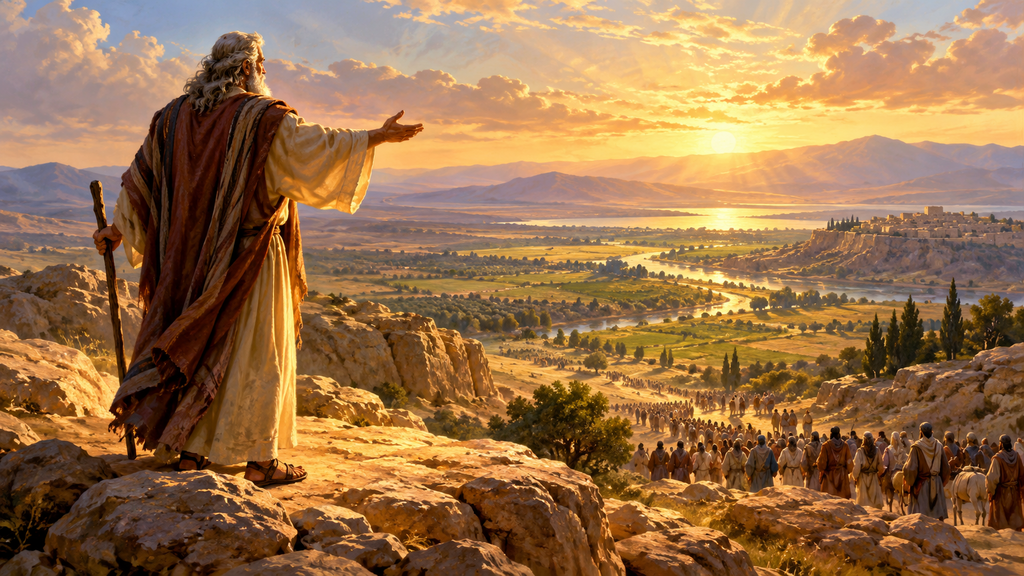
This isn't the first time Moses has delayed his ascent. In Numbers 27, God similarly commanded: "Ascend these heights of Abarim and view the land..." (Num. 27:12). There, too, Moses didn't ascend immediately but requested: "Let the Lord... appoint someone over the community." Joshua was then appointed.
Why is this command repeated, and why does Moses delay both times?
Rashi explains that in Numbers, Moses hoped the decree barring him from the land had been lifted, so God had to make clear that it had not. Ramban suggests the first command was merely advance notice of his passing which will take place this week. Abarbanel proposes these were two distinct commands: the first was to view the land's tribal divisions, enabling Moses to bless each tribe in accordance to its challenges and potential contribution to the nation. The final viewing, described in this week’s reading, was meant to reveal Israel's future history, rather than the Land itself.
Building on Abarbanel’s explanation, we may suggest another layer: In Numbers, Moses saw the land's impending challenges and therefore realized the people needed a leader. However, appointing a leader wasn't enough. The people also needed a vision and a narrative. They had to take an active part in realizing the national vision. And the new leader needed some training and overlap with the departing leader.
Thus, the entire Book of Deuteronomy was born of that first ascent. The book prepares Israel for practical life in the Land, by establishing laws, societal structures, and a covenant. In our Torah reading portion, which is the last portion of the Torah, Moses takes one final opportunity to bless the tribes as they prepare for their imminent national missions: conquering, developing, and defending the Land. He charts the path for building a state. The south-to-north order of his blessings in this week’s portion, echoes the future movement of conquest in the Book of Joshua. Essentially, throughout Deuteronomy, Moses delays his ascent to fully prepare the people and their new leader. Leaders and their legacy are judged by how they prepare their successors.
But, if Moses had already completed these tasks, why did he delay again after God's second command? And why couldn't Moses simply continue leading them himself? I would like to suggest that the answer lies in God's reminder: "because you broke faith with Me... at the waters of Meribath-kadesh". This isn't just about punishment; it highlights the need for a different kind of leadership. At Meribah, God commanded Moses to speak to the rock. Instead, Moses struck it. The people received water, but missed the opportunity to learn how to respond to God's word without their leader using extraordinary power to force a result.
Moses was a leader who did everything for his people: bringing them out of Egypt, navigating the wilderness, and fighting their wars. However, a leader who does everything prevents the people from learning to act independently. Moses cannot enter the Land because the people must learn to bear responsibility for their own destiny.
Realizing this, Moses uses his final moments to deliver "the blessing," empowering the people to succeed on their own. He highlights that each tribe has unique challenges and opportunities. (Notably, Simeon is omitted from the blessings, probably because its territory was entirely absorbed into Judah's and therefore posed no distinct national challenges of its own).
Following the blessings, Moses finally ascends Mount Nebo. God shows him the Land, but from north to south - the exact opposite of the order of Moses' blessings, which moved from the southern tribes to those who settled in the north. This reversal reflects a shift in perspective: Moses showed the people how to build their future, but God showed Moses that their independent choices might lead to a different outcome, as Jeremiah later warned: "From the north shall disaster break loose" (Jer. 1:14). Moses cannot continue striking rocks to fix their mistakes; the next steps belong entirely to the people of Israel themselves.
Did Moses' monumental effort bear fruit? Or perhaps he should have ascended the mountain right after the first command and been gathered to his kin? During Joshua's lifetime, there is no doubt that delaying his ascent and asking God to appoint the next leader was the right thing to do. But the Book of Judges, which describes the time after Joshua, reveals that the people had not yet fully embraced their responsibility. A cycle of sin, crisis, and rescue by temporary judges emerged. The judges deliberately served for limited periods, reflecting the hope that the people would learn to function independently and will establish a model society of civic responsibility.
The Torah concludes by presenting a stark contrast to the Garden of Eden story at its beginning. In Eden, humanity lived idly, lacking the need for agency or responsibility, which led to the sin of eating of the forbidden fruit. At the end of the Torah, Moses' ultimate goal is to instill within the people the courage to take full responsibility for their economic, security, and educational destiny.
"This is the Teaching that Moses set before the Israelites." (Deut. 4:44)