

Organizations know how to prepare for competitors, regulation and disruptive technology, but they struggle much more to identify the threat that emerges from within: ego, interests, habits and decisions that have already lost their logic.
Managers invest time and resources identifying external threats. They analyze competitors, monitor regulation, prepare for new technologies and examine declining demand. Each of these threats can usually be named, researched and addressed with a plan. But the hardest threats to detect are not necessarily outside the organization. Sometimes they are already inside it.
Rabbi Yitzhak Arama explains that the principles of warfare do not deal only with external conflict, but also with the battle taking place within the system itself, and sometimes within a person’s own character.
The internal enemy is deceptive because it almost always sounds reasonable. It can appear as an ego that struggles to admit a mistake, a fear of change presented as responsible conservatism, a product that has already lost its future but has absorbed millions in investment, or a department’s interest that gradually becomes more important than the interests of the company as a whole.
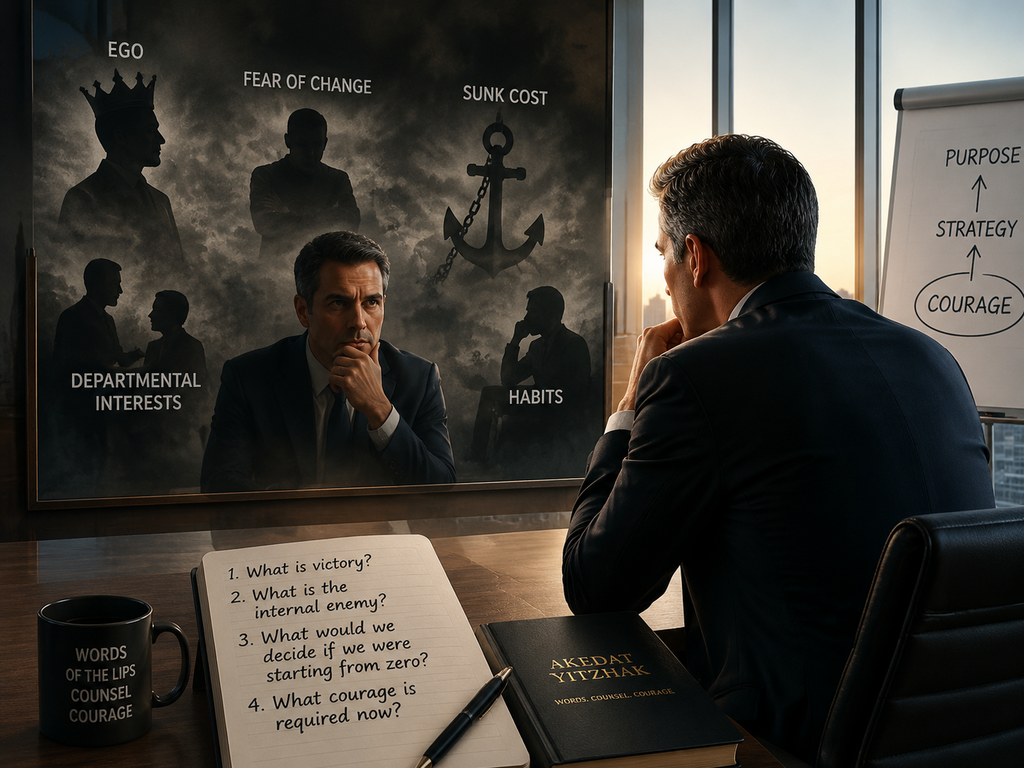
(Image generated by ChatGPT)
A manager may be deeply committed to a product they have built over years and therefore struggle to see that the market has already moved on. A department may honestly defend its budget even when the organization needs those resources elsewhere. Management may continue investing in a project not because it believes in it, but because admitting failure would force it to confront past decisions.
In behavioral economics, the phenomenon known as the “sunk cost fallacy” is well established: the tendency to allow what we have already invested to influence a decision that should be made according to the future. Money, time and reputation that have already been spent cannot be recovered, yet precisely because we have invested so much, it becomes harder to stop.
This is where the connection to Aristotle becomes particularly interesting. In Book Seven of Nicomachean Ethics, he discusses weakness of will — the situation in which a person knows intellectually what is the right thing to do, but acts differently because desire, passion or impulse overcomes them at the moment of decision. The problem is not always a lack of knowledge. Sometimes we know exactly what is right, and the question is whether we can act accordingly.
In this sense, leadership is not tested only by the ability to identify the right decision, but also by the ability to make that decision when it harms one’s ego, status or the story the manager has told employees and the board.
The author of Akedat Yitzhak offers three components for a successful campaign: “words of the lips,” “counsel” and “courage.” These three concepts fit almost perfectly into a management meeting as well.
“Words of the lips” is the ability to define precisely what the organization is fighting for and what victory looks like. Many organizations enter a campaign before deciding what they actually want to achieve. They want more customers, greater exposure and more activity, but do not ask where all of it is supposed to lead. Without a clear goal, it is very easy to win the wrong battle.
“Counsel” is strategy. If an organization wants to change its culture, it is not enough to announce it. It must examine whether incentives, budgets, measurements and decision-making processes actually support the desired behavior. An organization that says it wants innovation but punishes every small failure is, in practice, teaching its people to avoid risk.
The third component, “courage,” is the hardest of all. It is the moment when action is required: stopping a project, parting with a beloved product, giving up control, listening to criticism or admitting that a decision one defended is no longer correct. The sages defined courage by asking: “Who is mighty? One who conquers his inclination.” In the boardroom as well, courage is measured not only against competitors, but against ourselves.
There is a moment when the problem is no longer a lack of information, but the ability to see what we prefer not to see. In the language of prayer: “Grant us the wisdom to understand and gain insight.” Sometimes the data is already on the table, but the heart still struggles to accept the conclusion. That is precisely where the internal battle described by the Akedat Yitzhak begins.
I have seen this in my own professional life as well. There were situations in which we invested time, money and emotion into a product, while signs were already appearing that we needed to change direction. In one case, I managed to recognize it in time and make the decision to leave. In another case, in hindsight, I probably chose not to see the signs clearly enough. That is one of the lessons I carry into the month of Elul as well: true self-examination does not end with identifying the mistake, but requires deciding what we will do differently from this point forward.
This dilemma also appears in an interesting way in the insurance market. The issue of temporary discounts in life insurance illustrates how the “internal enemy” can also operate at the level of consumer decision-making. A low introductory price attracts attention in the present, while future costs feel distant and less tangible. But in life insurance, the ability to switch insurers in the future is not always simple. Age and health status may change, and therefore long-term cost has particular significance.
This is a clear example of what is known as “present bias”: the tendency to place excessive weight on immediate benefits while undervaluing future costs. Organizations do the same thing. The current quarter’s target defeats an investment that will mature in three years, avoiding a difficult conversation today creates a larger problem six months from now, and an immediate improvement in one metric may come at the expense of a long-term customer relationship.
This is where managerial responsibility becomes twofold. The question is not only whether an action is legal, accepted or effective in the short term, but whether the incentive structure causes the organization and its employees to do the right thing even when immediate temptation pulls them in another direction.
The Akedat Yitzhak does not suggest eliminating internal forces. Ambition, competitiveness, money, status and the desire to succeed are not enemies in themselves. An organization needs them. The question is who manages whom. Does profit serve the purpose, or has the purpose become an explanation designed to justify profit? Do metrics serve the company, or does the company operate in order to serve the metrics?
Perhaps that is why the Torah does not say “if you go to war,” but rather “when you go to war.” Some battles cannot be solved through awareness alone. There comes a moment when we must identify the habit, interest or fear that has taken control of the system, name it and make a decision that returns it to its proper place.
The greatest test of a manager is not only whether they know how to lead their people against an external threat. It is whether they can identify the moment when the threat is already inside the organization, and sometimes even sitting in their own chair.
An external competitor can take customers or market share from a company. An internal enemy is more dangerous: it can cause an organization to continue succeeding according to its own metrics while forgetting why it exists.
A management tool: The internal battle test
Before the next management meeting, choose one significant decision that the organization is struggling to make and examine it through four questions:
What is victory? Do we know how to define the outcome we truly seek, rather than only the activity we want to increase?
What is the internal enemy? What ego, interest, fear, habit or past investment may be distorting the decision?
What would we decide if we were starting from zero today? This question helps neutralize the power of sunk costs.
What managerial courage is required now? What is the action we already know is the right one, but are still struggling to take?
“Words of the lips, counsel and courage” are also three tests of leadership: honestly defining the goal, building a path that aligns with it and being brave enough to act, even when the enemy that must be defeated is within us.