

Penina Ben Yosef, who has lived since the early 1960s in Kfar Maimon near the Gaza border, was born as Pesia in August 1940 in Poland, in the midst of World War II. During the Holocaust, she fled with her parents while the rest of her family was murdered. As a child, she endured hunger and deprivation, and after the war wandered across Europe as a displaced person until immigrating to Israel.
Those experiences resurfaced on October 7, 2023, and in the days that followed, when she refused to evacuate her home for nearly three days, despite having a broken leg and only a handgun for protection. She may have survived by chance after dozens of terrorists were killed on their way toward the moshav.
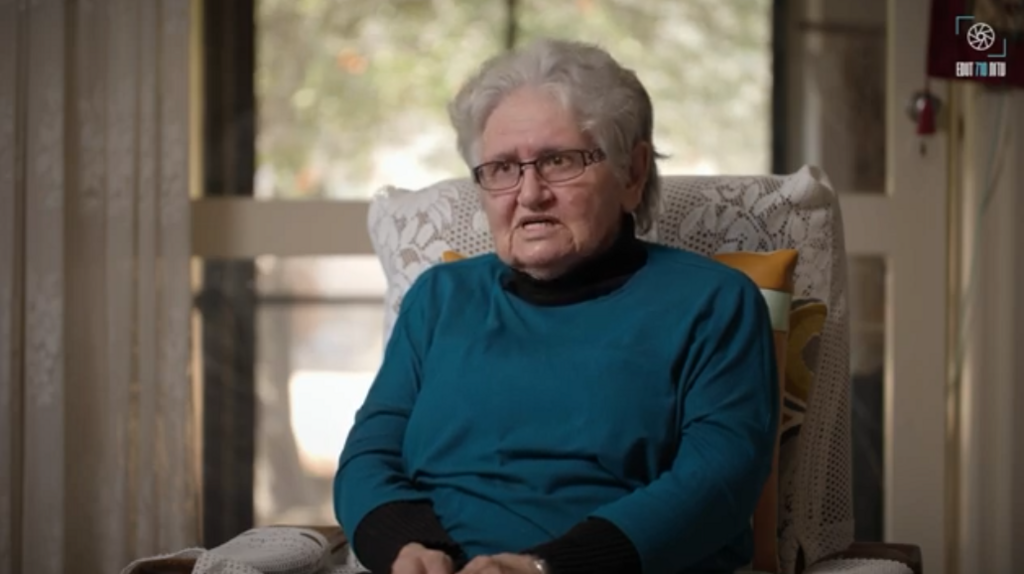
Ben Yosef’s life story was documented as part of the “Testimony 710” project, which records the accounts of survivors of the October 7 massacre.
“When I was born, the Germans were already in Poland, and my uncle had been murdered,” she said in her testimony. “My father worked as a train driver, transporting supplies and returning with wounded soldiers. One time he stopped in our town and told the family what he knew and had seen, trying to convince everyone to flee by train. My grandfather, his father, said we had lived there for hundreds of years, survived hard times and would survive this too. In the end, only my parents and I escaped to Russia. The rest of our family went up in smoke.”
She continued: “On the train, we hid our Jewish identity. It was forbidden to reveal that they were my parents. We claimed I belonged to another woman. I was not allowed to speak during the journey. There was tension and fear even when I said thank you for a piece of candy, which could have exposed us. In Russia, my father enlisted, and when he returned, when I was about three, I did not recognize him. We lived under a false identity, and my name was changed to Pola, or Pepa. I was trained to speak only Russian outside the house, or I would be beaten with a belt. At home, we spoke Yiddish. I was left alone in a long, narrow room while my mother went out to find work so we could eat. She even sold her thick hair. Her haircut traumatized me. While alone, I searched for ways to occupy myself and suffered from hunger. I peeled lime and plaster from the wall and ate it.”
“At the end of the war, we were expelled from Russia as Polish nationals,” she said. “That began a long journey to Israel. We wandered to Lodz in Poland, then Brno in Czechoslovakia, then to a displaced persons camp in Austria, where my name became Paula. Emissaries from Israel arrived to educate us and teach Hebrew, and that is how I received my Hebrew name, Penina. We were smuggled illegally in a furniture truck to Marseille, and from there sailed through a storm. Many around us were seasick. We arrived at an absorption center in Binyamina, then a room in Kfar Ganim in Petah Tikva, and eventually to the Gaza border region, first to Tushiya and then to Kfar Maimon, where I have lived since 1961.”
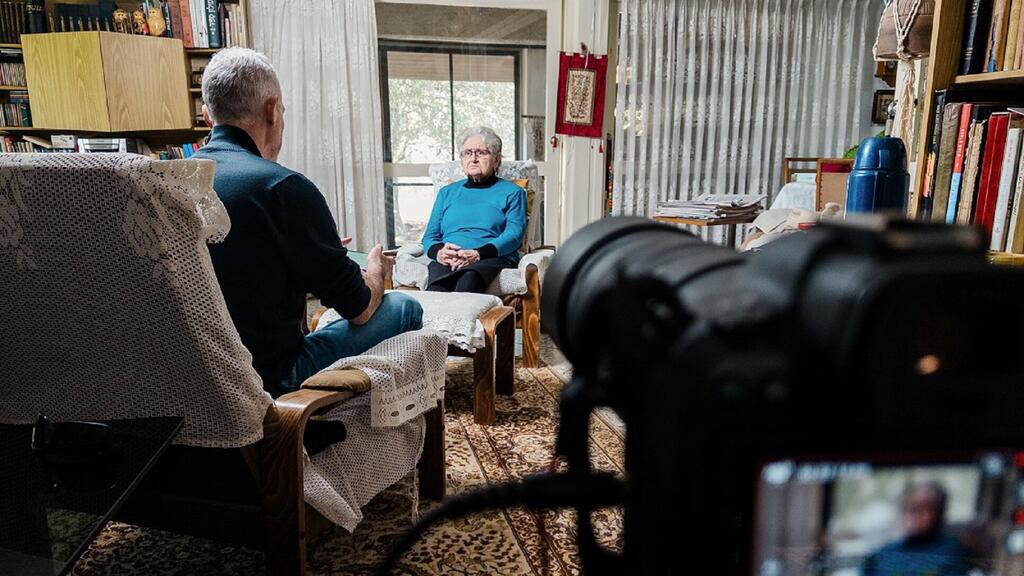
(Photo: Gil Levin)
Ben Yosef is a widow, a mother of two and a grandmother. She is a retired educator. The Hamas-led terror attack on the Gaza border communities struck her while she was physically vulnerable.
“Before October 7, I broke my leg and got around on a mobility scooter, functioning as best I could with the cast,” she recalled. “That morning I heard explosions. We are used to that after decades, so I did not think much of it. I sat in my armchair by the window and wondered why there was no movement toward the synagogue on the holiday morning. Suddenly my daughter Anat burst in with my granddaughter and my grandson, a soldier who had already been called up and was in uniform. They told me war had broken out and I had to move to the safe room.”
“The armchair could not fit inside, so they set up a lounge chair with a mattress,” she said. “I stayed there with a handgun until Tuesday, going out occasionally. My granddaughter stayed with me and was anxious. Aside from the safe room, the house is unprotected, with many windows that could be smashed.”
She said that on Saturday morning there were dozens, possibly hundreds, of terrorists along the fence of Kfar Maimon. At the same time, a helicopter carrying paratroopers was hit near the community, which turned out to be a miracle. The soldiers managed to escape and killed the terrorists who were on their way to slaughter residents.
“On Saturday afternoon, I received a message calling all weapons holders to the community armory,” she said. “I wondered what would happen if I arrived on a mobility scooter, with a cast on my leg and a handgun. People would probably collapse laughing. So I decided not to interfere.”
By Monday, she was among the last residents not evacuated. Her granddaughter wanted to take her away, and Ben Yosef tried to argue that she was fine in the safe room and had everything she needed.
“I argued for a long time with her and with another neighbor, the head of the local resilience team, who had been my student in first and second grade,” she said. “In the end, I realized that if I stayed, I would be a burden on everyone who would have to take care of me. The feeling was very hard. It was the first time I left Kfar Maimon in a time of crisis. It had never happened before, not in past wars or during the fedayeen years, even after my home was evacuated during the Gaza disengagement, when we thought it would never happen again.”
She eventually returned home. “After months as an evacuee, sleeping on a lounge chair because of my condition, I came back even though the war was still going on,” she said. “What had been green and well kept was now neglected and decayed. It felt like a foreign place. To protect my sanity, I did not turn on the television. We are not friends. I chose not to watch the horror videos. But things still reach me, such as a long conversation I had with a survivor of the Nova music festival who shared her story.”
Asked about the future of the community, Ben Yosef sounded resolute. “We will survive,” she said. “We will survive, all of us.”
“Testimony 710” is a nonprofit, civilian-led initiative founded on October 9, 2023, to record video testimonies of survivors of the October 7 massacre, including Holocaust survivors. Its digital archive is intended to preserve these voices for education, research and future generations in Israel and around the world.