

Desecration of the memory of Holocaust victims: A teenager visiting the Mauthausen concentration camp memorial site in Austria wore a shirt bearing the words "Free Palestine." On the back of the shirt was a Palestinian flag held by an illustration of a figure that some social media users identified as Dalal Mughrabi, a terrorist from the Fatah organization who led the 1978 Coastal Road massacre, in which 38 Israeli civilians, including 13 children, were killed.
The person who confronted the teenager and a teacher from the group was a young Jewish woman named Jordana, who posted footage of the incident on social media. The Jewish news site Jewish Breaking News reported that Jordana accused the teachers of bringing politics into a Holocaust memorial site and misleading students by describing the war in Gaza as genocide.
"Free Palestine" T-shirts in a concentration camp
(Credit: Combat Antisemitism Movement)


"You come to a concentration camp and call a war genocide? A real genocide happened here. You learned nothing. Shame on you," the young Jewish woman said.
Some students and teachers responded that they believe Israel is carrying out "genocide" in the Gaza Strip. Jordana rejected the claim, saying that a war is taking place in Gaza and that comparing it to the Holocaust dishonors the memory of the more than 100,000 victims who perished at Mauthausen, one of Nazi Germany's deadliest concentration camps.
Gallery
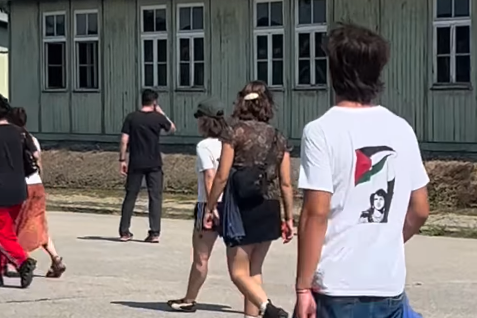
The boy walks shamelessly through the concentration camp
(Photo: from Instagram, crazibassoonist)
Jordana wrote on Instagram that eventually the concentration camp memorial site's staff called police because of the group's conduct.
"Shame on anyone who desecrates the memory of Holocaust victims by calling what happened in Gaza 'genocide.' This is unacceptable, and students should behave better," she wrote.
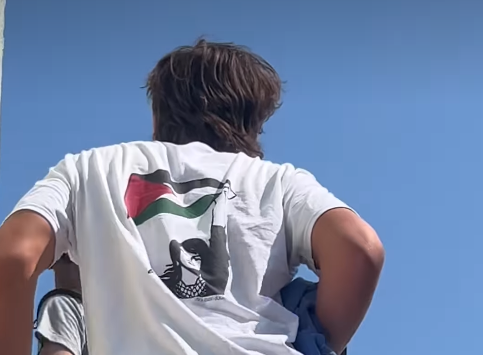
The Palestinian flag and a picture of the terrorist responsible for the 1978 Coastal Road massacre
(Photo: from Instagram, crazibassoonist)

The teacher with her students
(Photo: from Instagram, crazibassoonist)
More than 100,000 people were murdered at the camp by the Nazis
Mauthausen was a concentration camp established in northern Austria during World War II. The main camp, where the incident took place, was established near an abandoned granite quarry, 120 kilometers west of Vienna, beginning in May 1938. Initially, most of the prisoners were political prisoners from Germany and across Europe, mainly Poles, Czechs, Dutch, Spaniards and Soviets.
The first Jewish prisoners were brought to the camp in 1941 from the Czech lands and the Netherlands. Most Jewish prisoners arrived in 1944. In total, about 199,400 prisoners passed through the camp, of whom about 119,000 died, including 38,100 Jews. According to other estimates, the number of victims was significantly higher.
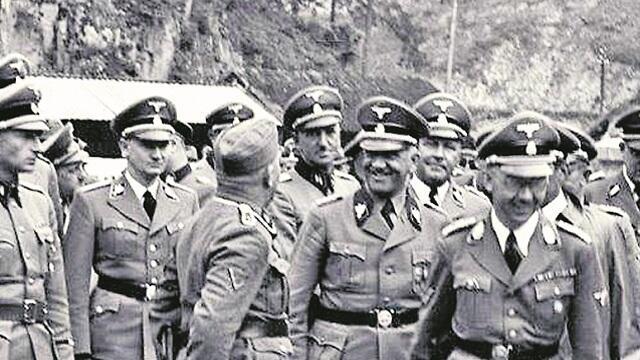
Senior Nazi officials visiting the Mauthausen concentration camp, June 1941
(Photo: Amical de Mautausen)
Living conditions at the camp were harsh and led to the deaths of more than half of its prisoners from starvation, disease and forced labor, primarily in the construction of underground tunnels for armaments factories.
Most of the Jews who arrived at Mauthausen were also forced to work on these projects: 6,000 Jews from Hungary who passed selection at Auschwitz in May-June 1944, 4,600 Jews from the Plaszow camp and thousands of Jews evacuated from Auschwitz in January 1945.
The treatment of Jews at the camp was particularly brutal, and most did not survive more than two or three months. In March-April 1945, thousands of Jews from Hungary who had been sent to fortification work along the Austria-Hungary border were brought to Mauthausen, and at least 3,000 of them perished.