

Germany’s government and institutions dedicated to commemorating Holocaust victims are demanding that social media platforms halt the spread of fake images, which they say distort history and make light of its meaning.
Memorial sites and documentation centers at former concentration camps this week expressed deep concern in a letter they sent over a wave of so-called “AI slop” — distorted images generated by artificial intelligence that deal with the Holocaust. Among the content circulated were highly sentimental illustrations of fictional events, such as invented encounters between concentration camp prisoners and their liberators, or children shown behind barbed-wire fences.
Gallery
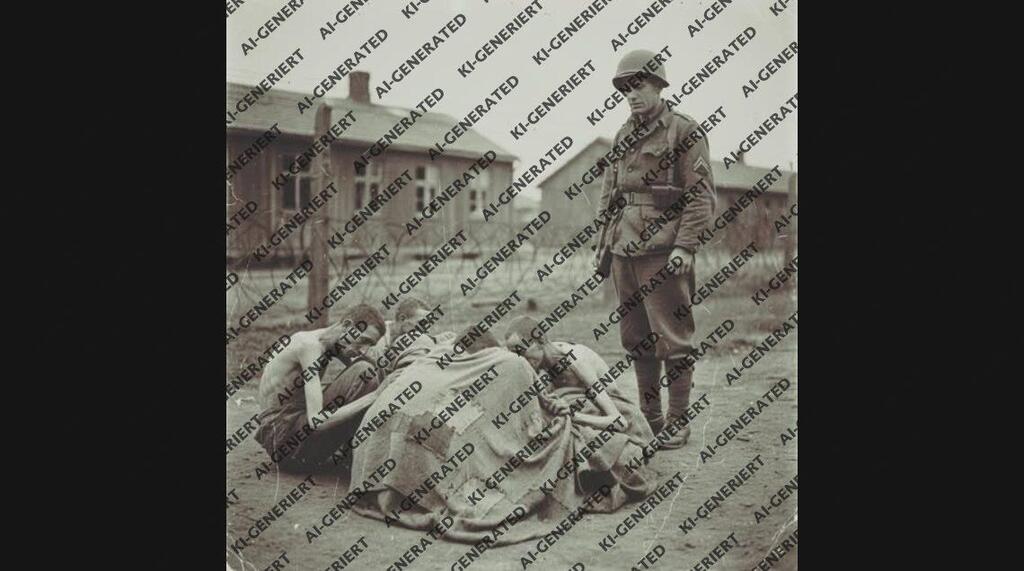
A fake image claimed to show prisoners at the Dachau concentration camp
(Photo: from social media)
“AI-generated content distorts history by trivialising and kitschification,” the organizations wrote. They added that such images contribute to a loss of public trust in authentic historical documents.
Germany’s minister of culture and media, Wolfram Weimer, said he supports the efforts of memorial institutions to require clear labeling of AI-generated content and, where necessary, its removal from online platforms. “This is a matter of respect for the millions of people who were killed and persecuted under the Nazi regime of terror,” Weimer wrote in an email statement to the Reuters news agency.
At the same time, artificial intelligence companies — led by Elon Musk’s xAI, which operates the Grok chatbot — are also facing pressure over the online spread of thousands of sexual deepfake images.
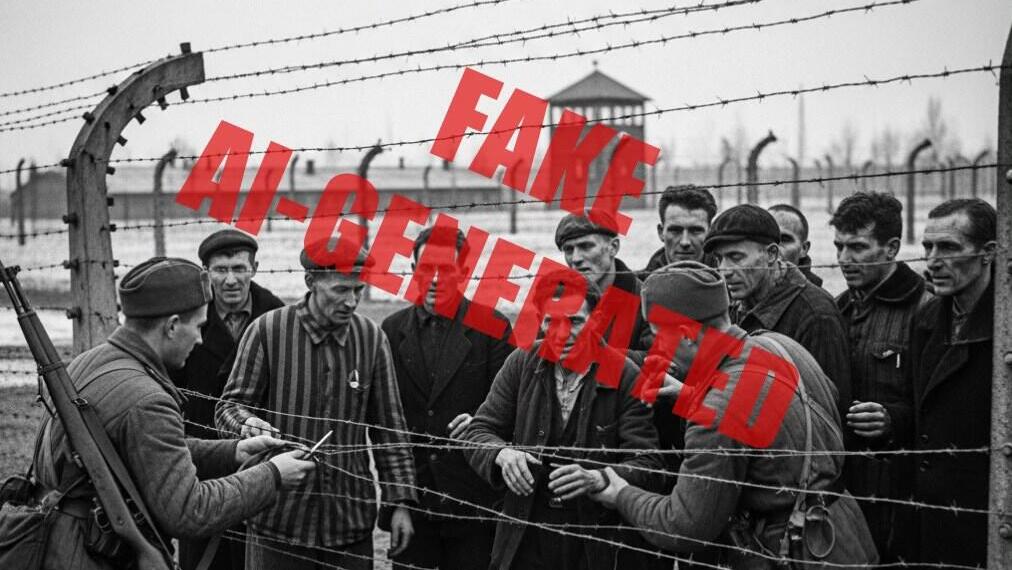
An image generated by artificial intelligence
(Photo: from social media)
The memorial institutions noted that some of the AI-generated images are designed to attract attention and generate profit, while others aim to “dilute historical facts, shift victim and perpetrator roles, or spread revisionist narratives.”
Among the signatories to the letter were memorial centers at the former concentration camps of Bergen-Belsen, Buchenwald, Dachau and others, where Jews and members of additional groups, including Roma and Sinti, homosexuals and people with disabilities, were murdered.
They said social media platforms must act proactively to stop the spread of fake AI-generated Holocaust imagery, rather than waiting for user reports, by clearly labeling such content and preventing it from being monetized.
The spread of low-quality “AI slop,” including fake texts, images and videos, has alarmed many experts, who warn that it could pollute the trusted information space and make it increasingly difficult to distinguish between truth and falsehood.