

The Days of Repentance, culminating in Yom Kippur, are among the most concentrated and emotionally charged periods of prayer in the Jewish calendar. Even people who rarely enter a synagogue during the rest of the year often set aside everyday distractions to join the collective rhythm and language of Jewish prayer.
And it is not only during the High Holy Days. Many people who do not consider themselves religious, observant or even believers find themselves praying in moments of distress and crisis, reaching toward a higher power as if grasping for a psychological lifeline.
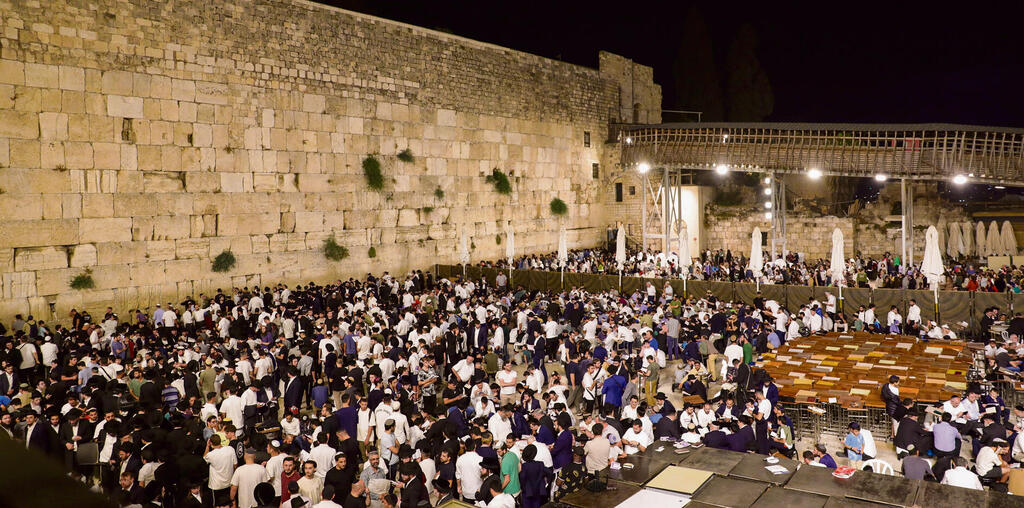
But prayer, says Dr. Shraga Bick of the Hebrew University of Jerusalem’s Department of Comparative Religion, a scholar of Judaism and Christianity who studies prayer rituals, is not a transaction with God and should not be understood simply as a way of obtaining something from Him.
So what is prayer?
“It is a ritual act whose purpose is to bring human beings into the service of God, through words but especially through the body, because so much of prayer happens through the body: swaying, movement,” Bick says. “On Yom Kippur, you cannot write the prayer on a piece of paper and send it to the synagogue. A person has to actually be there for many hours, standing, holding the prayer book, moving, swaying, bowing. Prayer is therefore a distinctly physical event.”
Then where do the soul and longing come in?
“We often think of prayer as something that emerges spontaneously from the heart, in quiet intimacy. But Jewish prayer takes place through the entire body, while I am surrounded by other people in the synagogue and everyone hears everyone else’s voice.
“Of course, alongside collective prayer there is also a model of personal prayer, but that is only one part of the ritual, one element in an entire puzzle.”
A wish list for God
One of the figures who came to embody prayer for many Israelis after October 7 was Rachel Goldberg-Polin, mother of Hersh Goldberg-Polin, who was murdered in Hamas captivity.
In the months after her son was abducted, Goldberg-Polin became known not only for her public campaign to bring the hostages home, but also for a deeply personal language of faith and prayer that came to resonate collectively.
“I grew up in Chicago in a secular family, and yet three times a year my parents would take off work and all of us would go together to synagogue,” she says. “Those were the High Holy Days, Rosh Hashanah and Yom Kippur. The prayers were long and mysterious. We had no idea what the words in the prayer book meant, and we didn’t know the choreography or rules of the ritual: when to sit, when to stand, when to step backward and when to step forward. We were like strangers who had wandered into an intricate dance in an unfamiliar land.
“In retrospect, it seems like a perfect recipe for disaster, like deciding once a year to run a marathon without training or exercising at any other point during the year. If, by some miracle, you make it to the finish line, you’ll be in tremendous pain and will have no desire to challenge yourself again. In my family’s case, that meant an entire year would pass before we entered a synagogue again. Until then, the ritual was over. Goodbye and see you next year.”
At first, Goldberg-Polin says, prayer itself seemed complicated and confusing.
“On the surface, it can feel as though we are drawing up a wish list and submitting it to some idea of God, who is himself elusive and difficult to comprehend. But the word tefillah, prayer, itself hints at what we are hoping to accomplish through this interesting opportunity.”
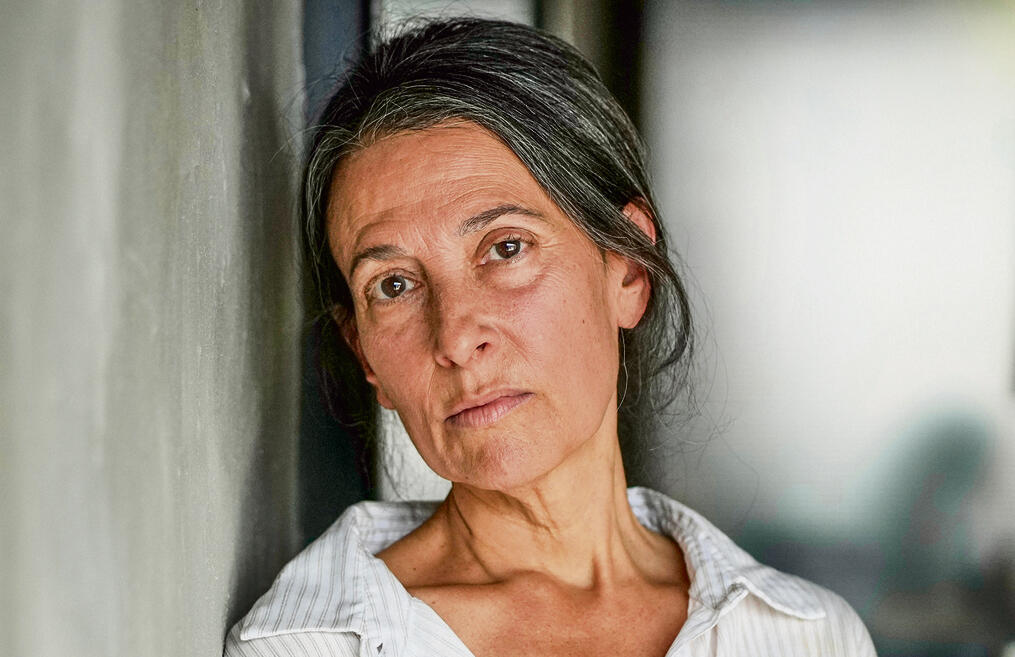
Rachel Goldberg-Polin
(Photo: Ohad Zwigenberg, AP)
What do you mean?
“The Hebrew verb lehitpalel, to pray, is reflexive. It describes something we are doing to ourselves. The root, p-l-l, also carries meanings connected to judgment and evaluation.
“So instead of seeing prayer as a shopping list directed toward an outside entity, when we pray we are actually undertaking an exercise in introspection and even self-examination. It isn’t easy, and it isn’t supposed to be easy. We ask: What matters to us? What should we focus on? What is our purpose here? What is our meaning?”
That language of purpose and self-examination has become closely associated with the legacy of her son Hersh.
Rachel Goldberg-Polin: “Instead of seeing prayer as a shopping list directed toward an outside entity, when we pray we are actually undertaking an exercise in introspection”
What is prayer for you?
“During this serious and solemn holiday season, I remember a conversation I had with a friend years ago. ‘The moment I believe there is a God, I’ll start praying and build a relationship with Him,’ she told me.
“I understood what she meant, but I thought that in other relationships the formula is reversed. First you meet someone and think, ‘This person seems special, and perhaps it is worth investing in getting to know them more deeply.’ Then we start thinking about them and acting accordingly: inviting them for coffee, calling to see how they are, asking them to go for a walk, stopping by when they are sick.
“Slowly, through effort, we create a connection, and one day we are amazed to discover that a relationship has been born. Jews believe action is one of the building blocks of what will come later. That is true with our families, our friends, our people and our Creator. Relationships deepen through actions and deeds. Sometimes that means beginning without knowing in advance where it will lead.”
Goldberg-Polin points to the teachings of Rabbi Abraham Joshua Heschel, who spoke of a “leap of action” rather than simply a “leap of faith.”
What does that mean?
“That a person must go beyond his own needs and do more than he understands, in order to understand more than he does. ‘I felt my legs were praying,’ Rabbi Heschel said of marching alongside Dr. Martin Luther King Jr. in the 1965 civil rights march in Selma, Alabama.
“That is the essence of prayer. Not only to think or believe, but to act.”
Order and fixed wording
Prof. Elisheva Baumgarten, dean of the Faculty of Humanities at the Hebrew University of Jerusalem and a scholar of medieval religious history, says evidence of prayer and appeals to gods or supernatural powers can be found across cultures going back to prehistoric times.
“The sociological assumption is that people have always prayed and turned toward forces greater than themselves, because there have always been circumstances we did not know how to cope with on our own,” she says.
“From the beginning of the biblical story, we see human beings speaking to God and making requests, while God positions Himself as the one who responds and makes decisions. There is individual prayer and there is organized prayer, and there are differences between them. When people pray together, there has to be order and a fixed text.”
Which came first?
“Clearly, personal prayer came first. Communities grew out of the personal, and prayers developed within those communities.”
Bick says spontaneous prayer is almost instinctive in moments of danger. “We all know that when we find ourselves in circumstances where we need help, whether a lion is chasing us, we are sick or our son has been wounded in Gaza, we automatically begin making requests. Something bursts out of us that can be called prayer.
“But there is always tension between the collective ritual side, which depends on prayer as something ordered and structured, and personal prayer, which is free and spontaneous and in a sense responds to institutionalized prayer.”
How does Judaism view prayer?
“In the Bible itself, there is no commandment to pray. Prayer takes shape as something governed by laws and rules only toward the end of the first century, and it becomes a central religious obligation in both Judaism and Christianity.
“It then develops into a powerful tool for creating an emotional community and producing a similar effect on the individual psyche. Just as all of us stand together during a memorial siren, we pray together in synagogue on Yom Kippur, cry together during Kol Nidre, move together and plead together.
“Even a secular person generally won’t pray alone on Yom Kippur, but will come to synagogue and pray with the community. We felt something similar in Hostages Square, when the crowd became an emotional community whose members stood together shouting, ‘Everyone now,’ and a collective shiver went through us.”
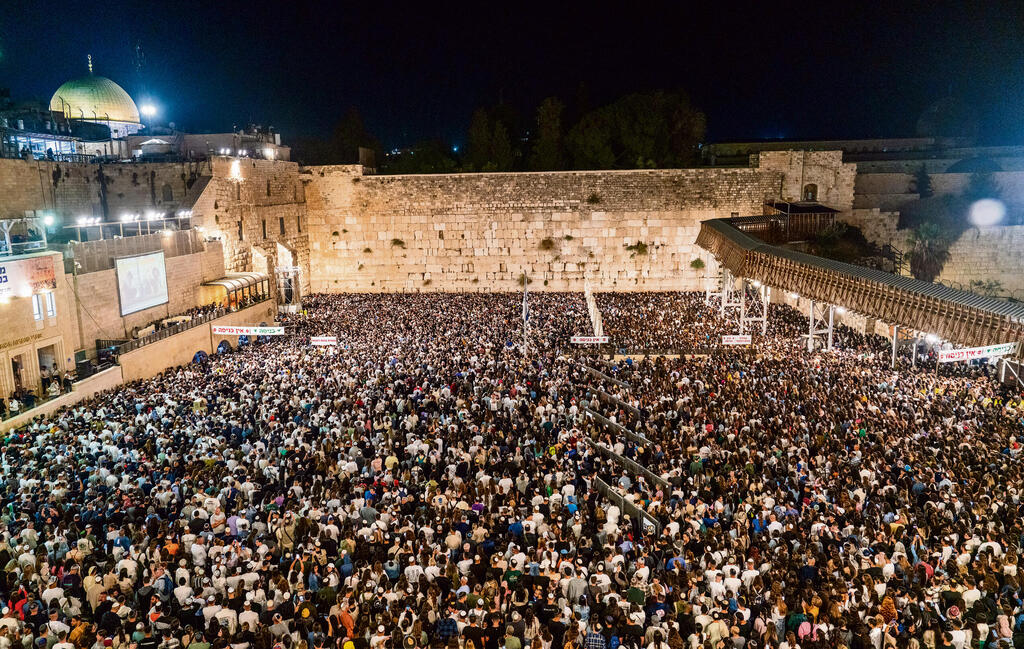
(Photo: Shalev Shalom)
Who were we shouting to?
“That is a good question, and everyone will have their own explanation of who they are praying to. But before that comes the tremendous communal partnership expressing a shared longing. That is one of the original purposes of collective prayer, beyond the prayer of the individual.
“Prayer is not a situation in which someone is supposed to stand there asking for something, imagining that if they shout loudly enough there is some God in heaven collecting enough requests and that whoever asks nicely enough will have their wish granted.”
But that is often what people are told: Pray, ask, focus and you will receive.
“There have been major disputes over precisely this question since late antiquity. Thinkers already argued then that prayer is not supposed to change anything.
“God cannot be manipulated. He does not perform magic and does not simply respond to requests. Prayer is instead an act of communion or conversation with the divine. For some thinkers it is an attempt by the soul to resemble or draw closer to the divine; for others it is part of serving God. But either way, it is not supposed to serve material, utilitarian goals.
“And if we look at reality, it is difficult to find support for the idea that prayers work in that direct utilitarian sense. Only a small proportion of people would say that their prayers were actually answered.
“What needs to be understood is that for most thinkers, prayer is not a mechanism for manipulating the divine or obtaining benefits from God through the act of praying. One indication is that personal requests occupy relatively little space in Jewish liturgy and sit at the margins of the prayer service.
“Prayer is general. It is not intended for one specific moment or one specific person. Above all, it is a conversation with God, or standing before God, as part of serving Him.”
Dr. Shraga Bick: “When we find ourselves in circumstances where we need help, we automatically begin making requests, and something bursts out of us that can be called prayer”
Bick notes that for roughly the past two millennia, words have become one of the primary means by which people practice religious worship, making language itself a central ritual instrument, whether prayer takes place publicly or privately at home.
Clean white clothes
If prayer is primarily an act of worship rather than a way to obtain things from God, why does distress so often trigger an automatic appeal for divine intervention, even when people know that the outcome they ask for may never come?
Bick says that even when people understand the limits of prayer as a practical mechanism for changing reality, they may still hold on to the hope that prayer can somehow affect what happens to them.
Baumgarten says the very act of articulating the request may itself carry psychological force. “When we pray, we name our desire. We say and define what we want to happen,” she says.
“Giving a name to the request we direct toward a supernatural figure, together with all the conditions surrounding prayer, creates a very powerful and basic psychological act.
“The request itself and the effort, whether through fasting, singing, swaying together, concentrating or simply recognizing that ‘now I am praying, I am wearing clean white clothes, I am concentrating and standing quietly,’ can provide psychological comfort.”
For Gefen Englard-Antebi, a drama therapist and lecturer at Levinsky-Wingate Academic College, prayer can also become a tool inside psychotherapy.
About a year ago, as part of her doctoral work at Bar-Ilan University, she established what she describes as the first center in Israel, and possibly the world, devoted to emotional therapy through prayer. Her clinic now regularly treats dozens of patients using established psychological approaches while incorporating prayer as one of its central therapeutic tools.
How does prayer become a psychological treatment tool?
“When the relationship with God enters the clinic, it is not only a treasure trove of the psyche. It also becomes a kind of litmus test through which we can examine different aspects of a person’s emotional world and behavior, including their relationships.
“There is so much valuable psychological information contained in the patient’s relationship with God, including patterns of early attachment to parents and other key figures, that I would not necessarily be able to reach from other places. That is one of the things that happens in prayer-based therapy.”
Her central research question, she says, concerns what moves inside a person when they enter a living ritual of prayer, and what a person’s manner of praying may reveal about their inner world.
Her underlying premise is that prayer, among humanity’s most ancient forms of reaching toward something greater than oneself, may offer a window into emotional processes that can otherwise remain hidden.
And what about prayer during crisis, as an appeal to a higher power?
“There are moments when we feel as though the boat of our life is being tossed around, and everyone experiences that somewhere different, with a partner, in a career, in something personal. Then a person seeks prayer as something that can hold the pain for us, the gap between reality and how we wish reality were.
“Many hostages who returned spoke about having conversations with God during captivity and genuinely feeling that someone was holding their hand.
“The psychological movement of prayer contains both surrender and longing at the same time. On one hand, this is my situation: I am a hostage in Gaza. On the other hand, I have someone who can hold the hope for me that I will get out of here.
“We saw differences in the hostages’ relationships with God. According to their own accounts, some asked God how He was doing. Some made promises to Him. Some asked Him for signs. The mechanism was different for each person, but in all these cases there was a relationship with a power they believed was holding their hand, and they prayed with tremendous faith.”
And for someone who did not grow up in a religious home, how does that faith emerge?
“It is never external. It is always internal. Faith truly occurs at the moment when you have examined your inner world and genuinely believe that you are worthy in your own eyes.
“When that happens, the inner process of connection and development arrives, and it can be an extraordinary process.”