

Australia has long been considered a safe place for its Jewish citizens. But the October 7 massacre and two years of war in Israel have triggered a wave of antisemitism in the country. Large anti-Israel protests, attacks on Jewish institutions and deteriorating relations between the Australian and Israeli governments have led to a renewed sense of unity within the Jewish community and a deepened connection with Israel.
“We always viewed Australia as a safe place, as Jews. They're a very robust, democratic nation, and I never really encountered antisemitism personally, until recently,” says T, a general physician working in rural areas who has lived in Australia his entire life and asked to remain anonymous due to fear of harassment.
"And I suppose the reason for wanting to remain anonymous is that there's always that fear of retribution from colleagues who might harbor antisemitic feelings, if they find out that you're pro-Israel, or a Zionist in their words," he continues.
Gallery
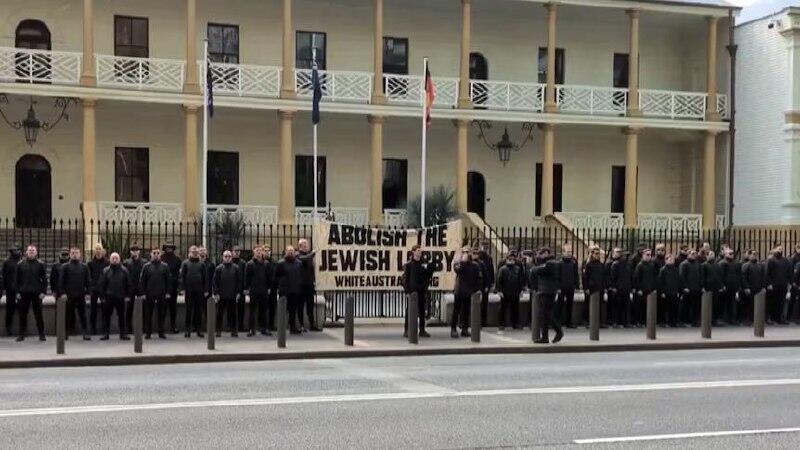
Anti-Jewish protest of Neo-Nazi group 'White Australia' over the weekend in Sydney
(Photo: Social media)
“I think October 7 lifts the covers on what was already brewing there. There's a certain subset of the population that has a simmering resentment of Jews, for whatever reason. And a lot of Jews think that our current government, unfortunately, hasn't been the most supportive of Jews, and probably has been pleasing its political constituents," he added.
This new reality, unfamiliar to many Australian Jews, has led some to consider immigrating to Israel. Michael and Karen, married and both doctors from Melbourne, are contemplating leaving their comfortable life in Australia and making aliyah.
“Our kids suddenly have to think about things that they never did,” according to Karen. “Our daughter went to do work to experience at one of the university campuses, and she said, 'I don't want to wear a star of David, and I don't want to be identified as Jewish'.
"Pre October 7, that would never have crossed her mind. School excursions are cancelled because of safety concerns, can't go into the city because of protests. So, I think all these things have started to enter into their mind and their day-to-day living, and that's not really how we grew up or the Australia that we sort of became comfortable in," she added.
“We've always felt comfortable, and that there was a future for our kids here, but there are things over time that have made us reconsider that. It's a big deal to move kids and our kids will be teenagers if we decide to move," Michael said.
"That's a hard transition, and there are things like consideration of army service, and other things that they didn't inherently grow up thinking about. But I think we have to look at the bigger picture and opportunities, then where they can form a life for themselves, where they can have a strong and free Jewish identity," he added.
Anti-Israel protest in Australia in August
(Photo: Reuters)


Like Michael and Karen, many Australian Jewish doctors are concerned about the challenges of making aliyah, including integration difficulties, lack of social networks and particularly the difficulty of finding work in their field and entering Israel’s healthcare system.
For that reason, they joined about 100 other Jewish doctors at the MedEx conference, which aims to encourage immigration among Jewish physicians. For the first time, it was held in Australia.
MedEx was incorporated two years ago, into a broader national program led by Israel’s Ministry of Aliyah and Integration, Ministry of Health, Ministry of the Negev, Galilee, and National Resilience and Nefesh B'Nefesh, in cooperation with The Jewish Agency for Israel. Following successful events in Paris, London, Buenos Aires, Los Angeles, and New Jersey, MedEx Australia marked the program’s first expansion into the Pacific region. This milestone reinforced Israel’s commitment to recruiting 2,000 new physicians over the next five years, with a focus on strengthening health care in the Negev and Galilee, bolstered by key partners including the Marcus Foundation, the Gottesman Fund, Jewish Federations of North America, the Azrieli Foundation and Arison Foundation.
“Nefesh B’Nefesh has been working to promote aliyah among Diaspora Jews for over 20 years,” says Zev Gershinsky, the organization’s executive vice president. “In our work, we identified that one of the biggest barriers for doctors is the medical licensing process. It used to take eight to 10 months to obtain a license and find a job, and during that time, the new immigrants were left waiting. That’s why we launched the MedEx conference in North America eight years ago, to help doctors navigate the Israeli bureaucracy."
“Including the program as part of a national initiative enabled rare cooperation between multiple bodies in Israel to provide a joint solution to a national problem — the shortage of doctors,” Gershinsky emphasized.
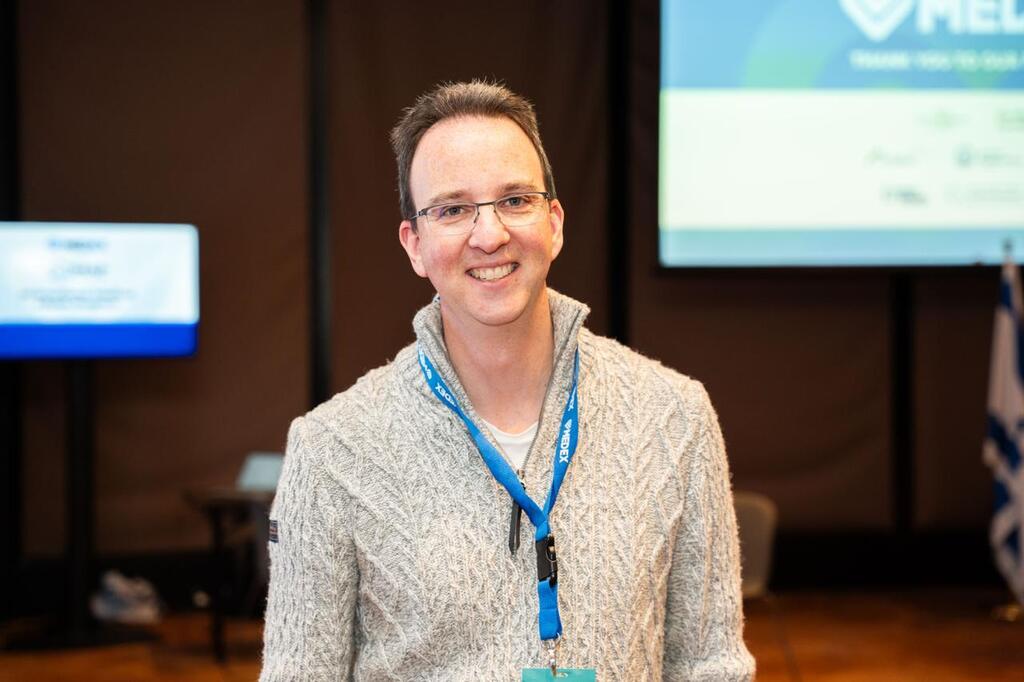
Mike M. an Australian physician who attended the conference
(Photo: Scott Ahler)
Aliyah and Integration Minister Ofir Sofer, who attended the conference, spoke about the significance of promoting immigration from Australia at this time:
"Unfortunately, the Jewish community in Australia is facing a sharp rise in antisemitic incidents. We are working to encourage Jewish people, especially now, to make aliyah, and I sincerely hope to hear of more families and young people taking this courageous step and fulfilling the Zionist vision.”

Karen Fink, Sharon Stolier, Debora Bell
(Photo: Scott Ahler)
"This important initiative turns Zionism into action by bringing outstanding medical professionals to strengthen hospitals and communities in the Negev, the Galilee, and the Gaza border region,” said Yitzhak Wasserlauf, minister for the Negev, Galilee, and National Resilience. “This is another step in reinforcing our national resilience, not only in security, but also in health.”
The conference brought together representatives from every relevant agency involved in the immigration process: officials from the Health Ministry to register physicians in Israel’s national health care system, legal and notary services for verifying academic documents, representatives from the Aliyah and Integration Ministry, and even soundproof workstations for online job interviews with representatives from Israeli health maintenance organizations and hospitals. The goal is for doctors to be able to make aliyah and begin working immediately, without delay.
A common sentiment among many participants was that the Australian government has turned its back on the Jewish community in the face of antisemitic attacks.
In response to increasing harassment and a lack of official action, health care professionals Karen Fink, Sharon Stolier, Debora Bell — all based in Melbourne — founded AZHA, the Australian Zionist Healthcare Alliance. The new organization aims to support Jewish health care workers (and others) who feel targeted.
"Health care is twisting what the word Zionism means, and anyone associated with Jews or Israel, we're just being tarnished, abused, bullied, harassed, complained against, attacked - you know, treated awfully in the workplace, in online spaces and socially," says Sharon Stolier, a non-Jewish midwife whose husband is Israeli, who identifies as a Zionist and as part of the Jewish community.
"So many patients, whom to me it's obvious that they're Jewish or Israeli, are hiding their religion, and they're hiding their country of origin. They're afraid of harassment, or worse, whether from medical staff or even someone working in the kitchen," adds Debora, an anesthesiologist.
Karen added that "a lot of Jewish health care workers have had complaints made about them that are completely fictitious, lies; they are sent to the regulators, and they end up having letters and notifications, and it's a very stressful process.
"And sadly, the government and our medical bodies or the regulatory bodies are doing nothing to reassure people", says Debora.
"The Australian Zionist Healthcare Alliance (AZHA) is there to advocate, we educate, and we intervene. And we don't just keep records. This is an antiseptic, we actually do something about it," they all explain.
"We are now working on a class action. We have started working on gathering. We've got the first and only national register that we are collecting on complaints that have been made to the regulator about antisemitic health care workers, and vexatious complaints that have come in against Jewish health care workers, and we're collating the data.
"We're trying to gather as much data as possible to paint the bigger picture, to show that systemic bias, comparing the way the complaints are being addressed." At the same time, "we are working on a class action against the regulators and the national boards for being biased in this way."
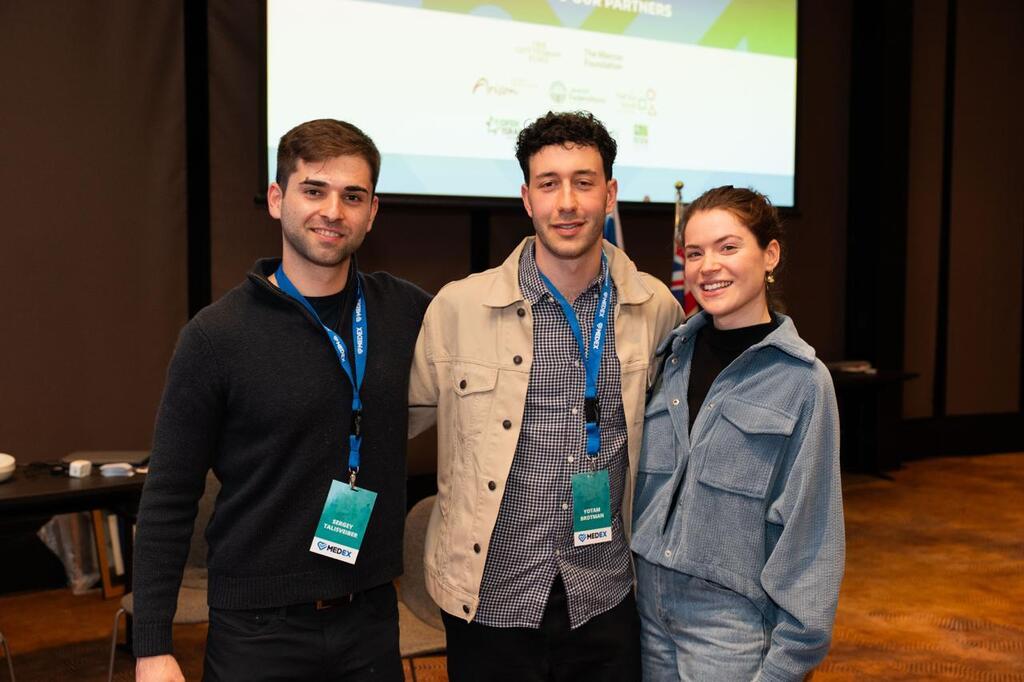
Sofia, Yotam and Sergei, medical students in Australia
(Photo: Scott Ahler)
Despite the troubling developments on the continent over the past two years, life for Australian Jews remains relatively calm compared to Israel.
"All our family after October 7th who are in Israel, want to be here in Australia, said Sofia, who attended the conference with her partner Yotam and their fellow medical student Sergei. The three came to explore options for aliyah and employment.
"I definitely understand the hardship in Israel, like the stress and the intensity compared to the comfortable life in Australia. But I still think it's worth fighting for Israel, and it's our home."
The reporter was a guest of Nefesh B’Nefesh.