

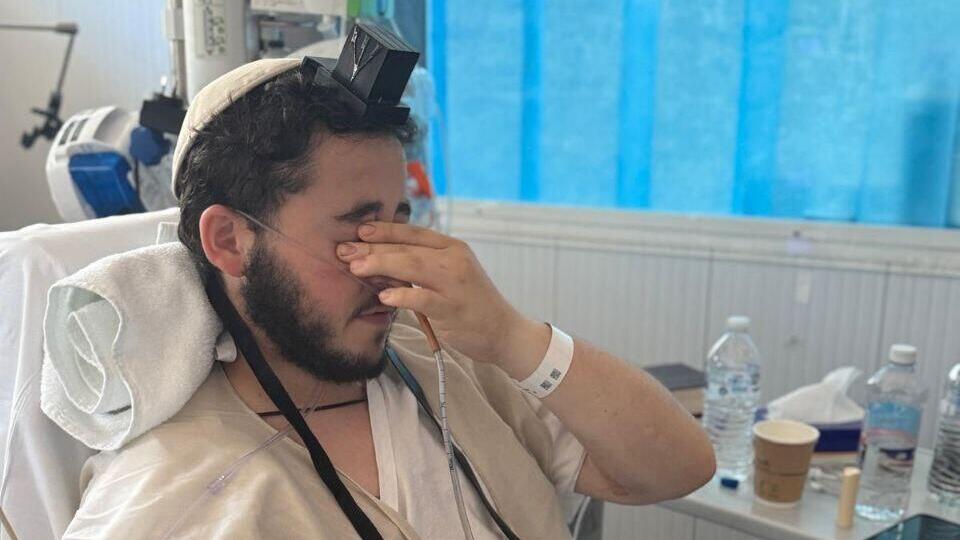
In a small hospital room in Sydney, after six surgeries and two weeks of being fed only through tubes, 20-year-old Leibel Lazarov held a small plate. For the first time since he was wounded in the deadly Bondi attack on Hanukkah, he was allowed to eat by mouth. Beside him stood his parents, Chabad emissaries at the University of Texas, who flew to him within hours.
Lazarov arrived in Australia ahead of Rosh Hashanah to assist Chabad emissaries in Bondi. He worked alongside Rabbi Eli Schlanger, who was killed in the attack, organized youth activities and visited the elderly. When the attack began, he was at the scene of the massacre and witnessed the horrors up close. “Suddenly, I heard gunshots,” he told Mendy Kortes in his first interview, published in the newspaper “Kfar Chabad.” “I immediately understood these were gunshots. I’m from Texas and I myself have a license to carry a firearm.”
Seconds later, he saw a police officer collapse beside him. “He shouted, ‘I’ve been shot.’ I saw blood flowing from his shoulder. I took off my shirt, made an improvised tourniquet and stopped the bleeding. He said he couldn’t get up. I told him, ‘Give me your gun. I know how to use a weapon. I’m from Texas. Let me shoot the terrorist and save people, otherwise we’ll both die.’ The officer refused,” according to Lazarov.
Gunfire continued in the background. Schlanger shouted that the attacker was approaching. “I tried again to ask for the gun, but the officer was no longer able to communicate,” Lazarov said. Moments later, Schlanger was shot and killed. The attacker then fired a rifle at Lazarov as well. “I was shot in the stomach and the leg. My stomach swelled instantly, like a bubble. I knew I was bleeding internally and tried to stop it. I didn’t know that blood was also flowing from my back,” he said.
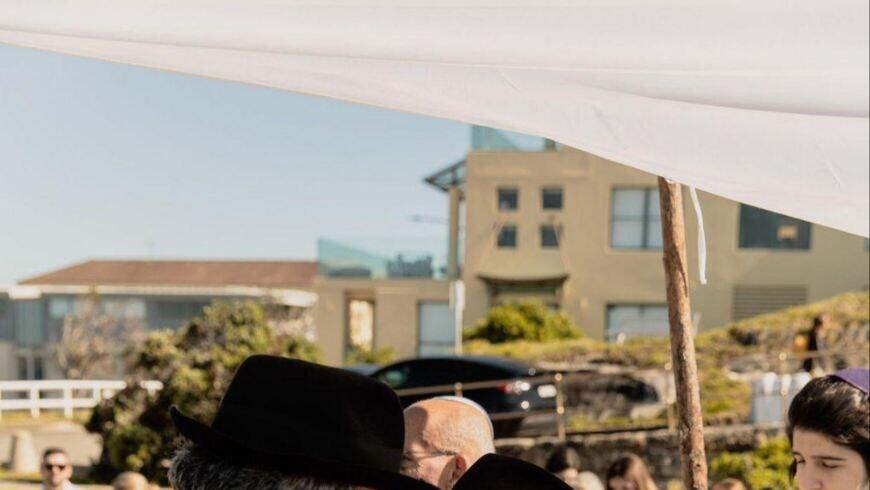
Leibel Lazarov next to murdered Chabad emissary, Rabbi Eli Shlenger. Archive
(Photo: Kfar Chabad magazine)
He lay on the ground, wounded and bleeding, as bullets whizzed overhead. “I wanted to run and help neutralize the attackers, but my body wouldn’t allow it,” he said. Only after the shooting stopped did people approach him, bandage his wounds and transfer him to the local medical center, where he was immediately taken into surgery and sedated. He regained consciousness only two days later.
At the same time, back in Texas, his parents were awakened by a knock on the door. “They told us Leibel was injured,” his father said. “Within hours, we were on a plane.” When they arrived in Sydney, they understood that their son had survived but was seriously wounded.
This week, for the first time since he was injured, Leibel stood on his feet and walked several steps down the corridor, to applause from the medical staff. “It was a two-minute walk,” he said, “but it felt like an hour-long workout at the gym.” His father summed it up simply: “We need to keep praying.”