

This Shabbat, the regular Torah reading cycle from Leviticus, which began two weeks ago, is set aside because of Passover. Instead, readings focus on the themes of the holiday.
The Torah contains many passages that deal extensively with Passover, yet tradition assigns a lengthy section for Shabbat of the intermediate days of the holiday. It describes the “cleft of the rock” revelation, when God speaks to Moses after the sin of the Golden Calf. Only at the end of the passage appears a brief, almost terse mention of the three pilgrimage festivals, including Passover.

This raises two questions. First, why did the sages choose these verses, among all references to Passover in the Torah, for this Shabbat reading? More fundamentally, why does the Torah link the discussion of Israel’s festivals to the episode of the Golden Calf and the renewed encounter between God and Moses?
A closer look reveals a profound insight. The Torah recounts how Moses asks God to forgive the people for their sin, and then goes further, requesting to see God’s face. God grants the first request but refuses the second: “You shall see My back, but My face shall not be seen.” It is unlikely that Moses is asking to literally see God’s face. If God has no physical form, then He has neither face nor back. Moses, who stood at Sinai and received this teaching directly, would have known this better than anyone.
So what is he really asking? Moses, like all of us, seeks to understand where we are headed. What is the divine plan? What lies ahead before reaching the promised land? What obstacles still await? Human nature is willing to endure great hardship, provided it knows where it is leading and what good outcome may follow. This is what it means to “see God’s face,” to know the direction of history and our place within it. The answer he receives is that only the “back” can be seen. Only in hindsight can we understand where we have come from and where we have arrived. We cannot know this in advance.

Passover matzah. Meaning comes only in hindsight
(Photo: Mykhailo Baidala / Shutterstock)
As citizens of Israel, we have learned this lesson firsthand. When David Ben-Gurion declared the establishment of the state, invading Arab armies entered Israel. At that moment, it was unclear whether the declaration was a reckless gamble or a historic decision that would reshape the fate of the Jewish people and the world. Looking back, the answer is clear.
The same holds true for the Yom Kippur War. At the time, and even as it ended, despite significant military achievements, many felt a deep sense of failure. In retrospect, it paved the way for Egypt, Israel’s most formidable enemy, to recognize Israel and sign a peace agreement. Human beings, limited in their vision, can only look backward and trace the path of divine action in history. They cannot fully see what lies ahead.
This realization is unsettling. We would prefer to know the road in advance so we can prepare for it. The Torah addresses this frustration through the commandment of the three pilgrimage festivals. Immediately after denying Moses’ request, the Torah states: “Three times a year all your males shall appear before the Lord God, the God of Israel.” Moses does not merit seeing God’s face in the way he sought, yet the entire nation is granted a form of encounter during the festivals, when they ascend to Jerusalem.
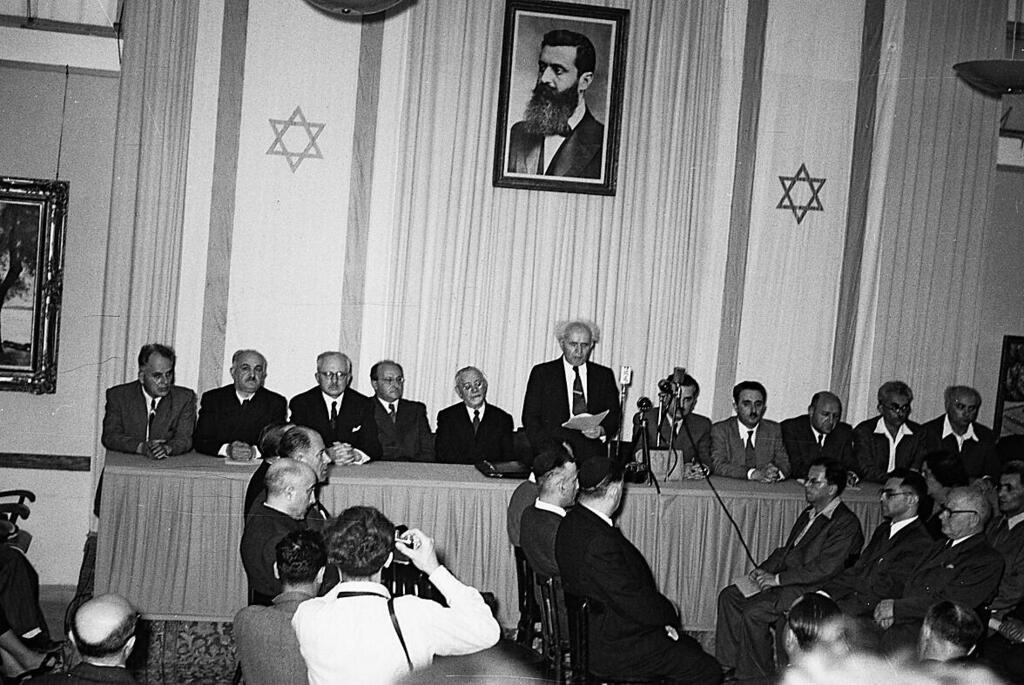
The declaration of the state. At the time, it was unclear whether it was a reckless, irresponsible move or a historic decision
(Photo: Hans Pinn, GPO)
How can the people attain a revelation denied even to Moses, the greatest of prophets? The Torah suggests that during the festivals, when the nation gathers in Jerusalem and chooses to rejoice before God, that very act becomes the clearest expression of the enduring bond between the people and their God. When Israel trusts in God, celebrates together with the stranger, the orphan and the widow, and brings offerings that are received with favor, there is no greater “vision of the divine.”
Even if we do not know how the current conflicts will end, we believe that God has spoken good concerning Israel. We will grow, even through the complexity and uncertainty of these days.