

In the opening portions of the Book of Numbers, Nachshon ben Aminadav stands out. This prominence extends to the holiday of Shavuot, which always falls between these two weekly Torah portions. On Shavuot, we read the Book of Ruth, where Nachshon serves as the central axis, positioned exactly in the middle of the ten-generation lineage connecting Perez, the son of Judah, to King David:
"Perez begot Hezron; Hezron begot Ram, and Ram begot Amminadab. Amminadab begot Nahshon, and Nahshon begot Salmah. Salmon begot Boaz, and Boaz begot Obed. Obed begot Jesse, and Jesse begot David." (Ruth 4:18-21)

This genealogical list deliberately begins with Perez rather than Judah himself, to emphasize Perez's breakthrough from the womb, having pushed ahead to exit before his twin brother. The community's blessing to Boaz at the end of the story of Ruth echoes this emphasis: "...and let your house be like the house of Perez, whom Tamar bore to Judah..." (Ruth 4:12). We also see this with David: "...and he was accepted in the sight of all the people... because he went out and came in before them" (I Samuel 18:5-16), which means that he led them into battle. The nation deeply recognizes the value of this profound tradition of courage, audacity, breakthrough, responsibility and leadership. Like Abraham initiating a war to rescue his nephew Lot, David confronting Goliath or Nachshon, who was leading the conquering march toward the land of Israel, they all moved forward into an unknown and threatening future.
Encampment vs. journey
Correspondingly, in this week’s Torah portion reading - Nasso, Nachshon is chosen to be the first of the twelve tribal princes to bring an offering for the dedication of the Tabernacle. This choice prompts a question: why didn't the prince of the tribe of Reuven, who was the firstborn, offer first?
This question highlights the gap between Chapter 1 of Numbers and Chapter 2. Chapter 1 lists the princes and census results by birth order, starting with Reuven and ending with the camp layout wrapped around the central Tabernacle. Chapter 2 completely resets the narrative. Although this chapter concludes by repeating the same census totals as Chapter 1, the structural order is completely changed as the order begins with Judah and Nachshon, who "shall journey first". Reuven's camp is designated to journey in the second group.
Why does Chapter 2 echo Chapter 1 while altering the tribal order? Why does Chapter 7 in this week's portion, which describes the dedication offerings, follow Chapter 2's journeying order rather than Chapter 1's resting order?
The difference lies in resting versus journeying toward a destination. Chapter 1 focuses on the stationary camp, using the natural birthright order starting with Reuven. Chapter 2 describes the journey, where leading is not a privilege, but a mission involving heavy responsibility and costs.
Surprisingly, though the dedication of the Tabernacle was performed while the people were stationary it followed the journeying order. This teaches that the Divine Presence dwells among us to stimulate action, creativity and forward progress. Holiness leadership in spiritual endeavors follows productive action, including leading military action like Nachshon Ben Aminadab, that inherently instills Torah values within the nation.
Chronologically, the dedication (Chapter 7) occurred on the first of Nisan, a month before the census described in Chapter 1. By altering the chronological order, the Torah narrative conveys a message: holiness belongs to those who take responsibility and possess audacity. This applies to Nachshon crossing the sea and leading into battle, Boaz descending directly into the fields to notice the poor widow Ruth, and David joyfully bringing the Ark of God to Jerusalem.
The dangers of initiative
Yet, innovators and initiative takers sometimes fail. According to the Sages, the first of Nissan was the exact day Nachshon's nephews, Nadav and Avihu (the sons of Aaron), were consumed by fire after entering the sanctuary with a foreign fire they were not commanded to bring. Nachshon's distinctive offering of a golden ladle filled with incense suggests that Nadav and Avihu may have been inspired by the spirit of the day and by Nachshon's personal initiative to break in.
The distinction is critical: Nachshon plunged into the sea to fulfill a divine command ("speak to the children of Israel, that they go forward"), and march toward the conquest of the Land, creating a breakthrough for the entire nation and encouraging everyone to follow. Nadav and Avihu's breakthrough was a personal, sectorial act to draw close to God. One cannot appropriate holiness for oneself. True leadership belongs to those who pull the collective forward.
Following their deaths, Aaron and his surviving sons refrained from eating Nachshon's offering. It demonstrates the gap between them as the servants of the Tabernacle to the breakthrough leadership who take self-risks where the community can follow.
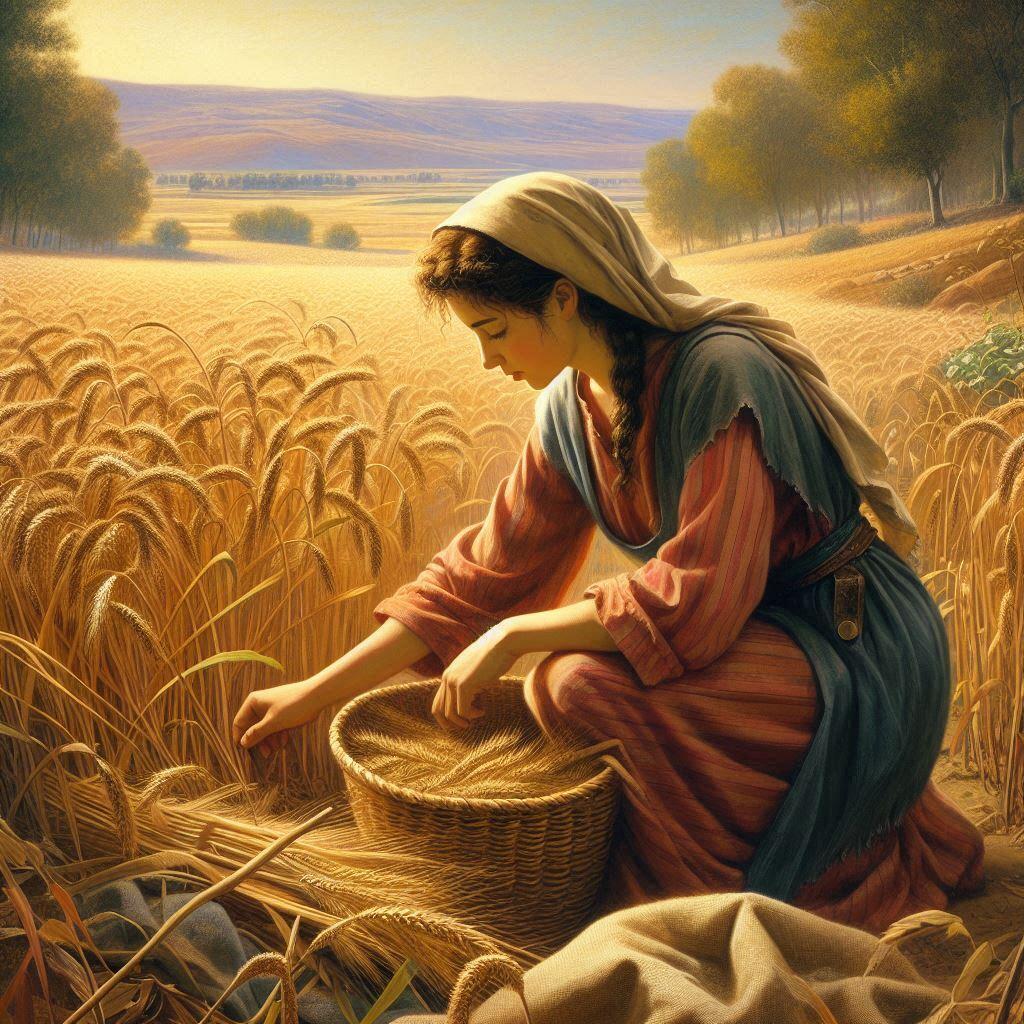
Ruth the Moabite
(Illustration: Created using Dall-E 3)
In Megillat Ruth, Nachshon’s descendants clearly internalized this lesson. While others distanced themselves from Naomi and Ruth, Boaz took responsibility for both of them. He protected Ruth in his fields and ultimately showed audacity by navigating and innovating delicate halakhic boundaries regarding Moabite converts in order to marry her. This was an important message to the community, and to future generations, regarding the treatment of the stranger and regarding bold halakhic ruling.
Future challenges
The future is unknown and, as noted in my book Milk, Honey and Uncertainty, nowadays is shifting rapidly through wars, challenged democracies, collapsing welfare states and disruptive artificial intelligence. The future can feel as daunting as a raging sea or an impending war. It brings anxieties, much like a Moabite widow crossing lines, proving that where Moabite men lacked the courage to greet Israel, perhaps women dared to lead. It mirrors the fear of a desert generation transitioning to an agricultural economy to bring the best of their first fruits before God on Shavuot, or a young shepherd boy, born on Shavuot, stepping out to fight a giant.
Ultimately, the future becomes better when we refuse to be passive. Faced with international, security, social and economic challenges, we must be pioneers - acting as "Nachshonim" to lead the way forward.