

As the war with Iran continues, this year’s Purim holiday will carry particularly symbolic weight: once again a war against the Persians, once again a preemptive strike against enemies who sought to destroy the Jewish people. In light of Operation Roaring Lion against the Iranian regime and the missile fire from Iran at Israel, Home Front Command directives will not permit the usual public celebrations — but it will still be possible to observe the mitzvot of the holiday.
“If a person has a megillah, even if he does not know the cantillation, he can read from it,” says Rabbi Yosef Zvi Rimon, rabbi of the Gush Etzion Regional Council and president of the World Mizrachi movement, who heads the Sulamot organization. “Reading the megillah with a minyan is only a beautification; if there is no minyan, a person can read for himself, recite the blessings, and fulfill his obligation from the outset. He can even listen over the internet to someone reading accurately and read along from the kosher megillah he has.”
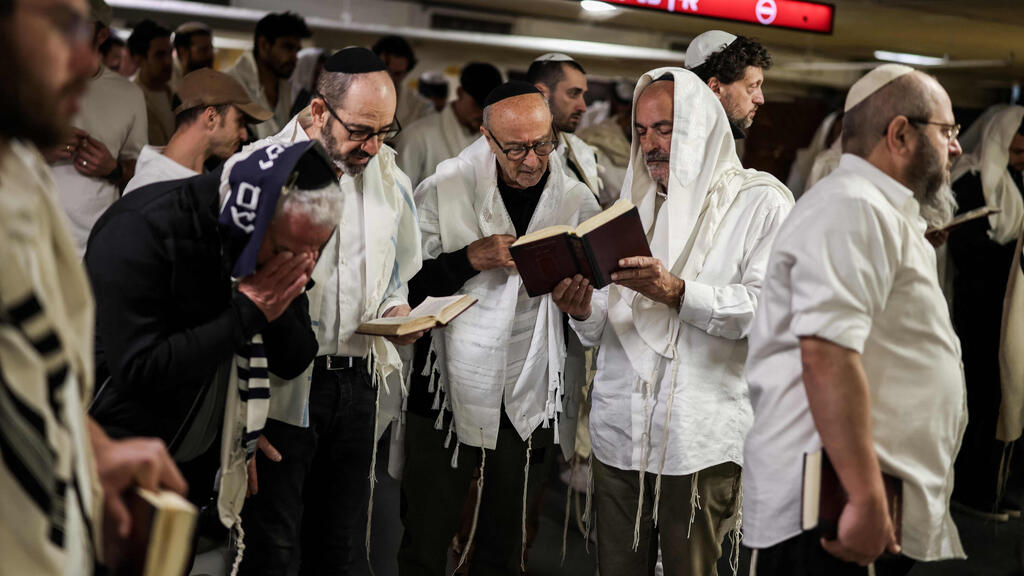
He adds that “if there is no kosher megillah, and no one to read from one, then we will return to the days of COVID and say that in such a situation one may fulfill the obligation by hearing the megillah via Zoom. When a person is stuck and there is no other option, that is what can be done.”
By contrast, Chief Rabbi David Yosef has ruled that someone who hears the megillah via telephone, radio or Zoom does not fulfill the obligation, and in such a case it is preferable to read from a printed copy without the blessings. Yosef emphasized that, in any event, Home Front Command instructions must be followed due to concerns of saving life.
The Tzohar rabbinical organization also issued Purim guidelines, clarifying that if an individual reads alone from a kosher parchment scroll, he should not recite the “Harav et Riveinu” blessing said after the reading, since that blessing was instituted for communal recitation. Regarding online readings such as via Zoom, the Religious Zionist rabbinical group stated: “Although halachic authorities are divided as to whether one can fulfill the obligation through such hearing, many were lenient in exigent circumstances, and in the current situation one may rely on the lenient opinions.” Tzohar added that, although speaking during the megillah reading is generally prohibited, “speech necessary for safety, such as announcing a siren, is permitted.”
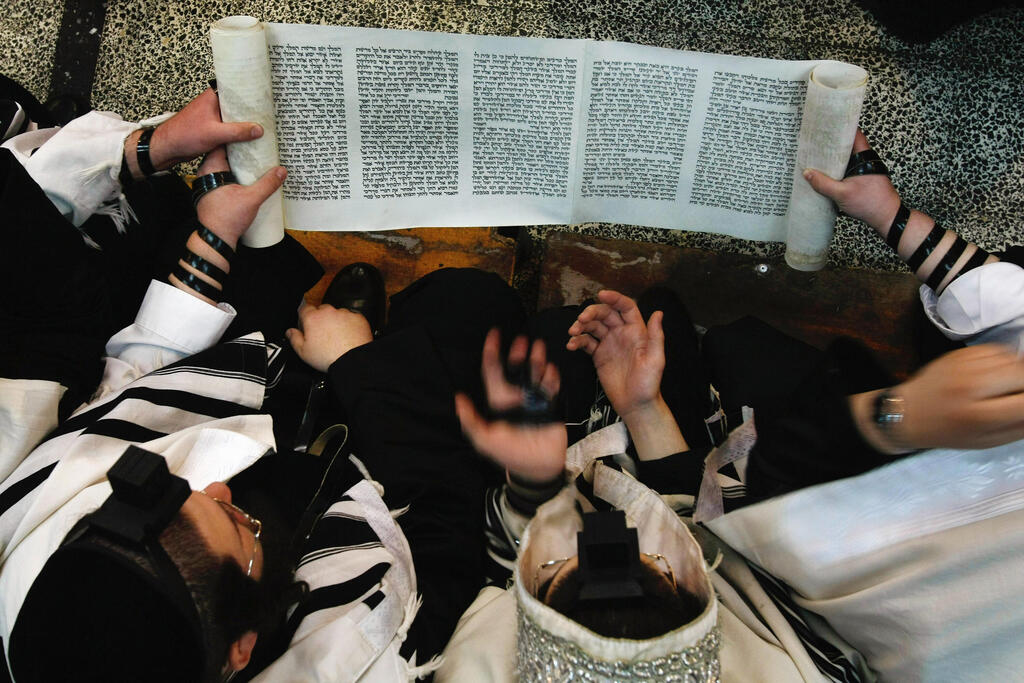
Reading from a Book of Esther scroll in Bnei Brak
(Photo: David Silverman / Getty Images)
What should you do if a siren sounds in the middle of a megillah reading held outside a protected space? Rabbi Kalman Bar wrote in his guidelines that in such a case “the congregation should move silently to a protected space. Once everyone is there, if possible, they should continue the megillah reading in the protected space. If it is not possible to continue there, they should wait until they can return to their original location, and then resume the reading from where it was interrupted.” He added that “synagogue officials should announce this arrangement before the reading begins.”
To get drunk or not?
Regarding mishloach manot (gifts of food), Rimon says: “In principle, one only needs to give two portions to one person. It is hard for me to believe that there is anyone who does not have a neighbor to whom they can give. I suggest looking around your building and seeing who needs strengthening now, whom we can make happy and uplift at this stage — not necessarily our friends. I think that precisely now, in wartime, the Jewish people need this power of unity. Strengthening people who are struggling — that is the mitzvah this year. There are people who are afraid, and the more a person engages in action, the happier he is. Mishloach manot can give us strength — both to the one who receives and the one who gives.”

Dizengoff parking lot during the Iranian attack
(Photo: Motti Kimchi)
Gifts to the poor can be given digitally without difficulty. The Purim meal can be held near a protected space. A more complex issue is alcohol consumption on Purim, the day when Jews are told to drink “ad delo yada” or “until one does not know” (the difference between Haman and Mordechai). “On the one hand, we want to drink and rejoice; on the other hand, we must be careful not to cross the line and do foolish things," Rimon says. "This year, during wartime, we must be even more careful — both because one may need to enter a protected space if there is a siren, and someone who is drunk might not notice what is happening, and also because wartime brings tension, and when there is tension one must be careful not to reach a state of doing foolish things or harming others. I suggest drinking to a level where a person feels more relaxed, happier and more able to thank God, family and friends — but to pay attention to the limits.”
So do you recommend not becoming intoxicated 'ad delo yada' this year?
“The truth is, one could say I suggest that every year. I recommend becoming mildly intoxicated, but not reaching excessive drunkenness. It is true that in the Talmud, in Tractate Megillah, Rava said, ‘A person is obligated to become intoxicated on Purim until he does not know the difference between cursed is Haman and blessed is Mordechai,’ but most of the early authorities interpreted this differently. Maimonides and the Rema said one should drink to the point that he falls asleep, and because he is asleep he does not know the difference. Many halachic authorities understood that it is neither appropriate nor fitting for us to become intoxicated in a way that causes a person to lose control.”
Rimon is not alone in this view. Chief Rabbi Kalman Bar likewise emphasized in his published guidelines: “In these days we will hold the Purim meal with joy and gratitude for God’s abundant kindness; however, care must be taken not to drink and become excessively intoxicated, in order to maintain the ability to follow instructions and to be prepared to act and enter protected spaces if necessary.”
Iranian report on death of Khameini


As for the essence of the holiday, Rimon notes that according to the Megillah, “the main battle took place on the 13th of Adar, the date observed as the Fast of Esther, and Purim is the time when we celebrate the rest from war. We do not celebrate the war itself. Our goal is not only to defeat Iran; our goal is that this will lead us — the State of Israel — to be better and more ethical, more united and stronger in faith. We want to win and also to think about how this makes us a better country. To care for unity — which is expressed in mishloach manot; to care for the weak — through gifts to the poor; and to remember that everything comes from God — which is the megillah reading, showing the hand of God.”
Recently, Rimon met with leading Muslim clerics in the United Arab Emirates, who invited him to visit after reading the English translation of “Megillat HaTekuma,” a document he authored describing the course of the war from a faith-based perspective.
“It is moving that other nations are with us,” he says. “They were also attacked now (the Iranian regime also struck in the UAE). They too are religious believers, and in the end they see our victories and achievements. They want to come to Israel in a few months to deepen ties between Israel and the Emirates. Security officials who wanted me to travel there told me — victory today is not only about winning the war; we need global awareness, and when a Muslim country draws closer to us, that is very significant.”