

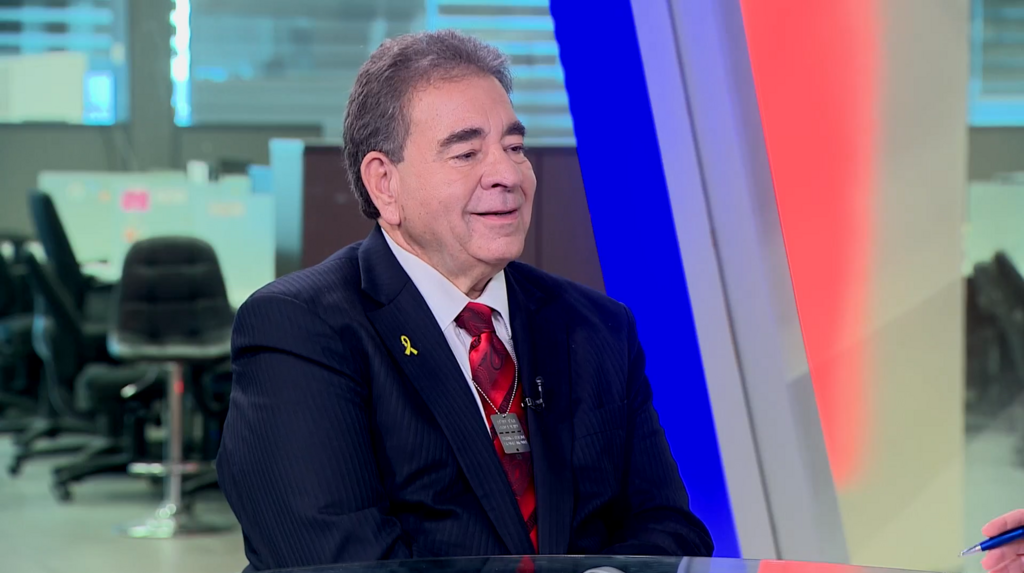
Jewish National Fund-USA CEO Russell Robinson describes his organization’s moment not as a departure from history, but as a continuation of it. Speaking with ynet Global, Robinson said the past year has reaffirmed both the relevance and responsibility of an institution that has operated for 125 years.
“We’ve been here for 125 years, and the name is one of the most trusted names in the philanthropic world,” Robinson said.
Studio interview Russell Robinson


Since October 7, he added, the organization has added more than 57,000 donors to its campaign. “It’s not just an emergency campaign. It’s because of trust and longevity, donors who want to be part of what we did yesterday, what we’re doing today and what we’re doing tomorrow.”
Robinson said that trust is inseparable from a clear ideological foundation. For him, that foundation is Zionism, something he believes must be claimed openly rather than avoided.
“Zionism is one of the greatest movements that ever happened in the world,” he said. “For us not to use the word Zionism with pride… is a shame.”
He traced Zionism’s impact from the return of the Jewish people to their ancestral land to the rescue of Ethiopian and Soviet Jews, and to milestones such as women receiving equal voting rights at the First Zionist Congress. “I don’t have to defend Zionism,” Robinson said. “I could show the difference Zionism has made; the world is a better place because of it.”
Asked about the most urgent challenge facing Israel today, Robinson returned repeatedly to October 7. He described the attack as a national and global wake-up call that must not be ignored.
“October 7 wasn’t just something that happened in one area of Israel,” he said. “It impacted the entire land and people of Israel. It impacted the entire Jewish world.” The response, he argued, must focus on rebuilding and strengthening the country’s most affected regions—the north and the south.
Robinson pointed to long-term, strategic investments as Jewish National Fund-USA’s guiding approach. He cited Be'er Sheva as a case study: once losing population, it is now Israel’s fastest-growing city after sustained infrastructure investment. Similar thinking, he said, is now shaping plans for the Galilee, including a culinary institute intended to transform the region into a national and international hub.
Central to Robinson’s vision is education, especially for teenagers. He said the organized Jewish world has failed to engage them early enough.
“We failed on our teenagers,” he said. “College is too late.” Robinson described a semester-abroad high-school program in Israel that has continued even after October 7, attracting public school students from across the United States, some, he noted, coming because Israel felt safer than their own schools.

(Photo: Shutterstock)
That focus feeds into what he calls the World Zionist Village in Be'er Sheva, a large-scale initiative bringing together teens, students, Israelis and Diaspora Jews. The goal, Robinson said, is not politics but shared values and common destiny. “That is Zionism,” he said.
On Israel’s cost-of-living crisis, Robinson framed development of the Negev and Galilee as both an economic and national solution. He cited thousands of new housing sites in the Gaza border region and young families relocating from central Israel. “Don’t ever say Israelis aren’t moving back,” he said. “The spirit of Israel is never moving back; it’s moving forward.”
Personally, Robinson said October 7 reshaped his leadership. He was in Israel that day and lost friends. The crisis, he said, sharpened his understanding that philanthropy sometimes requires saying no, insisting on strategy and encouraging cooperation among organizations. “Lower the logo ego a little bit,” he said. “It doesn’t have to be this or that. It can be both.”
Looking ahead, Robinson said he remains deeply optimistic. He pointed to young donors, emerging community leaders in Israel’s periphery and a growing sense of responsibility across generations.
“Somebody did this for us yesterday,” he said. “Don’t allow 100 years from now for somebody to say you did nothing for the children yet unborn. I challenge everybody, make them say thank you.”