

Managers are quick to ask how to emerge from a crisis. Rabbi Yitzhak Arama suggests beginning with a deeper question: What does the crisis reveal about reality, about the organization and about the way we made decisions? Only after understanding the destruction can one begin to build.
The hardest moment in a manager’s life is not always the moment when the organization enters a crisis. Sometimes it comes a little later, when the manager is no longer sure he understands the reality in which he is operating.
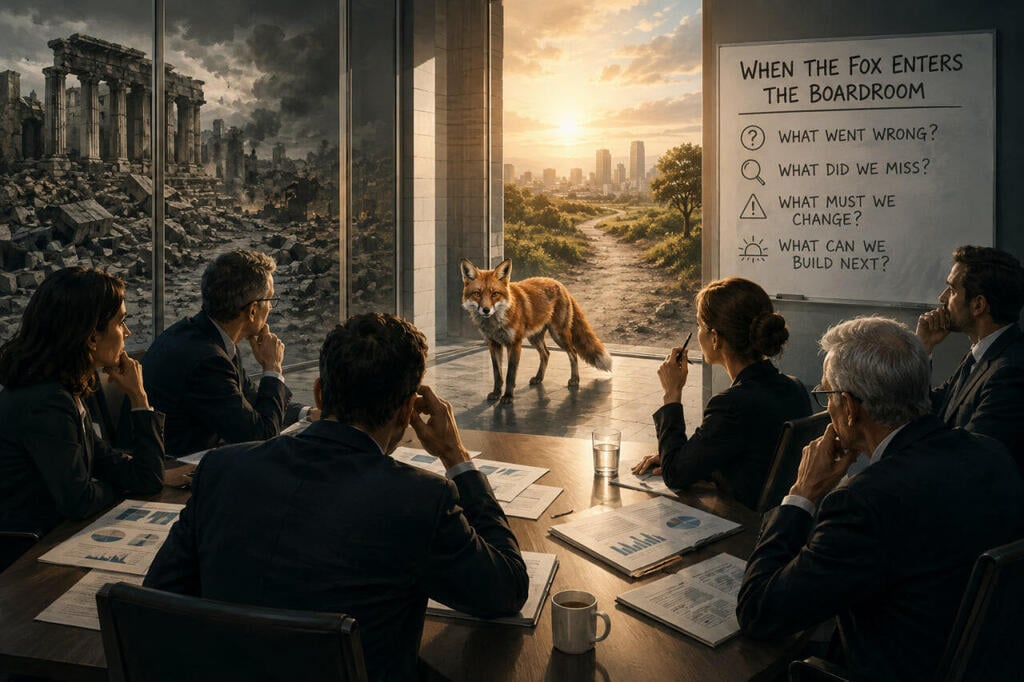
(Illustration: Created with ChatGPT)
A product that took years of investment fails. Longtime customers leave. Excellent employees decide to go. A strategy that looked promising turns out to be an expensive mistake. In the management meeting, people look for solutions, but beneath the discussion lies a deeper question: Did we make a mistake in a specific decision, or did we lose the ability to understand the world in which we operate?
An organization can cope with losses. It is much harder for it to cope with the feeling that reality has become incomprehensible. As long as the manager knows why he failed, he has a starting point for repair. When everything looks random, even the recovery plan becomes a guess.
It is precisely at this point that Rabbi Yitzhak Arama, author of “Akedat Yitzhak” and one of the great Jewish philosophers of the 15th century, offers a surprising reading of the well-known story of Rabbi Akiva and his companions.
The sages go up to Jerusalem after the destruction and see a fox emerging from the Holy of Holies. The place that had been the nation’s holiest and most stable center had become a dwelling place for wild animals. They burst into tears, while Rabbi Akiva laughs.
Rabbi Akiva explains that Scripture linked two prophecies together: Uriah’s prophecy about the destruction of Jerusalem and Zechariah’s prophecy about the day when old men and children would once again return to its streets. As long as he had not seen the prophecy of destruction fulfilled, he feared that perhaps the prophecy of consolation would not be fulfilled either. Now that the harsh prediction had come true, his faith was strengthened that the promise of the future would also be realized.
It is easy to turn the story into a slogan: Every crisis is an opportunity, every decline is the beginning of an ascent. But not every company will recover, not every failed product will come back to life and not every destruction conceals future success. Responsible leadership does not promise that everything will be all right.
Here lies the great innovation of the author of “Akedat Yitzhak.” Rabbi Akiva provides the story, but Rabbi Yitzhak Arama turns it into a complete theory of leadership. Destruction, in his view, does not prove that reality has spun out of control. On the contrary: It reveals that the warnings were not empty words, that choices had consequences and that reality still operates according to a logic that can be understood.
That is why a leader should not first ask, “How do we get out of the crisis?” but rather, “What does the crisis teach us about reality and about ourselves?” Which basic assumption turned out to be wrong? Which warning did we ignore? And what in the way we managed the organization allowed the crisis to happen?
This is also the difference between optimism and hope. Optimism says things will be good. Hope says there is meaning. The person who hopes does not know how the story will end, but believes that actions have consequences and that it is possible to learn from the past in order to choose differently in the future.
Rabbi Akiva does not ignore the destruction and does not dismiss his companions’ tears. They look at what was lost; he looks at the same reality and asks what it teaches about what can still be. The destruction is real, but it does not erase the possibility of understanding, repairing and building.
A leader must know how to provide direction, but also how to say, “We were wrong.” To offer hope, but hope that rests on learning, on a plan and on a willingness to change — not on artificial confidence
So too in an organization. A company that ignored customer complaints for years may one day discover that churn rates have risen, the brand has eroded and revenue has declined. The crisis does not guarantee recovery. Customers who have lost trust are not quick to return, and the market changes in the meantime. But it removes the fog: It exposes the connection between decisions and results. When the cause is understood, it becomes possible to build a plan that is not based on guesswork.
For a crisis to become learning, management must have a rare degree of honesty. It is easy to say that the market changed, that competitors acted unfairly or that employees failed to execute. These explanations protect the ego, but they do not build a better organization.
A real explanation begins with uncomfortable questions: What information did we have but not want to see? Which warning did we dismiss because it did not fit the strategy? When did we stop listening to the people closest to the customers? And which basic assumption became for us a truth that could not be challenged?
During the coronavirus period, and later during the war as well, there were management meetings in which the most important sentence I could say was actually: “I don’t know.” Managers feel the need to project certainty even when they do not have it. But employees, investors and customers do not need a leader who pretends to know everything. They need a leader they can believe.
A leader must know how to provide direction, but also how to say, “We were wrong.” To offer hope, but hope that rests on learning, on a plan and on a willingness to change — not on artificial confidence.
Perhaps this is the most important difference between a manager and a leader. A manager is occupied with solving the problem; a leader is also occupied with interpreting it. He understands that the way the organization tells itself the story of the crisis will largely determine its future.
An organization that tells itself everything happened because of bad luck will learn nothing. An organization that places all the blame on others will not change. But an organization capable of saying honestly, “We were wrong, we understood why, and now we choose differently,” lays the foundation for rebuilding.
The next time a fox enters the boardroom, the instinct will be to ask how to quickly turn the crisis into an opportunity. But that question comes too soon. The more important question is what this fox has come to reveal: Which truth that we did not want to see does it expose, and which basic assumption does it undermine?
That is the innovation Rabbi Yitzhak Arama finds in Rabbi Akiva’s laughter. He does not promise that everything will be all right, but teaches that even when reality falls apart, one must not lose the ability to understand it.
Leadership is not measured by never having made mistakes. It is measured by the ability to look at a mistake without running away from it, to understand what it reveals to us and, from that understanding, to choose a better path.