

As the number of living Holocaust survivors continues to decline, Jewish leaders, scholars and technology experts gathered in Jerusalem last week to examine one of the defining questions facing Holocaust remembrance: how to preserve historical truth in an age of artificial intelligence, digital media and rising Holocaust denial.
The event, organized by the Conference on Jewish Material Claims Against Germany, known as the Claims Conference, was held under the theme "The Day After the Survivors: Between Denial, Technology and Historical Truth."
Gallery
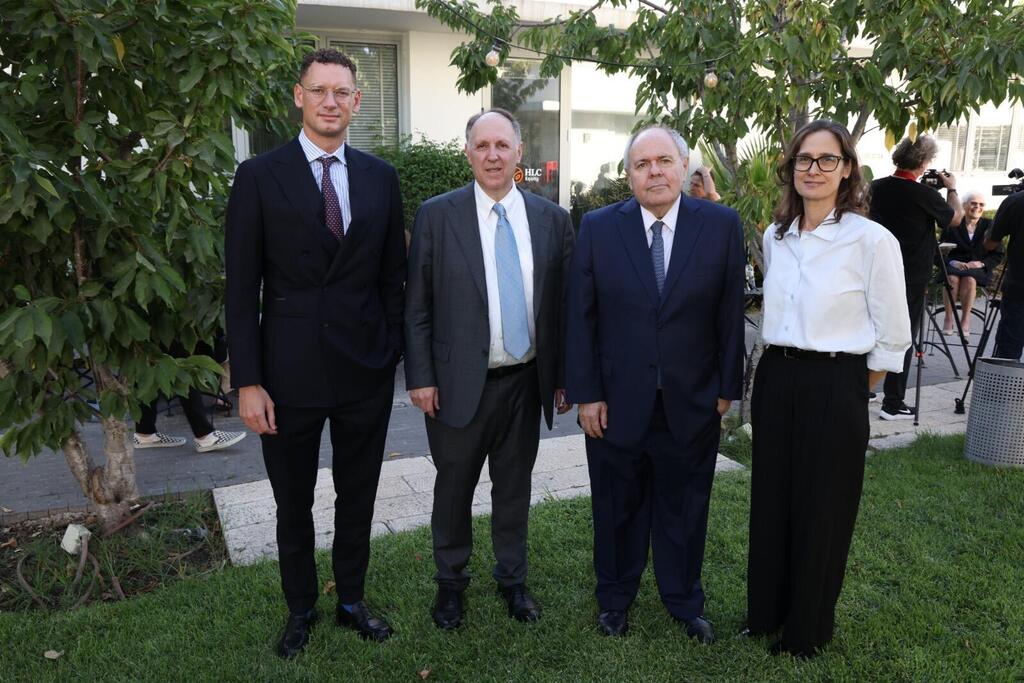
Ziona Koenig-Yair, vice president of the Claims Conference in Israel, Yad Vashem Chairman Dani Dayan, Claims Conference Executive Vice President Greg Schneider and Nikola Petkovic, consul at the German Embassy in Israel at the Claims Conference's event on Holocaust remembrance in the age of AI
(Photo: Edward Stern)
Speakers focused on the approaching transition to an era in which no living witnesses to Nazi atrocities will remain, at a time of rising antisemitism, Holocaust denial and rapid advances in artificial intelligence.
"The boundary between documentation, reconstruction and synthetic creation is blurring," said Dr. Tehilla Schwartz Altshuler, a senior fellow at the Israel Democracy Institute.
Schwartz Altshuler presented research titled "From Post-Testimony to Post-Truth," examining how artificial intelligence is reshaping the creation, distribution and interpretation of historical memory.
As part of her presentation, she screened a video based on her grandmother's life. One version recounts her grandmother's survival during the Holocaust, while another, generated by artificial intelligence, portrays an idyllic life story stripped of the persecution and suffering she endured.
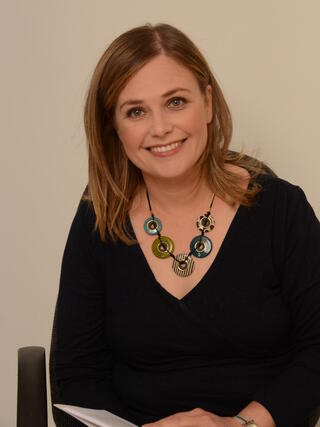 Dr. Tehilla Schwartz Altshuler Photo: Israel Democracy Institute
"Precisely for this reason, the question of how we develop and manage artificial intelligence is also a question of how we will remember the Holocaust. The greatest danger in the AI era is not just the spread of crude and deliberate fake news, but the 'pleasant flattening' of history," Schwartz Altshuler said.
"When artificial intelligence systems are trained on the preferences of consumers seeking easy and accessible emotional experiences, they may produce narratives that whitewash the atrocities and erase moral complexity."
She cited media research suggesting that emotional or comforting content, even when inaccurate, often receives significantly greater engagement online than complex historical material.
"Holocaust memory is no longer shaped only in museums and schools, but also in artificial intelligence systems and digital platforms. Therefore, the discussion on the future of memory must also take place around the decision-making tables where the technologies that will carry historical testimony to future generations are designed."
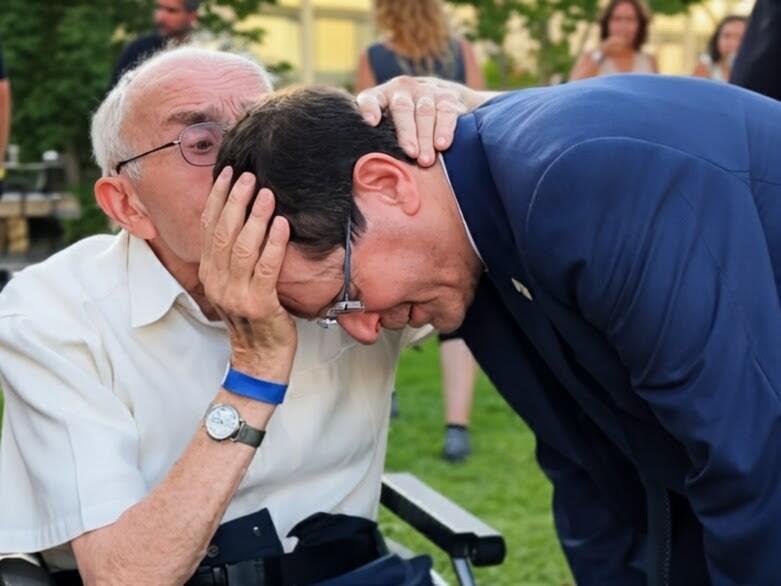
A Holocaust survivor plants a kiss on President Isaac Herzog's head at the Claims Conference's event on Holocaust remembrance in the age of AI
(Photo: Office of the president spokesperson)
Her warning comes as recent international surveys commissioned by the Claims Conference have found widespread gaps in Holocaust knowledge among younger generations.
According to the studies, many respondents ages 18 to 29 in the United States and several European countries said they had either never heard of the Holocaust or were unsure whether they had. Most respondents also underestimated the number of Jews murdered during the Holocaust, with many believing the death toll was 2 million or fewer rather than about 6 million.
Organizers said the findings underscore the risks of allowing generative AI systems to shape historical understanding without safeguards.
Alon Carmel, a technology entrepreneur specializing in artificial intelligence and a third-generation Holocaust survivor, argued that AI presents both significant risks and important opportunities.
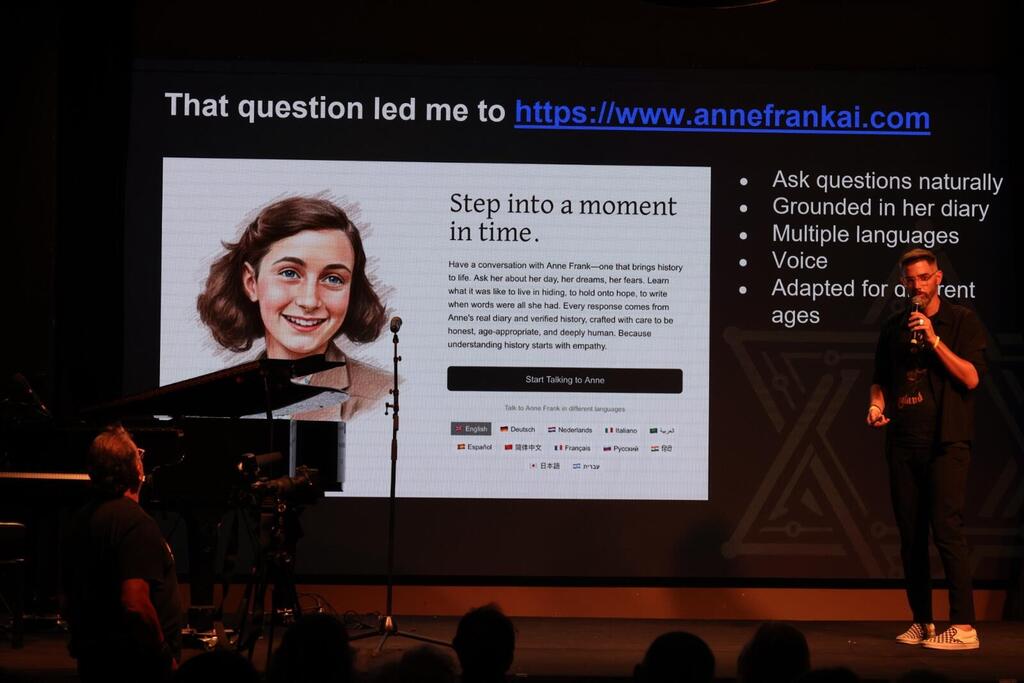
Alon Carmel
(Photo: Edward Stern)
"For me, AI is both a risk and a responsibility when it comes to Holocaust memory," Carmel said. "It can generate convincing but inaccurate versions of the past, and as the number of living survivors declines, that danger will only grow."
At the same time, he said, AI can help younger generations engage with Holocaust history through interactive educational tools.
Carmel highlighted AnneFrankAI.com, a project that allows users to ask questions about Anne Frank's life in natural language while generating responses grounded in her diary and verified historical sources.
"AI does not recreate Anne Frank," he said. "It creates a responsible doorway to her voice."
Schneider said the concerns expressed by Holocaust survivors have evolved over time.
"During my visits with Holocaust survivors, their greatest concern was how they would be cared for as they aged," he said. "Today, the question I hear most often is how they will be remembered."
"We have a profound moral responsibility to ensure that the Shoah is never forgotten, and that those who survived—and those who were murdered—are honored, remembered and their stories and lessons of the Shoah are carried forward from generation to generation, especially against the backdrop of the various challenges that the new era brings with it."
Among those attending were President Isaac Herzog, German Consul to Israel Nikola Petkovic, Yad Vashem Chairman Dani Dayan and Claims Conference Executive Vice President Greg Schneider. During the event, retired Supreme Court chief justice Aharon Barak received a special award recognizing his legal contributions and public service.