

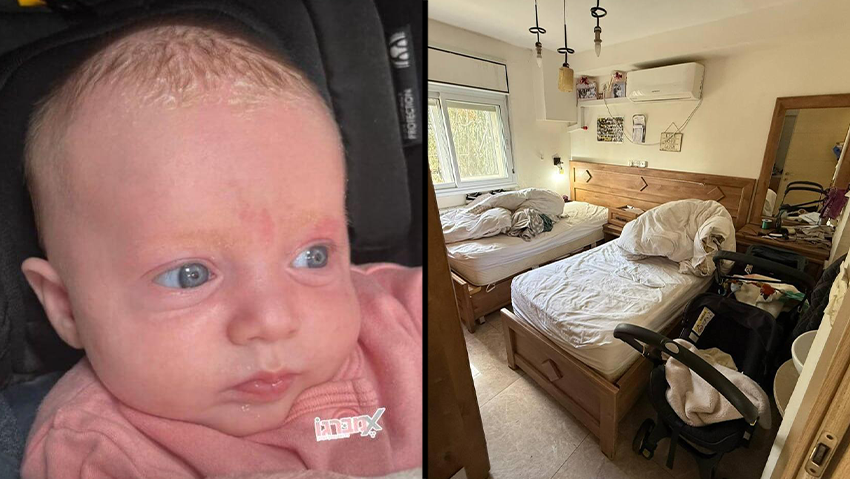
The recent angry protests by ultra‑Orthodox Jews against the planned autopsies of infants Leah Goloventchitz and Aharon (Ari) Katz, who died at a daycare center in Jerusalem, were driven by deeply rooted religious beliefs about kavod hamet — the Jewish value of preserving the dignity of the dead.
Michael Guttwein, head of the legal department at ZAKA, explained why the organization petitioned the Supreme Court against the autopsies. “An autopsy is desecration of the dead — a violation of kavod hamet. Dignity of the dead is more important than burial. A person must be brought whole to the grave of Israel. Even a tiny needle piercing the deceased is suffering for the soul — like a thousand pins in the soul.”
Following the decision on the autopsy of babies, an ultra-Orthodox demonstration in Jerusalem
(Video: Gil Yonatan)


The police arrested the daycare owner and a caregiver, who are suspected of causing death by negligent action and neglect of a minor. Initially, the Jerusalem Magistrate’s Court approved the prosecution’s request to autopsy the infants’ bodies to determine the cause of death, but the Supreme Court reversed that decision, accepting the petitioners’ arguments. ZAKA’s petition was first submitted on behalf of Aharon’s family, and later Leah’s family joined the petition.
Gottwein noted that “dignity of the dead appears in the Torah” as far back as Jacob’s death, when he asked Joseph to preserve his dignity.
“There have been cases where ultra‑Orthodox families opposed autopsies,” he said. “If there was real suspicion of murder — and not performing an autopsy would let a murderer escape — I would not oppose it and we support autopsy in such a case. There are autopsies limited to the precise location of injury, e.g., at a wound site, that can prove cause of death. Here, this is something else.”
He explained that doctors had indicated the deaths were likely caused by overheating rather than poisons or toxins.
“But an autopsy is needed to write that in a legal report that the prosecution can rely on,” he said. “I’m not in favor of autopsying the body just to reach a conclusion identical to what the doctor already determined, for a definitive legal ruling.”
ZAKA CEO Dovi Wiesenthal — whose organization petitioned the Supreme Court — told ynet Thuesday morning: “The cause of death — halachically it’s important and relevant, but we are not sure that an autopsy now will add beyond the findings already made about the cause of death. Today there are enough technological means that, in our view, can determine the cause of death. That’s all we ask: to exhaust the maximum possible and to hear the family for the sake of kavod hamet.”
'A very difficult dilemma'
The case highlights the issue of kavod hamet in Jewish law and the moral dilemmas that arise from it.
“Burial of a person in full is one of the most essential foundations of Judaism in its regard for the individual,” said Rabbi Yuval Cherlow, head of the Ethics Center at the Tzohar Rabbinical Organization. “A person’s soul ascends, and the body returns to its place — the earth. For this reason, halacha is stringent on many matters related to a person’s body: it forbids deriving benefit from a corpse, using a dead body, and requires that the entire body be brought to burial.”
He added that the importance of Jewish cemeteries, funerals, eulogies and many other practices stems from the deep belief that humans are created in the image of God, and that all parts of the body must be treated with dignity. Ancient biblical texts already reflect concern over whether a person received proper burial.
When there is suspicion of criminal acts, Cherlow said the answer is more complex. “There are situations where serious crimes cannot be addressed without forensic evidence obtained precisely through autopsy," he said.
"The dilemma is very difficult, because on the one hand there is the absolute obligation to preserve kavod hamet and bring the deceased to burial without harm, and on the other hand there is the grave risk of removing deterrence and punishment for severe acts, because the perpetrator may know they cannot be convicted. What is the appropriate halachic solution? As with many issues — one must move beyond automatic absolute thinking of ‘forbidden’ and ‘permitted.’”
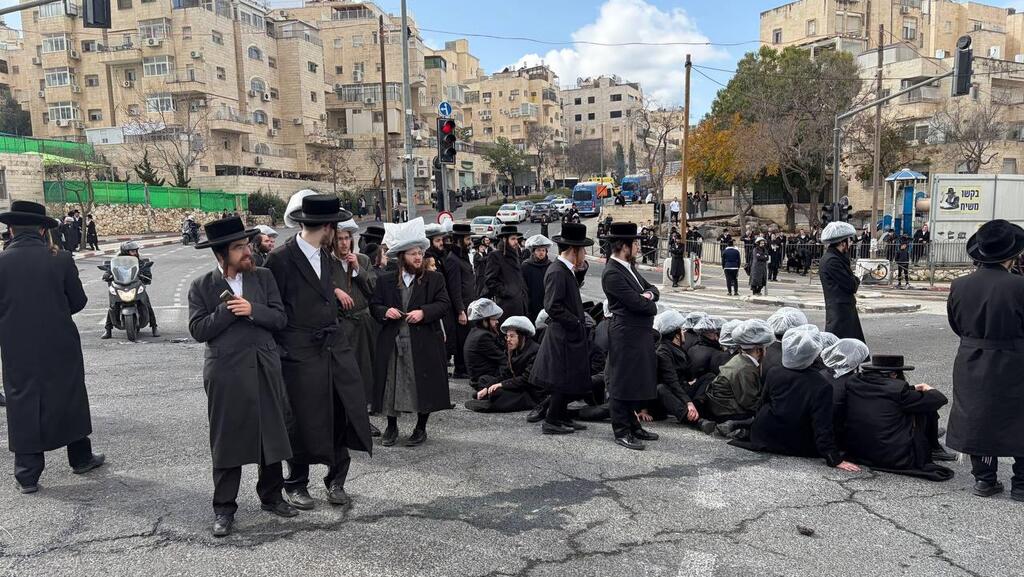
Following a discussion on the autopsy of babies, an ultra-Orthodox demonstration in Jerusalem
(Photo: Idan Blumhof)
Without addressing the details of the current case, the rabbi explained further. “The starting point should be that bodies are not autopsied, as part of the dignity due the human and respect for his body, consistent with halacha and Jewish tradition over the generations," he said.
"Every effort must be made not to reach that point, including relinquishing outcomes when not essential, and not allowing autopsies without justification. There are cases where results can be reached without invasive procedures, using advanced equipment and various scans. Only in extreme situations, where it is necessary and essential — whether to save lives or to combat serious crime — should it be permitted, and even then with many restrictions and meticulous preservation of human dignity,” he explained.
Autopsy and medical practice
Cherlow also noted that autopsy issues are relevant in medicine.
“The question of whether halacha permits, or perhaps even obligates, autopsy arises first in cases where autopsy of a deceased could directly save a living person suffering from the same condition,” he said. “This situation is defined as a ‘sick person lying before us.’ In such cases, the commandment of pikuach nefesh (saving a life) overrides dignity of the dead, and even strict halachic authorities permitted it centuries ago.”
He added that today every patient is considered “a sick person lying before us,” because autopsy findings can quickly enter databases and information systems that may save others.
“Therefore, some halachic authorities believe that in certain situations it is permitted,” Cherlow said. “The question is broader — for example in medical education — because if we must have highly trained doctors, and this too falls under pikuach nefesh, then autopsy is part of their training.”