

In this week's Torah portion, Parashat Vayera, Abraham negotiates fiercely with God in an attempt to save Sodom. Though his efforts fail, God sends messengers to rescue his nephew Lot before raining sulfur and fire upon the plain. Looking down the following morning, Abraham sees "the smoke of the land rising like the smoke of a kiln" (Genesis 19:28).
The image of smoke rising like a furnace evokes a world of industry and production, now reduced to ruins. Abraham's gaze closes a circle that began when Lot chose to settle in Sodom because the surrounding plain was fertile and prosperous. Genesis describes the region before its destruction as being "like the garden of the Lord as you come to Zoar" (Genesis 13:10).
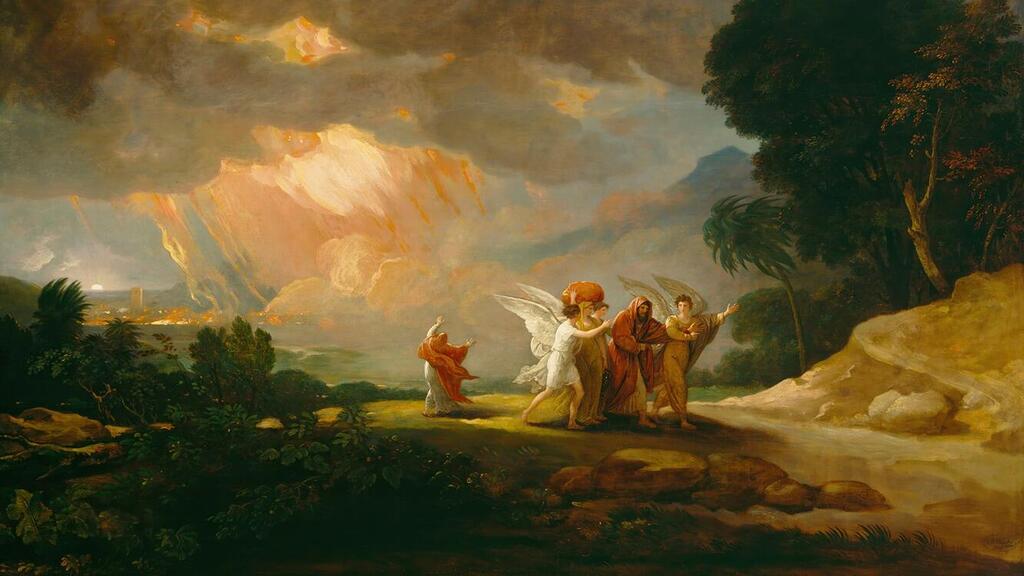
Lot fleeing Sodom
(Painting: Benjamin West)
While that verse mentions only Sodom and Gomorrah, Deuteronomy (29:22) makes clear that the neighboring cities of Admah and Zeboiim were also destroyed. Zoar, however, was spared.
As destruction approaches, Lot pleads with the angels to let him escape to Zoar: "Let me flee there... and let my life be saved" (Genesis 19:20).
Why was Lot so determined to reach this particular city?
Rashi offers two explanations: Zoar was either small enough to have accumulated fewer sins or sufficiently young that its wrongdoing was less severe. But perhaps Lot was also thinking about his economic future.
The city that survived the destruction
Tracing the five cities through Genesis reveals an intriguing pattern.
In Parashat Noach, Genesis 10:19 describes the borders of Canaan by naming Sodom, Gomorrah, Admah and Zeboiim, extending as far as a place called Lasha. Later, in Parashat Lech-Lecha, the fifth city is identified as Bela, "that is, Zoar" (Genesis 14:2).
The name Bela invites an additional interpretation. It can be associated with the Hebrew root meaning to swallow, suggesting resources buried or "swallowed" beneath the earth. This reading calls to mind the ancient copper deposits of Faynan, in the Arabah region southeast of the Dead Sea.
Another detail emerges from the biblical account of the War of the Kings. The kings of Sodom, Gomorrah, Admah and Zeboiim are named, while the king of Bela-Zoar remains anonymous. Later, when the invading armies seize property and provisions, the text specifically mentions the plunder of Sodom and Gomorrah, not Zoar.
Could these distinctions hint at the city's special economic significance?
The War of the Kings can be read through the lens of ancient supply chains. Copper from the Arabah, including the mining districts of Faynan and Timna, was a crucial resource for producing bronze when combined with tin. Bronze, in turn, was essential for manufacturing weapons, tools and other advanced products of the ancient world.
Within this interpretation, the struggle among regional powers was not simply about territory. It was also about access to resources and the trade routes that made advanced production possible.
Perhaps Zoar was small enough not to threaten the surrounding powers, yet economically valuable enough to be preserved. The biblical account does not establish such a connection, but it offers an intriguing way to understand Lot's insistence on fleeing there.
Facing the destruction of the surrounding cities, Lot may have recognized Zoar as a place where economic life could continue, a surviving center from which the region might eventually recover.
Why did Lot abandon the city he fought to save?
Yet the biblical narrative takes an unexpected turn.
Shortly after reaching Zoar, Lot leaves the city and retreats to a cave in the mountains because "he feared to dwell in Zoar" (Genesis 19:30).
Why would he abandon the very city he had pleaded to save?
I would suggest an economic explanation that Lot may not have anticipated: Even the most valuable industry cannot thrive when the surrounding cities, markets and economic networks have been destroyed.
A copper-producing region depends on far more than the mines themselves. It needs workers, food supplies, transportation, trading partners and buyers. Without those connections, even an indispensable resource can lose its economic value.
Archaeological research documents extensive copper production in the Faynan region during the Early Bronze Age, followed by major changes in production patterns during subsequent periods. Although these findings cannot establish a direct connection to the biblical destruction of Sodom, they illustrate the dependence of ancient industry on broader economic systems.
In my reading, Lot discovered that preserving a city's physical infrastructure was not enough. Without a functioning regional economy, Zoar could no longer offer the prosperity or security he had expected. Scarcity and economic isolation may have made life there increasingly precarious, ultimately driving him away.
The city had escaped destruction, but Lot could not build his future there.
From ancient copper to Israel's AI revolution
In a recent interview with Calcalist, American billionaire investor Bill Ackman argued that Israel's relatively small size could become a major advantage in the age of artificial intelligence.
AI, he explained, reduces the need for enormous workforces. What matters increasingly is the concentration of talent and the ability of small, highly skilled teams to produce extraordinary results.
Ackman also argued that the greatest economic value would not necessarily belong to the companies building foundational AI models, but to those developing products and services that apply the technology.
That was, perhaps, Zoar's ancient promise: a small city occupying a potentially critical position in a transformative technological economy.
Perhaps this also gives new meaning to a seemingly minor geographical detail near the Torah's conclusion. When God shows Moses the Promised Land, the description ends with "the plain, the valley of Jericho, the city of palm trees, as far as Zoar" (Deuteronomy 34:3).
Through this interpretation, Zoar represents more than a surviving settlement. It symbolizes the economic potential of a region whose prosperity depends on the connections that give its resources value.
But Parashat Vayera also offers a warning.
Technology alone cannot guarantee prosperity. Copper without trade routes is merely metal in the ground. Artificial intelligence without customers, institutions, productive partnerships and a functioning society cannot realize its full potential.
A small country can achieve extraordinary things when its technological capabilities become a force multiplier. But that requires more than talent or advanced infrastructure.
It requires community, trade, alliances and justice.
Zoar's lesson is that surviving is not the same as thriving.