

My first meeting with Elie Wiesel took place in November 1983. When I knocked on the door of his apartment, then on Manhattan’s West Side, the door opened and two people stood before me. I was surprised. I recognized Wiesel immediately, but who was the guest, the second man who at that moment was taking leave of his host? The answer came at once: “Meet the writer Primo Levi.”
Two in one meeting, and what two they were. I was deeply embarrassed. I did not know what one says at such a moment. I still did not know any of Primo Levi’s books in Hebrew, but I had heard of the man. In Kvutzat Yavne, where I grew up, there was a member, Yosef Hartom, a native of Turin, the same age and classmate as Primo Levi. Both studied chemistry, but Yosef’s family was Zionist and immigrated to Israel in 1938, while his friend Primo Levi remained in Italy and endured the torments of the hell of Auschwitz. Since Yosef knew of my interest in Holocaust literature, he once told me at length on a Shabbat about his good friend.
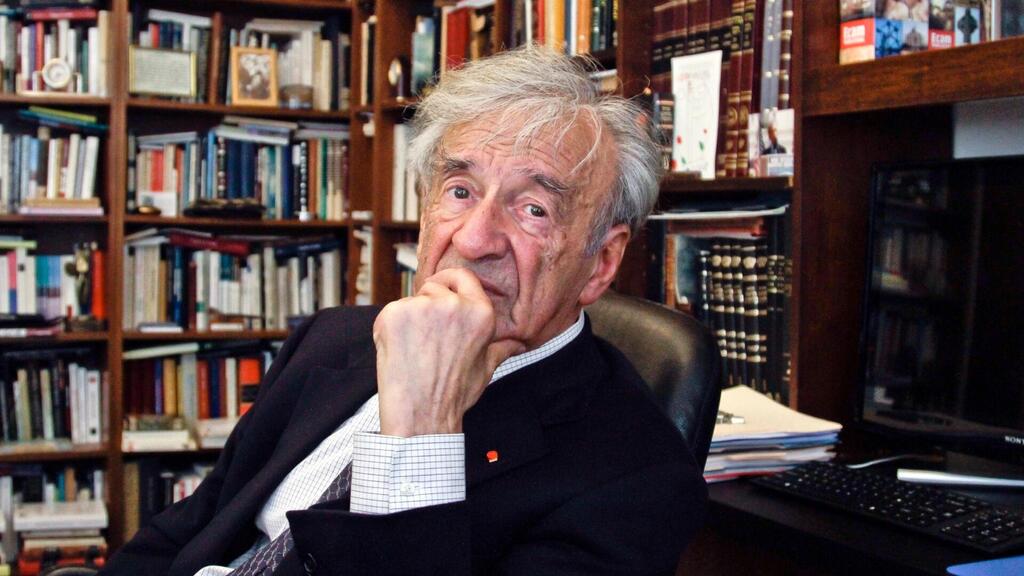
Elie Wiesel and Primo Levi met in the early 1970s and immediately became close friends. They called each other “my brother” and exchanged letters, most of which I found in the archive. When Primo Levi died, his widow wrote to Wiesel in a telegram: “We will delay the funeral until you arrive, so that you, as he wished, will eulogize him.” The funeral was not delayed, but on the 30th day more than 2,000 Italian Jews gathered for a memorial service in Turin, where Wiesel was the only speaker and eulogist. He came especially from New York.
I asked Wiesel what he and Primo Levi spoke about in their long conversations, and he replied: “We spoke about our days in the Buna camp, Auschwitz III, and about the different understanding each of us had of the meaning of those difficult days.”
They were close friends, but very different from one another. Wiesel represented a spiritual, moral and theological voice, while Primo Levi was analytical and rational. From the moment they met, they knew they had been tortured and had suffered at the same time and in the same camp, without knowing it in real time.
Their time in the extermination camp produced two unique books, Wiesel’s Night and Primo Levi’s If This Is a Man. I heard a great deal from Wiesel about their conversations, which never truly ended. As he said: “We paused until the next continuation of the conversation, but the pause from the last conversation is still continuing.”
Primo Levi was only one of the many writers with whom Wiesel maintained ongoing contact, a relationship well reflected in the hundreds of letters I found in the archive. Wiesel loved friends, and friendship was for him a value of deep meaning. Anyone who betrayed friendship was quickly removed from the “club.”
Wiesel and Primo Levi had another mutual friend, the writer Jean Améry, who was in the same camp at the same time. His well-known book At the Mind’s Limits: Contemplations by a Survivor on Auschwitz and Its Realities expresses a philosophical view according to which Auschwitz was an experience entirely defined by the humiliation of man as man. Therefore, it has no forgiveness and cannot be reconciled.
A real bond existed among the three, even though each of them viewed the terrible period in the extermination camp differently. If I had to classify or characterize the three of them, I would say that Wiesel was first and foremost the Jewish witness of Auschwitz. For him, Auschwitz was the arena of struggle between man, God and memory. His descriptions are emotional, with great emphasis on the Jewish experience.
Primo Levi’s name did not allow him to flee his Jewish identity, but his interest in God and faith was more limited. He dealt extensively with human behavior under extreme conditions and with the meaning of moral edge situations.
In Jean Améry’s case, Jewish identity was forced upon him by Nazi antisemitism. He was born into an assimilated family, and discovered that everything he thought he had, homeland, culture, education, history and progress, had been taken from him. “The past was suddenly buried, and you no longer knew who you were.”
Three Jewish writers, and there were others, such as Viktor Frankl and Ka-Tzetnik, but these three maintained friendship and dialogue among themselves. Two of them, as a result of severe mental crises, took their own lives.
When I asked Wiesel about his two friends, with whom his connection began only in the 1970s, and whether he could have anticipated that they would end their lives early and by their own choice, he replied that the differences among the three of them were clear. Still, the fact that they experienced the same severe torments forced them to confront the same intellectual questions, and that was the foundation of the dialogue among them.
“Of the three of us,” he said, “I was the only one who remained with my father almost until the final month, and the thought that accompanied me was a thought of hope, and more than anything, faith in the future.”
• • •
Wiesel was born in the town of Sighet, a Jewish shtetl in the southern Carpathian Mountains, where the borders of Hungary, Romania and Ukraine meet today. His exit into the wider world was in Paris. After leaving the orphanage and moving to the big city, he studied at the Sorbonne and began working as a journalist, a profession he practiced for 25 years, from 1947 to 1972.
François Mauriac was Wiesel’s mentor and the man who opened many doors for him, but I was interested particularly in Albert Camus, whose books The Plague and The Stranger I had read and loved. In the archive, I found a handwritten letter by Camus, and it was an opportunity to ask Wiesel about their connection.
He spoke of his days as a young journalist and student, when he would go to the literary cafés of Montparnasse. Many writers sat there, gathering around Jean-Paul Sartre and Simone de Beauvoir.

Wiesel's home in Sighet
(Photo: Yahav Palticiniano)
“They would sit in circles,” he said, “and everyone who came to Café de Flore made efforts to get close to Sartre and Camus, who were always at the center and were occupied with existentialism. I drew close to Camus. I read all his books, found great interest in what he said and in the way he spoke, and slowly a connection formed between us, first through a glance, then through conversation. The connection strengthened after he learned of my past. He was the one who pushed me, a young Jewish man who was not French, to tell mainly Sartre, Simone de Beauvoir and also him about my difficult experience in the Holocaust. I remember almost every sentence, or at least every subject, that I discussed with Camus.”
The acquaintance with Mauriac was the keystone of Wiesel’s entry into French culture. He went out looking for donkeys and found a kingdom. “To François Mauriac, the Nobel Prize laureate in literature, I owe my career,” Wiesel summarized in a few words the close relationship between them. It all began when he sought to conduct a journalistic interview with Mauriac, hoping that Mauriac would persuade his Jewish friend, Prime Minister Pierre Mendès France, to be interviewed by Yedioth Ahronoth.
The interview did not take place, but the time set aside for it was used for a long conversation between a young Jewish Holocaust survivor and a devout Catholic. “From the day I left Paris in 1956 until Mauriac’s death in 1970, there was not one visit of mine to the city that did not include a visit to him,” Wiesel said.
The introduction Mauriac wrote to Night was, for many years, the key that persuaded publishers in various countries to publish the book. “To a large extent,” Wiesel said, “the success of the book was thanks to him.”
In a letter written by the French writer André Maurois, which I found in the archive, he tells Wiesel of his memories from the days when they would speak and walk together along the Seine. I was surprised, since the age gap between them was 43 years.
I asked Wiesel: What do two people talk about when one represents the world that was, and the other the world built after the war? “Maurois treated me like a son,” he replied. “When I met him, he was already writing little. He had published most of his books at a younger age, and he dreamed of seeing me as part of French culture in general, and literary culture in particular.”
• • •
Alongside Camus, Mauriac and Maurois, Wiesel maintained very close ties in France with the leading thinkers of the “Paris School” of Jewish thought. Among them were Emmanuel Levinas, André Neher and Rabbi Yehuda Léon Ashkenazi, known as Manitou, whose circle was joined for several years by Shushani. These people, who embraced him into their hearts and their spiritual world, had an enormous influence on him. Wiesel often took pride in their contribution to shaping his Jewish identity and developing his thought.
One day, as I opened a box in the archive, a pile of large papers protruded from one of the envelopes. Written on them in red ink, in large handwritten letters, was the text of a poem. From its external appearance, I did not attach any special importance to it. I gathered the pages, placed them in the envelope and made a note to myself that I had to check what it was.
Two days later, I arranged the pages according to the serial numbers that appeared at the top of each page. Within a short time, it became clear to me that I was holding Allen Ginsberg’s original manuscript of the poem Kaddish, written in memory of his mother, Naomi. I was stunned. How did Allen Ginsberg’s manuscript reach Elie Wiesel?
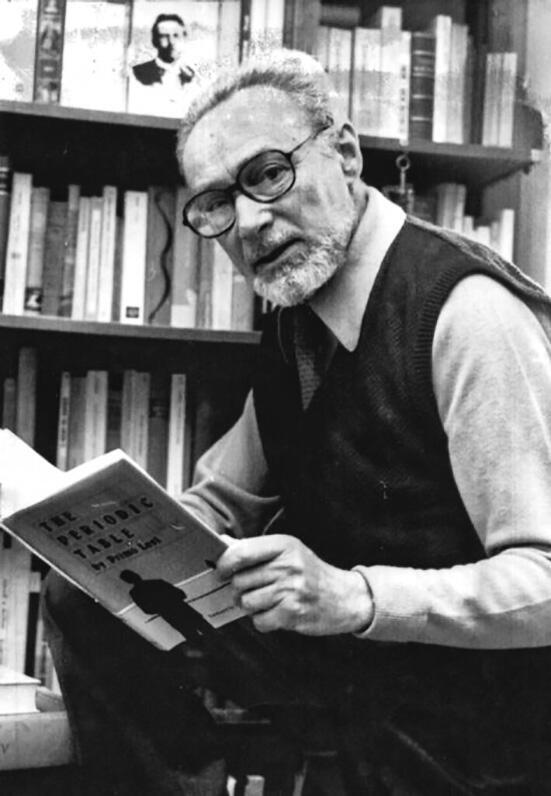
Primo Levi
(Photo: AP)
I could not restrain myself and called immediately to find out how this treasure had found its way into his archive. Wiesel told me that one day Ginsberg called him and asked for a meeting, without stating any special reason. A time was set, and the beatnik poet, wild-haired, arrived with an unidentified bundle of papers in his hand. “I think,” he told Wiesel, “that you will keep this better than I will.” He left the manuscript with him and went away.
Few, if any, know that the original manuscript of Kaddish lies in Elie Wiesel’s archive. For 60 years Wiesel lived in New York, and in the center of this cultural world he could have, had he wished, known the best writers and poets of his generation. But he was a meticulous man, who guarded his time jealously and devoted a large part of it to writing his books and essays, 57 books in all, and of course also to academic teaching, which demanded great dedication from him.
Allen Ginsberg was not among Wiesel’s close friends, but the gesture itself testified to the regard many American creators, a large share of them Jews, had for Wiesel’s special standing.
He brought Saul Bellow to teach at Boston University. He encouraged the writer Chaim Potok to take on the management of the Jewish Publication Society. With Isaac Bashevis Singer, who was a close friend, he even fell out after noting, in a review he wrote for The New York Times, the extensive preoccupation with sex in the work of the writer who later won the Nobel Prize.
Wiesel was also close to the writer Israel Joshua Singer, Bashevis Singer’s brother, and to the Jewish writer Cynthia Ozick. The letters they exchanged are fascinating in their content and attest to an abundance of shared subjects of interest and writing.
Still, Wiesel’s literary milieu in the United States was composed less of writers of belles lettres and more of thinkers, scholars and intellectuals. Among his friends and conversation partners were Prof. Saul Lieberman, Prof. Abraham Joshua Heschel, the writer and scholar Arthur A. Cohen, the philosopher Arthur Cohen, the Lubavitcher Rebbe, Cardinal John O’Connor, the writer Jerzy Kosiński, a Holocaust survivor who took his own life, and the poet and writer Aaron Zeitlin.
And we have still not said a word about the many Israeli writers who made sure to maintain contact with Elie Wiesel.
• • •
Elie Wiesel Primo Levi
Central Park West 75 Corso Re Umberto
New York, 10024 10128, Turin
Dear Elie,
For some time I have wanted to write to you, but because of the appearance of your fifth “son,” for which I thank you, I delayed writing until I had finished reading it. It seems to me a great achievement of yours. Among the books of yours that I know, it is probably the most beautiful, and certainly the most mature and “comprehensive.” It is a book in which you combined the best of your talent as a writer with the need to bear witness, which is never satisfied. I was especially moved by the final pages, which describe the meeting between “Ariel” and the angel. In fact, this is a theme that returns again and again in my dreams, the meeting, the confrontation with one of “them,” which one desires and also fears, as with your hero. The connection I had with Dr. Müller from Buna, which you may have read about in the story I left for you in Milan, is only a rather rough approximation of such a meeting.
Must I confess? I came to Milan then with apprehension. In view of the difference in our cultural origins, I feared that our meeting would be limited and would amount only to a return to our shared experience, and also that our words would be disrupted by the surroundings and suffer from the absence of a common language, not only in the literal sense. What happened was the opposite. Immediately after I saw you, I understood that we were friends, more than friends, and not only from that moment but from always. I am convinced that despite our very different educational backgrounds, our choices in the face of any political or moral problem would not be so different.
I thank you very much for calling Renzo. He is in Atlanta from January until next July. He is satisfied with his work, but not so much with the human relations. He will come to us for vacation toward Christmas. We will certainly discover that a great change has taken place in him.
I hope to see you again, and soon, in one place or another, despite my family difficulties, which I surely hinted to you about. In the meantime, together with my wife, I embrace you with a great brotherly hug. Send greetings to your wife and to the child, whom I liked very much during our brief meeting.
Primo