


This week, we read the fascinating and remarkable Torah portion of Noah, the famous story of the flood and the ark.
Why do I say that it’s fascinating and remarkable? What’s so special about it? We all know the story. Is there anything new to learn here?
My friend Rabbi Efrem Goldberg reminded me again this week that the Torah is alive and every single time you read it, not only are there new lessons to learn, but often times, those lessons are more relevant than ever.
That is most definitely the case with the story of Noah. The portion is absolutely filled with lessons for us today. Let’s jump in.
The portion begins with the verse: “This is the line of Noah. Noah was a righteous man; he was blameless in his age; Noah walked with God.”
“Blameless in his age…” What does that mean? What do the words “In his age” add? That he was righteous in his generation.
Rashi, the commentator on the Torah, says something both famous and confusing. He says that some rabbis interpret those words “In his age” as criticism of Noah, that he was righteous in his own generation, but had he been in the generation of Abraham, he wouldn’t have been considered that righteous.
What a strange statement. Noah, who saved the entire world from destruction, who stood out in a deeply corrupt world, how on earth could any rabbis understand this verse as being critical of Noah? In fact, the Torah literally says that Noah had favor in the eyes of God. It says that more than once!
How could this be a criticism of Noah? The answer quoted by Rabbi Goldberg is both beautiful and deeply applicable to today.
The criticism here, when the Torah says “In his age,” is indeed a criticism, but not of Noah, rather of the generation. This is actually a compliment to Noah.
Here is the correct way of understanding the verse: Despite Noah being in a terrible and morally depraved generation, he still managed to remain righteous and faithful to God!
Despite being in a morally bankrupt environment, Noah maintained his moral clarity. And yes, the reason Noah shone is because his light was that much more apparent among all the darkness. Noah was called righteous and is described as having favor in the eyes of God because his generation was so terrible.
Today, each and every one of us has the opportunity on a daily basis to be a Noah. We live in a confused and immoral generation where boundaries are broken and even ridiculed. We each have the chance to shine, to find favor in the eyes of God, to speak our truth, not to be silenced by all the craziness out there.
It’s not easy to remain truthful when all you hear all day long are lies. That was Noah. He showed the world in which boundaries are broken that there are boundaries, there is good and evil, and that morality is not relative, it is absolute. Let’s go deeper.
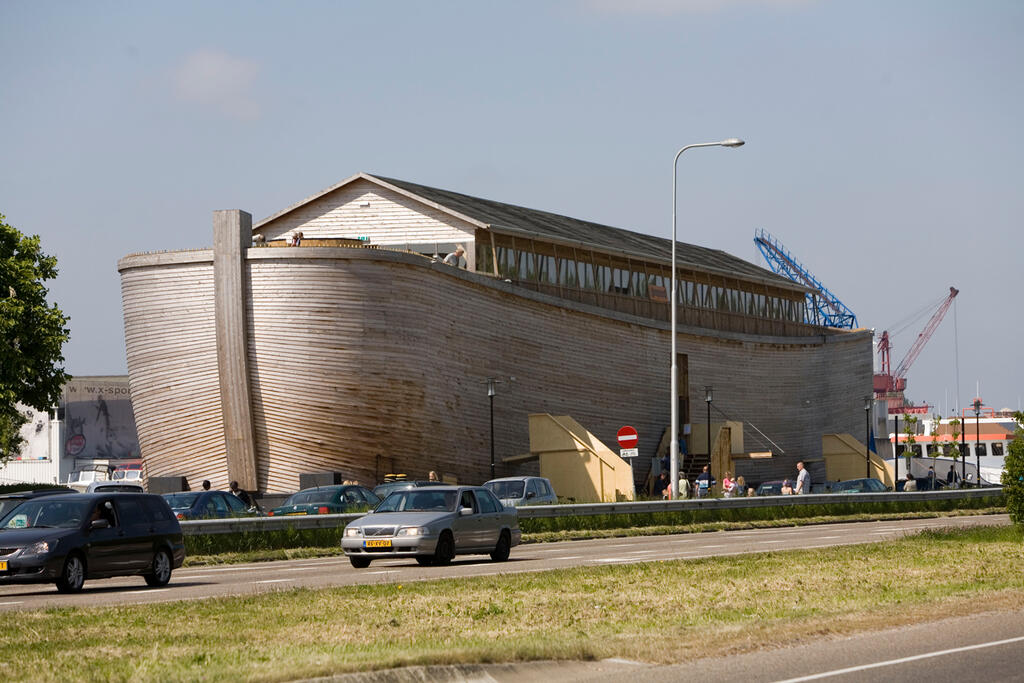
A full-scale replica of Noah’s Ark, built by Dutch carpenter Johan Huibers, stands on display in the Netherlands. Huibers constructed the wooden vessel based on biblical descriptions
(Photo: gettyimages)
So how does the Torah describe this world without boundaries? Does the Torah use the word Ra, which means bad? Does it use the word Achzar, which means evil? No. The Torah uses the word, and sit down for this, Hamas.
That’s right. The generation of Noah was full of Hamas. That’s what the Torah says. Hamas. Hamas represented the lack of boundaries.
Want to know what that looks like? How it manifests? When you ignore borders and break through fences. When you enter homes and abduct and murder people. When you pay no attention to who a person is or what they’ve endured or even what they stand for and you murder (and worse) with no concern for boundaries. That was Hamas back then and that is Hamas today.
The commentary on the Torah explain that the punishment of a flood was the appropriate punishment for the transgressions of the generation.
Why? What does a flood have to do with a lack of boundaries? The answer is obvious. God is saying in essence, “You wanted to live without boundaries on earth? I will show you what no boundaries look like. I will instruct the rain to ignore the boundaries between the heavens and earth, and I will flood the land with water. You wanted to live without boundaries? No problem. That’s what you’ll get.”
What is the antidote? What does God instruct Noah to do to reinstate boundaries? Create an ark with clear boundaries between the evil in the world and the good from within, the good that will survive and guarantee continuity to the world.
Again, super relevant for us today. The world would have you believe that there are no boundaries and everything is acceptable. It is our job to remind the world that, since the beginning of time, humanity has had clear boundaries, and trying to remove those boundaries isn’t progress, liberal or moral. It’s the opposite.
Let’s go even deeper, and stop reading here if you’re easily offended… The commentary explain that the people of the world, the evil people, the people with no boundaries, planned on murdering Noah upon him entering the ark.
The portion says that God had to close the door to the ark behind Noah in order to protect him from the evil people who wanted to kill him.
Again, the question here is obvious and the answer enlightening. Why on earth would they want to kill Noah? He wanted them to repent. He offered them the opportunity to fix their ways. He guaranteed the continuity of humanity. What is there to hate?
The answer is that to them, Noah represented a moral conscience. He represented a light in a very dark world. He represented boundaries in a boundaryless world. He stood for something that was paradoxical to everything they stood for. And they hated him for it.
When people want to behave immorally, the last thing they want is someone holding a mirror before them to show them how immoral their behavior truly is.
That is why the world hated Noah back then, and that is why the world hates the Jews in every generation, including ours.
Where does the world know that it is immoral to murder? After all, in ancient times, it wasn’t. Many of the things that were once considered moral are today considered morally repugnant. Why? What is the source? The answer is obviously the Torah. The Torah represents moral clarity.
The world, as it becomes more and more immoral, as boundaries continue to increasingly disappear, antisemitism spikes.
Why? Because the Jewish people are a beacon of light, a source of ethics and morals. The Jewish people have stuck to their tradition despite all the suffering we endured. We didn’t let the “Enlightened” culture of Germany make us forget who we are, and we don’t let the “Liberal” culture of the West today make us forget who we are. And they hate us for it!
 Hillel Fuld Photo: Courtesy
If I wanted to live a life without boundaries and without morality and there was someone constantly reminding me what boundaries are and what morality is, I’d also hate them.
The Jews have been and continue to be the moral compass of a very lost world. We try to show them the right way but they prefer to use a broken moral compass. The more we try, the more they hate us.
In fact, if I were immoral and someone was constantly reminding me how moral they are or what morality is, I would hate them for it, but I’d also do something else. I’d try to prove that that person is, in fact, not so moral.
If someone represented morality in an immoral world, I’d spread lies about them, blood libels. I’d accuse them of genocide, of starvation, of sexual crimes, of perversion, of deviance, of anything that would vilify them and delegitimize them. I’d do that to hide my immorality by saying, “See? They’re immoral too!!”
Now you understand why the world hates us and why the world constantly, throughout the generations, feels the need to lie about the Jews and make up often ridiculous stories to paint us in the most negative light.
Where did we receive the Torah? Where did morality originate? At Mount Sinai! Sinai, the same root as the word Sinaa, which means hatred. (The letters Samech and Sin are often interchangeable, in case you were wondering about that.) The source of Sinaa, hatred in the world, is Sinai, the Torah.
A few more incredible things about the portion (It’s hard to choose which to share. There are so many!)
The first verse also begs another question. “This is the line of Noah. Noah was a righteous man; he was blameless in his age; Noah walked with God.”
After the words “This is the line of Noah”, you’d expect the Torah to give the names of his children, the next in his line. But it doesn’t. Want to know what Noah’s line was? That he was righteous.
It’s true that we all want our children to continue our legacy, but first and foremost, we need to make sure that our legacy, as humans, as individuals, is righteousness. The line of Noah was that he was a righteous man first and foremost.
After the flood, as Noah emerges from the ark, God’s instructions could not have been clearer. Build! Reproduce! Repopulate!
God reminded Noah that yes, his entire world had been destroyed, but now is the time to rebuild. Now is not the time to despair. It’s ok to be sad and remember all the loss, but our story, the story of the Jewish people, is that we are masters of rebuilding! That was true then, and that is true now!
The portion as a whole teaches us the most important message of all—Hamas wants to destroy worlds. That was true then, and it is true now. Hamas, as a representative of radical Islam, wants to destroy the world as we know it.
We, as Jews and as moral people of all religions, need to reinstate boundaries, fight and defeat the evil, stand our ground and ultimately save our world.
Shabbat shalom.